Ex-Iranian commander claims Saudi Arabia has nukes; did Pakistan leak its N-bomb plan under a defence deal?
Former Iran's Islamic Revolutionary Guard Corps commander Hussein Kanani claimed that Saudi Arabia now possesses nuclear weapons and that the US and Israel are both aware of it, raising question on how the Middle Eastern nation has been able to develop the nukes.
A former senior commander of Iran's Islamic Revolutionary Guard Corps has made a dramatic allegation, claiming that Saudi Arabia already possesses nuclear weapons and that both the United States and Israel are aware of it. Hussein Kanani made the remarks in an interview at a time of heightened regional tensions over Iran’s nuclear programme and an expanding US military presence in the Middle East.
Kanani also accused the US and Israeli intelligence agencies of supporting anti-government protests in Iran. He warned that any American military strike could provoke an unconventional response from Tehran, including possible action against Israel or disruption of shipping through the Strait of Hormuz.
The claims have triggered questions about whether it was Pakistan which leaked its nuclear program to help Riyadh develop nuclear weapons, particularly since the two countries recently signed a defence pact.
Claims about Saudi nuclear capability
Kanani claimed that although Saudi Arabia presents itself to the world as a non-nuclear state, the reality is different. "Saudi Arabia shows the world that it is a non-nuclear weapons country, but the truth is the opposite. It is a nuclear country,” he said, adding that Iran, the United States and Israel are aware of this.
He further alleged that discussions had taken place between Saudi Arabia, the United States and Israel regarding the issue. According to him, Washington had linked any informal approval of Saudi Arabia’s nuclear capability to conditions such as recognising Israel.
Abraham Accords and alleged understandings
Kanani, who is also associated with Iran’s Green Party, claimed that the historic Abraham Accords between Israel and several Arab countries included knowledge of Saudi Arabia’s nuclear status. Citing Iranian intelligence, he alleged that there had been an understanding under which Saudi Arabia would be granted leeway on nuclear weapons in exchange for signing the Abraham Accords, though he said those talks did not ultimately progress.
Saudi Arabia does not officially possess nuclear weapons, but it has on several occasions indicated its intention to pursue nuclear capability if Iran acquires a bomb. The kingdom also maintains strategic ties with nuclear armed Pakistan, including a reported understanding that an attack on one would be treated as an attack on the other.
Recently, the US Vice President said in an interview that if Iran were to build a nuclear bomb, Saudi Arabia could become a nuclear armed state the very next day, underscoring ongoing concerns about a potential regional arms race.
Saudi Arabia-Pakistan defence deal
In September 2025, Saudi Arabia and Pakistan signed a Strategic Mutual Defence Agreement in Riyadh, a significant pact stating that any aggression against one country will be treated as an attack on both. The deal formalises deep military cooperation, including intelligence sharing, joint exercises and potentially an extended nuclear deterrent arrangement for Saudi Arabia.
The agreement operates as a mutual security framework, obliging both nations to come to each other’s defence in the event of war.
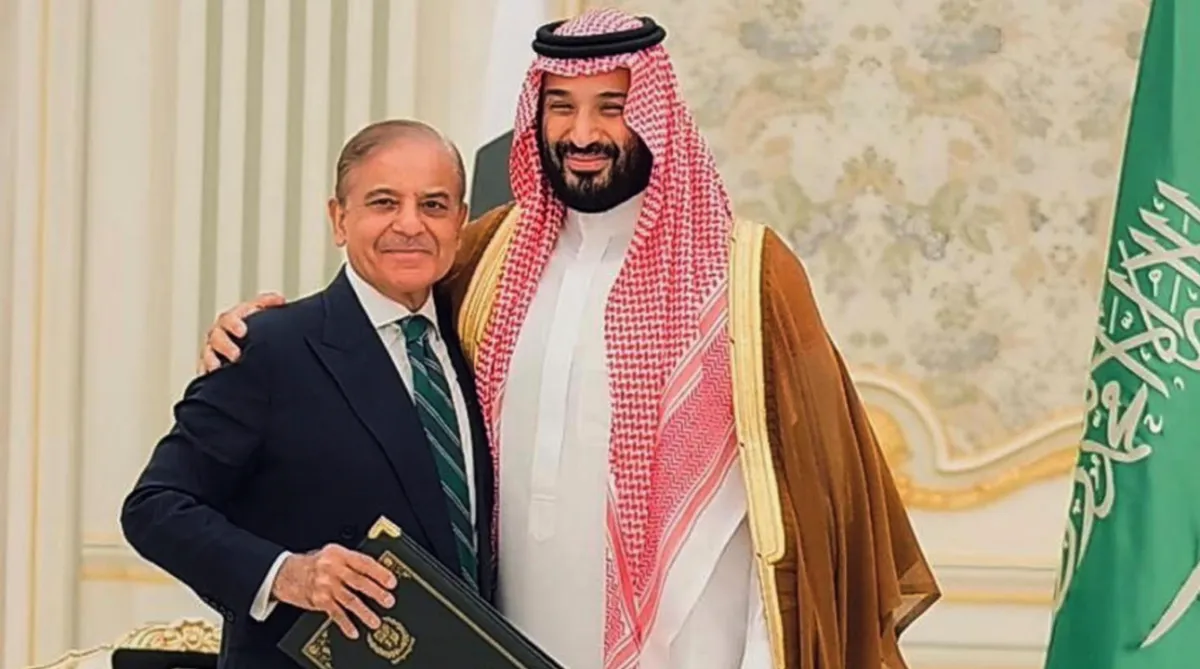
It was signed by Saudi Crown Prince Mohammed bin Salman and Pakistan Prime Minister Shehbaz Sharif on September 17 2025 in Riyadh. The pact signals a shift from what had long been viewed as a largely transactional relationship to a more structured, institutionalised and legally binding military alliance.