MiG-21 farewell: From 1971 war to Op Sindoor, the iconic jet gave great strength to armed forces, says Rajnath
The Indian Air Force retired the MiG-21 fighter jet after nearly six decades of service in a ceremony held in Chandigarh. Defence Minister Rajnath Singh praised the aircraft's heroic role in wars and key operations, calling it a symbol of strength for the armed forces.
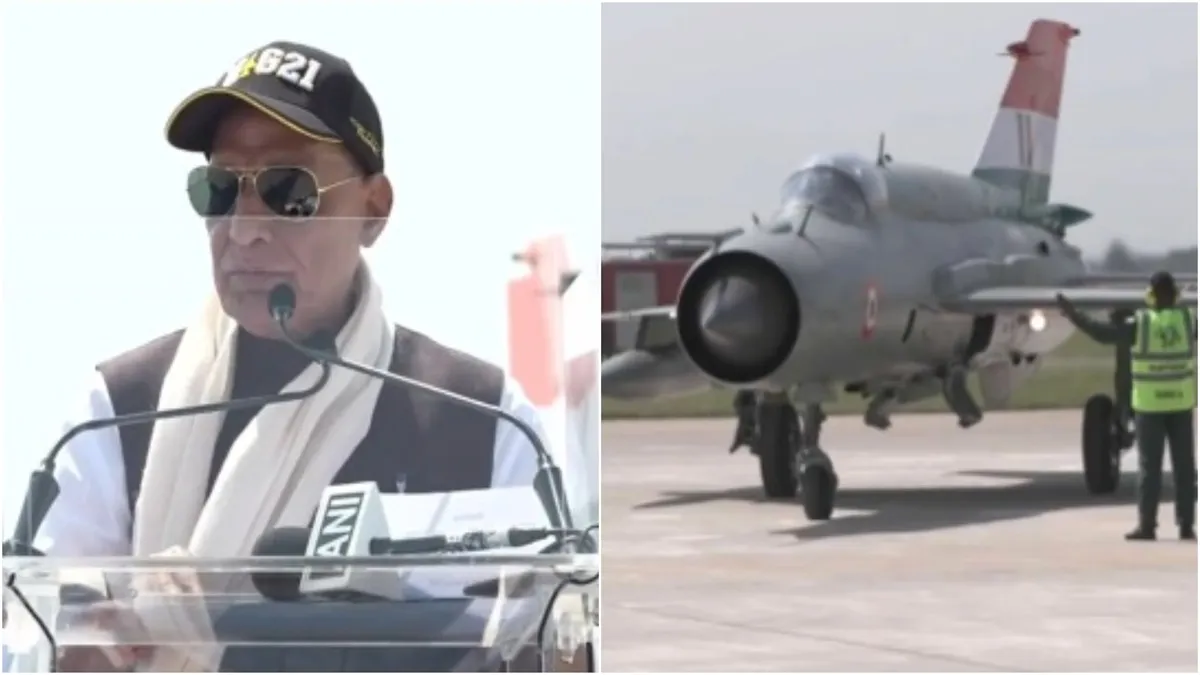
The Indian Air Force (IAF) on Friday retired its legendary MiG-21 fighter jet after nearly sixty years of service. The final sortie was flown during a solemn decommissioning ceremony held in Chandigarh, marking the end of an era in Indian military aviation. Defence Minister Rajnath Singh attended the ceremony and paid tribute to the aircraft’s unmatched legacy. Speaking at the event, Defence Minister Rajnath Singh said, "For a long time, MiG-21 has been a witness to numerous heroic deeds. Its contribution has not been limited to a single event or a single war." He added that the fighter jet played a decisive role in the 1971 war, the Kargil war, the Balakot airstrike, and even in Operation Sindoor. "There has not been a moment when the MiG-21 has not provided tremendous strength to our armed forces," Singh said.
Singh also recalled the valour of the MiG-21, saying who can forget the 1971 war when the aircraft struck the Governor’s House in Dhaka and virtually sealed the outcome of the conflict despite adverse circumstances. He said that throughout its long service history, the MiG-21 has time and again demonstrated its decisive capabilities. "Whenever there have been historic missions, every time the MiG-21 has enhanced the honour of the tricolour. Therefore, this farewell is also of our collective memories, of our national pride, and of that journey in which the story of courage, sacrifice, and excellence has been written," he added.
More than just a fighter jet
Rajnath Singh said the MiG-21 is deeply embedded in the memories and emotions of the nation. Since its induction in 1963, the aircraft has served for over six decades, a journey he described as unmatched. "For all of us, this is not just a fighter jet, but rather a family member with whom we have a deep attachment. The MiG-21 has shaped our confidence, strengthened our strategy, and helped us establish ourselves on the global stage," Singh added.
Clarifying misconceptions about MiG-21's age
Responding to frequent criticism, Singh clarified that the Indian Air Force was not flying 60-year-old aircraft. "The MiG-21 aircraft that came to our armed forces in the 1960s and 1970s have long been retired from service. The MiG-21 aircraft we were flying until now were at most 40 years old. A 40-year lifetime is completely normal by the standards of such aircraft," he explained. He added that many countries keep such fighter jets active for a similar span of time.
Continuous upgrades kept MiG-21 relevant
The Defence Minister highlighted that the MiG-21 had always been technically updated and modernised to meet evolving requirements. Known by names such as Trishul, Vikram, Badal and Bison, the fighter underwent several upgrades during its service life. "Here, I also appreciate Hindustan Aeronautics Limited, which has fulfilled its important role in continuously updating the MiG-21 with its advanced radars and avionics," Singh said, noting the aircraft’s adaptability and enduring relevance.
End of an era for the IAF
Inducted into the IAF in 1962, the MiG-21 became India's first supersonic fighter and earned the reputation of being the backbone of the air force for decades. Known for its speed and agility, it gave India a significant edge in multiple wars and operations. The retirement of the MiG-21 marks the closing of a historic chapter for the IAF while opening the door for modern indigenous aircraft such as the Tejas to take its place.