India-EU FTA: 7 million jobs, IMEC push and 25% of global trade; all about the 'mother of all deals'
Sharing the details, Piyush Goel said the deal was a win-win for all sections of industries, both in India and the European Union. He said the deal would open a plethora of opportunities and attract significant investment.
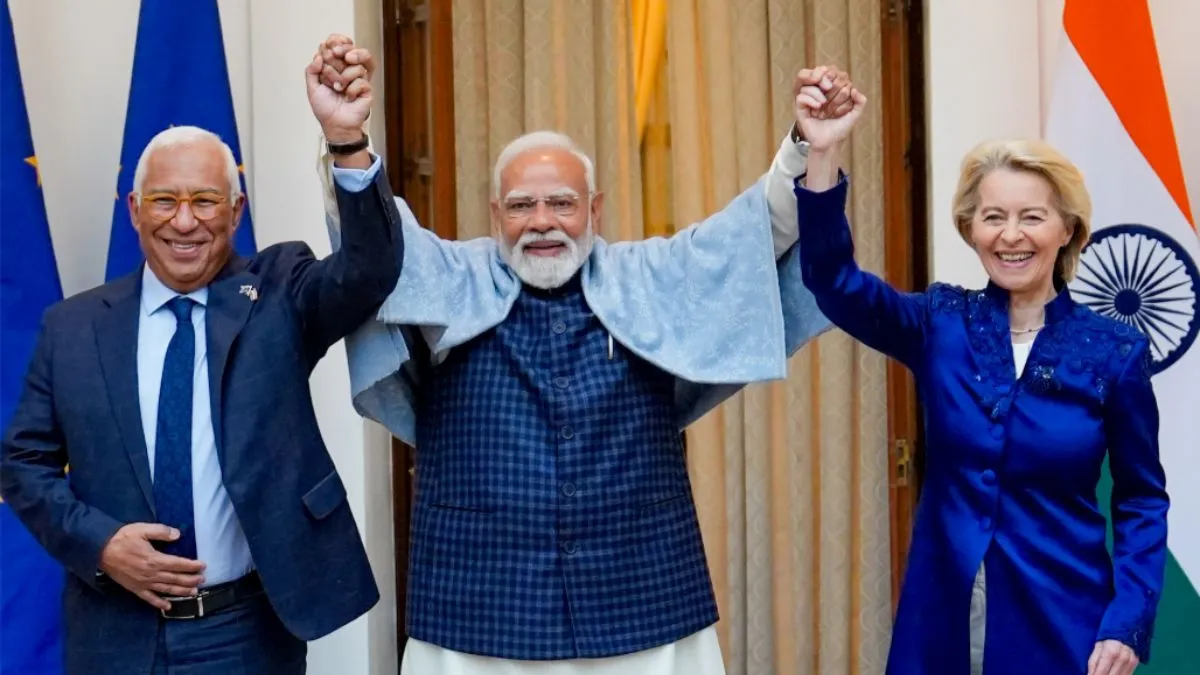
Union Minister of Commerce and Industry, Piyush Goel, hailed the conclusion of the historic Free Trade Agreement (FTA) between India and the European Union. He said the breakthrough comes after 20 years after over 16 rounds of negotiations. Minister Goel said the efforts to push the deal through were aborted in 2013 but the Modi government relaunched negotiations in mid-2022.
Sharing the details, Piyush Goel said the deal was a win-win for all sections of industries, both in India and the European Union. He said the deal would open a plethora of opportunities and attract significant investment.
“India will gain access significantly in labour-intensive industries like marine products, chemicals, footwear and leather, plastic rubber goods, textiles, apparel and clothing, gems and jewelry, furniture, sports goods, toys, and the European Union industries gaining access to the large and fastest growing economy of India in innovation, technology, sectors of precision engineering, and areas where India continues to look for partnerships and technologies from across the world," he said.
Hailing PM Modi’s leadership, Goel said the free trade agreement covers 25 per cent of global trade and it was the eighth such agreement by India.
"We are also very pleased to have concluded negotiations. As Ursula von der Leyen has articulated, 'the mother of all deals', a free trade agreement which covers 25% of global trade. It is our eighth free trade agreement under Prime Minister Narendra Modi. Each and every one of them with developed nations and collectively reflecting an agreement between India and 37 developed nations. 37 developed nations and India have entered into free trade agreements in a short span of four years under the leadership of Prime Minister Narendra Modi," he said.
He said the deal covers 99 per cent of the total exports that are sent from India to the European Union and about 97 per cent plus of the total exports from the European Union to India.
The asymmetry in economic development between the two nations has been kept in mind while framing the deal, which would provide strength to both economies.
He said the efforts were ongoing to implement the deal within calendar 2026, adding that it will be taken up on legal scrubbing on a fast-track basis.
India-EU express unity in IMEC initiative
Sharing further details, Foreign Secretary Vikram Misri said connectivity featured prominently in discussions between India and the European Union, with both sides reaffirming their shared commitment to strengthening cooperation in this area. He said both sides agreed that the India–Middle East–Europe Economic Corridor (IMEC) remains a key strategic initiative and should be advanced to the next stage. The two partners decided to move beyond working-level engagements and push for higher-level consultations, with the aim of convening a summit of IMEC member countries. India and the EU expressed unity on the initiative and said they would work closely with other IMEC partners to take the project forward.
India-EU FTA likely to add millions of jobs: Piyush Goyal
Piyush Goyal highlighted the significant employment and export potential of the proposed India–European Union Free Trade Agreement (FTA), particularly for India’s textile sector.
Speaking about the labour-intensive nature of textiles, Goyal noted that the industry is already India’s second-largest employer after agriculture, providing livelihoods to nearly 40 million people. He said the removal or reduction of tariffs under the FTA could dramatically improve India’s competitiveness in the European market.
At present, India exports textiles and garments worth around USD 7 billion annually to the EU, with duty rates going as high as 12 per cent. In contrast, countries such as Bangladesh, which earlier enjoyed duty-free access to the EU as a least developed country, were able to secure a much larger share of the market, exporting nearly USD 30 billion worth of textiles, he said.
“With improved market access, India has the potential to rapidly scale up its textile exports to the EU from the current level to USD 30–40 billion,” the minister said. Such growth, he added, could lead to the creation of an estimated 6–7 million additional jobs in the textile sector alone.
ALSO READ: 'Largest trade deal in India's history': PM Modi sends strong message after India-EU FTA
ALSO READ: India-EU trade deal: What gets cheaper for Indian consumers and why the deal matters?