NMACC, led by Isha Ambani, partners with Qatar Museums to develop museum-in-residence education initiatives
Qatar Museums and the Nita Mukesh Ambani Cultural Centre (NMACC) have entered a five-year partnership to introduce museum-based, play-led education programmes for children across India and Qatar, focusing on creativity, cultural exchange, and early learning.
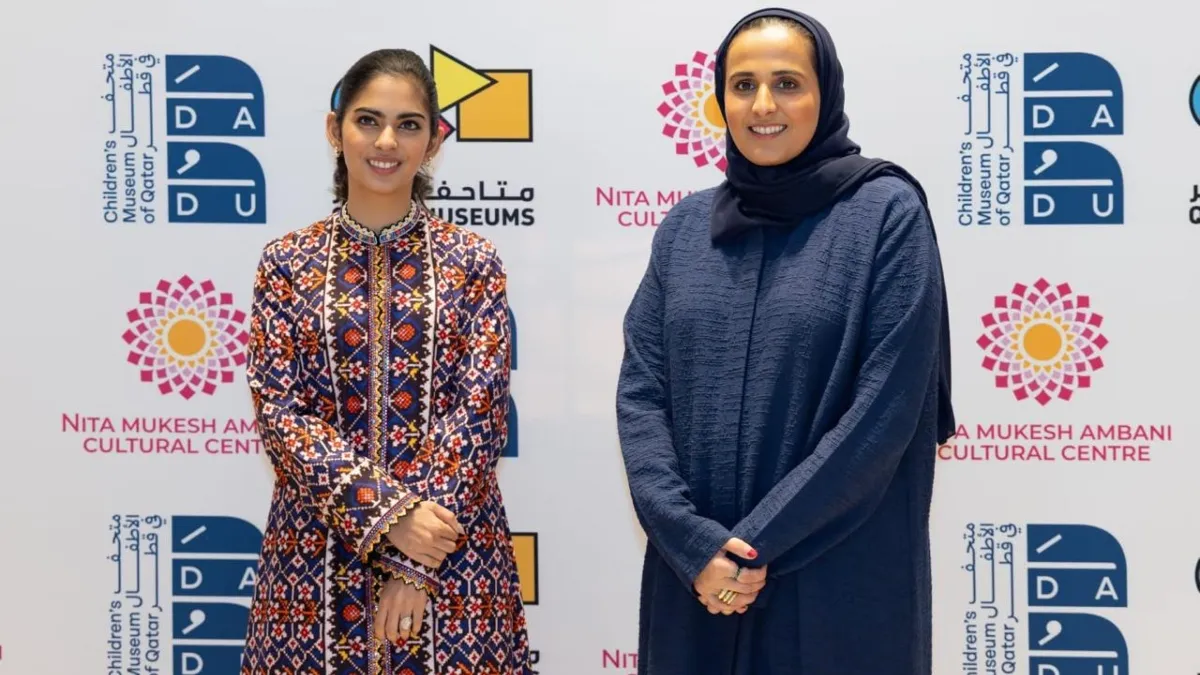
In a move that places children and creativity at the heart of cultural exchange, Qatar Museums (QM) and the Nita Mukesh Ambani Cultural Centre (NMACC) have announced a five-year partnership aimed at transforming how young learners engage with art, culture and education in India and Qatar.
Sheikha Al Mayassa bint Hamad bin Khalifa Al Thani, Chairperson of Qatar Museums, and Isha Ambani, Director at Reliance Industries, signed the agreement at the National Museum of Qatar in Doha. The purpose of the partnership is to develop museums into places of play and education for local schools and community centres to provide a more immersive, exciting and inclusive experience for children.
The partnership will introduce a series of Museum-in-Residence programmes that draw on Qatar Museums’ innovative educational models. These programmes are designed especially for early childhood learning, encouraging curiosity, imagination and hands-on exploration rather than rote methods. While children remain the primary focus, teachers, volunteers and educators will also benefit through training, new learning tools and creative teaching methodologies.
Isha Ambani, Director of Reliance Industries, described the partnership as a meaningful step towards building world-class educational experiences for children. She emphasised that culture is often where imagination takes root, while education is where potential is realised. By combining global perspectives with India’s rich cultural heritage, the collaboration aims to empower children to learn with confidence and dream without limits. She said, "Through this partnership, we aim to spark new forms of learning that empower every child to dream boldly and to learn confidently."
Speaking about the collaboration, Sheikha Al Mayassa highlighted the shared philosophy behind the initiative. She noted that both institutions believe creativity and cultural exchange play a vital role in shaping confident and empathetic young minds. As part of Qatar’s Year of Culture legacy with India, the partnership allows Qatar Museums to share its experience with NMACC’s already strong educational ecosystem, helping expand its reach into classrooms across India.
On the Indian side, NMACC will work closely with the Reliance Foundation to roll out the programmes across multiple regions. Specialists from Qatar Museums, including experts from Dadu, the Children’s Museum of Qatar, will lead masterclasses and offer hands-on mentoring. Each initiative will be carefully adapted to suit different learning environments, from urban schools to anganwadis and community centres in rural and underserved areas.
A key highlight of the partnership is the introduction of Dadu’s Museum in Residence programme in India, including the Light Atelier, an immersive learning environment created for children aged three to seven. The Light Atelier was developed using the philosophy of learning through play and promotes experimentation, using the senses and stimulates creativity. As stated by Maha Al Hajri (Acting Director of Dadu), the Light Atelier provides opportunities for the museum to expand its way of thinking from a physical space into a digital space, thereby allowing for cultural exchange.
Beyond structured programmes, QM and NMACC will continue to explore new initiatives that promote empathy, discovery and creative expression. The collaboration aligns closely with Qatar National Vision 2030, which prioritises human and cultural development, while also reinforcing NMACC’s mission of bringing the best global ideas to India’s cultural landscape.
For Qatar Museums, the partnership marks another milestone in its growing global educational outreach. For NMACC, it represents a deeper commitment to shaping the future of learning through culture, art and imagination — ensuring that classrooms become spaces not just for instruction, but for inspiration.