- Home
- Explainers
- China's air defence system HQ-9B explained: How US-Israel strikes breached Iran's shield
China's air defence system HQ-9B explained: How US-Israel strikes breached Iran's shield
Coordinated US and Israeli airstrikes deep inside Iranian territory have placed Tehran’s air defence architecture under intense scrutiny. At the centre of the debate is the Chinese-origin HQ-9B long-range surface-to-air missile system, integrated into Iran’s layered defensive grid.
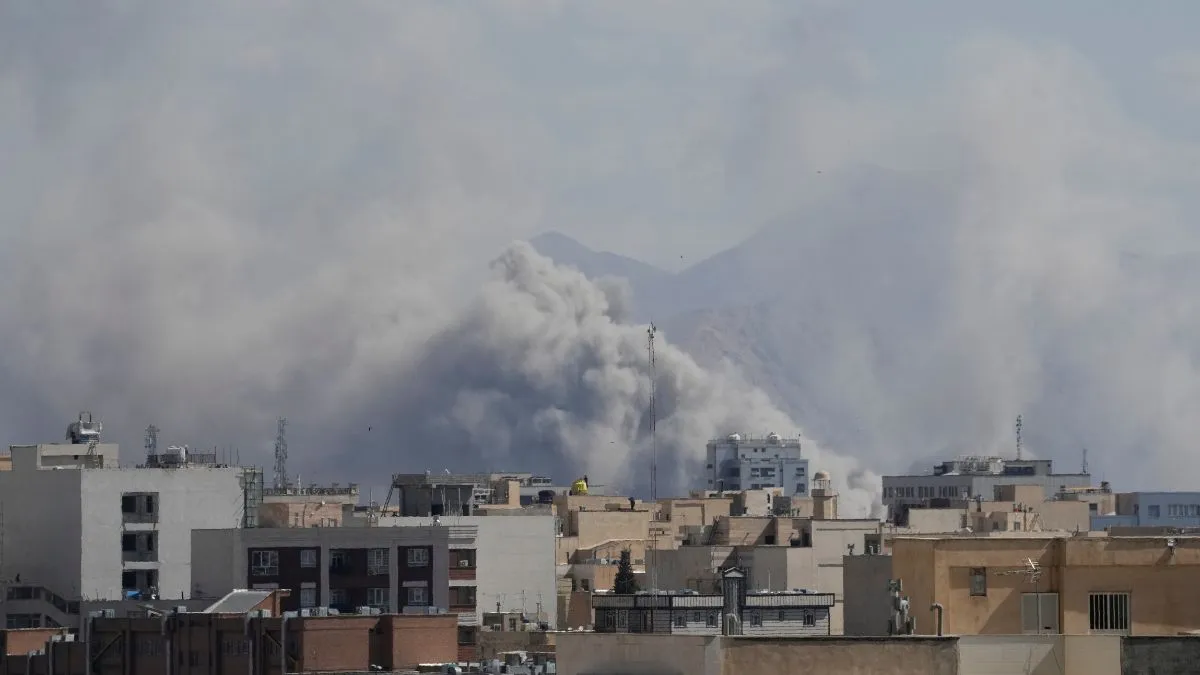
The latest round of strikes between Israel and Iran has moved beyond shadow conflict and into open aerial confrontation. A series of coordinated attacks by both Israeli and American forces has managed to penetrate deep into the Iranian airspace, attacking the country’s military infrastructure in different provinces, highlighting the weaknesses in the country’s defensive capabilities, which have, over the years, been perceived as robust and multi-layered. Satellite imagery and field reports suggest several radar installations and missile batteries were neutralised in the opening phases of the operation.
At the centre of the debate is Iran’s air defence architecture, an intricate mix of Russian, Chinese and indigenous systems built over two decades to deter precisely this kind of assault. Among them is the Chinese-origin HQ-9B long-range surface-to-air missile system, inducted to strengthen high-altitude interception capability. HQ-9B-backed infrastructure's battlefield performance is now under scrutiny.
What is HQ-9B-backed infrastructure?
The term “HQ-9B-backed infrastructure” refers not simply to a missile launcher or a single weapons platform, but to an entire ecosystem built around China’s long-range HQ-9B surface-to-air missile system. In modern warfare, a missile battery is only the visible tip of a much larger network that includes surveillance radars, command centres, communication links and mobile launch vehicles designed to operate as one coordinated unit.
Essentially, the HQ-9B is a long-range air defence system designed to counter fighter jets, cruise missiles, and other high-flying targets over considerable distances. Each air defence engagement generally employs powerful phased array radar systems with the ability to detect multiple airborne targets, as well as command post vehicles that process incoming radar signals to allocate engagement tasks to the launchers, which are located several kilometres away. These launchers, mounted on mobile transporter-erector vehicles, allow rapid relocation to avoid being targeted.
How Iran’s air shield is designed to work
Iran’s approach resembles layered air defence doctrines seen in Russia and China: a series of concentric defensive rings intended to detect and engage hostile aircraft, missiles and drones at increasing distances from the homeland.
Long-range interceptors
At the outermost layer are systems designed to engage high-altitude threats far from critical infrastructure: S-300PMU-2 batteries, supplied by Russia after years of sanctions-related delays, form the backbone of Iran’s long-range umbrella around Tehran and other vital centres. HQ-9B surface-to-air missiles, acquired from China to bolster gaps against high-performance aircraft and long-range cruise missiles.
Indigenous systems such as Iran’s Bavar-373, Tehran’s answer to Russian SAMs (surface-to-air missiles), are intended to provide overlapping coverage. Together, these assets give Iran theoretical reach well beyond its borders, but the real test is not range alone; it’s sensor fusion and battle damage resilience.
Medium and short-range layers
Closer in, Iran fields mobile medium-range batteries like Khordad-15 and Raad units that can be repositioned rapidly to respond to evolving threats. These are backed by point-defence missiles and guns intended to intercept drones, missiles and aircraft that dodge long-range interceptors. The philosophy is simple: if an intruder slips through the outer screen, the inner layers will have another go. But that design depends on a continuous, real-time flow of sensor data, something recent strikes appear to have disrupted.
HQ-9B-backed infrastructure: The limits exposed by recent strikes
The recent strikes, which reportedly targeted air defence radars and missile batteries themselves, reveal a stark reality of modern war. No matter how capable the missiles, once the radar and command network (the nervous system of air defence) is degraded or jammed, even advanced systems struggle to respond.
This vulnerability becomes more acute when adversaries combine:
- stand-off weapons fired from beyond radar horizons,
- electronic warfare and jamming to blind sensors,
- and drone swarms that saturate defence systems.
Analysts suggest that such a combination was present in the recent operation, not a knockout blow, but a strategic probing of Iran’s defensive seams.
Air defence integration: The weak link
Unlike tightly networked Western air defence systems, Iran’s inventory is a mix of Russian, Chinese and indigenous technology. True multi-sensor integration, where radars, command posts and launchers operate seamlessly, remains a work in progress. Without that fusion architecture, reactions become slower and more predictable, reducing the system’s effectiveness against coordinated, precision attacks.
Recent strikes likely took advantage of this fragmentation: hitting radars and command posts first reduces the system’s situational awareness, making missiles blind and reaction times too slow.
What Iran’s struggle shows about modern air defence
The core lesson from the recent strikes is not that missiles are obsolete; it’s that sensor networks, data sharing and resilience under electronic attack matter more than ever. An air defence system can have the best missiles in the world, but if it can’t see the incoming threat, or if its brain is neutralised, those missiles are sitting ducks.
A relevant benchmark: India’s air defence in Operation Sindoor
A useful comparison comes from India. In Operation Sindoor, conducted in May 2025, India’s integrated air defence network demonstrated how layered defences can work together to blunt a sophisticated aerial threat. Indian forces combined systems at multiple ranges, including the S-400 long-range SAM, indigenous sensors and the Akashteer drone-kill system, to intercept hostile drones and missiles with very high success rates.
The key was not just hardware, but integration, linking radars, shooters and command systems into a coherent whole so that aerial threats could be detected, tracked and neutralised quickly across the battlespace. That ability to fuse data from disparate sensors and respond comprehensively, something Iran continues to refine, is emerging as the essential ingredient of effective air defence in the 21st century.
Iran’s mixed results in the latest strike campaign show that advanced missiles are necessary but not sufficient.
Also read: Israel releases footage of precision strike that killed Iran's Khamenei in Tehran | VIDEO