
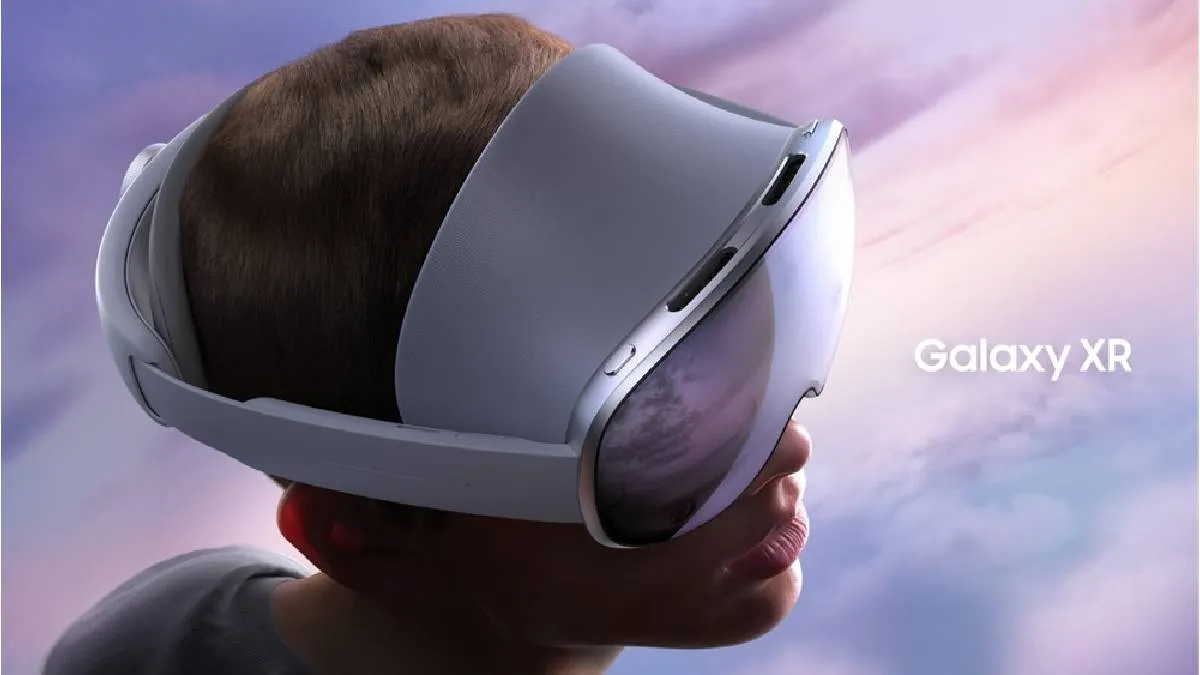
Samsung has officially launched its new wearable headset, the Galaxy XR. The device is positioned to compete directly with the Apple Vision Pro and designed to deliver immersive experiences. Notably, it is the first device to run Google's new Android XR platform, which was developed in collaboration with Samsung, Google, and Qualcomm Technologies. As part of its broader extended reality (XR) roadmap, Samsung is also developing multiple future form factors, including AI glasses.
Samsung Galaxy XR headset specifications and design
| Memory | 16GB Memory, 256GB Storage |
| Display | 3,552 x 3,840, 27 million pixels Micro-OLED 6.3‑micron pixel pitch, 95% DCI‑P3
Refresh rates: 60Hz, 72Hz (Default), 90Hz (Up to, upon service request) |
| Chip | Snapdragon XR2+ Gen 2 Platform |
| Camera | Supports 3D Photo and video capture 18mm / F2.0 6.5MP* *Resolution may vary depending on use case |
| Sensors | Two High-resolution Pass-through cameras Six World-facing tracking cameras Four Eye-tracking Cameras Five Inertial Measurement Units(IMUs) One Depth sensor One Flicker sensor |
| Optic (Iris) | Supports iris recognition – Use iris recognition to unlock the device and to enter passwords in certain apps. |
| Audio and Video | Two, 2 Way speaker(Woofer + Tweeter) Six Microphones array – Multiple microphones among the six microphones support beamforming feature depending on the use case Audio Playback – Codec : MP3, AMR-NB/WB, AAC/ AAC+/ eAAC+, Vorbis, FLAC, Opus, Dolby Digital (AC3), Dolby Digital Plus(E-AC3) , Dolby ATMOS(E-AC3 JOC, AC4) Video Playing Resolution UHD 8K(7680 x 4320)@60fps Video Playback (Supports HDR10 and HLG) – Codec : H.263, H.264, HEVC, MV-HEVC, MPEG-4, VC-1, VP8, VP9, AV1 |
| Battery | Up to 2 hours of general use Video watching up to 2.5 hours Galaxy XR can be used while charging the battery. |
| Connectivity | Wi-Fi 7(802.11a/b/g/n/ac/ax/be) BT 5.4 (Up to) |
| Interpupillary Distance (IPD) | 54~70mm Vision Correction Galaxy XR supports vision correction through separately purchasable optical-inserts. |
| Weight | 545g* (w/ forehead cushion) Weight may vary depending on whether light shield is attached or not Separate battery weighs 302g. |
The Galaxy XR is deeply integrated with Google's Gemini AI at the system level, allowing users to manage tasks intuitively through voice, gesture, and vision.
The headset is powered by the Snapdragon XR2+ Gen 2 chipset and features a dedicated Qualcomm Hexagon NPU for advanced AI processing. Samsung claims the device offers 2.5 hours of battery life. It is equipped with an array of sensors, cameras, and powerful hardware designed to precisely track the user's head, hand, and eye movements. The device also features strategically placed microphones and supportive software to effectively filter out external noises and clearly capture the wearer's voice.
Design
For user comfort, the company states the headset is ergonomically designed to distribute pressure across the forehead and the back of the head. To keep the device light and compact, the Galaxy XR battery pack is separate from the headset.
It also features a detachable light shield, which enhances comfort when removed and offers deeper immersion by blocking external light when attached.
Optimised Google experience
Google has optimised several of its core apps for a wide array of XR experiences, including Google Maps, YouTube, Circle to Search, and Google Photos.
- In Google Maps, users can explore the world in immersive 3D maps and ask for personalised suggestions about nearby places.
- YouTube allows users to easily find the content they want and get more information about the video they are currently watching.
- The device includes a pass-through mode, which lets users clearly see the physical world around them. They can then simply draw a circle with their hand to instantly search for information using Circle to Search.
- The system also features an "Auto-spatialise" function that converts 2D photos and videos into 3D, bringing them to life for the user.
Samsung Galaxy XR availability
The Galaxy XR will be available starting October 21 in the USA and October 22 in Korea, priced at $1,799 (approximately Rs 1,58,000). The company has not yet announced its availability in India.
ALSO READ: New AI ‘blueprint’ aims to boost real-world deployment from diverse kinds of data
