
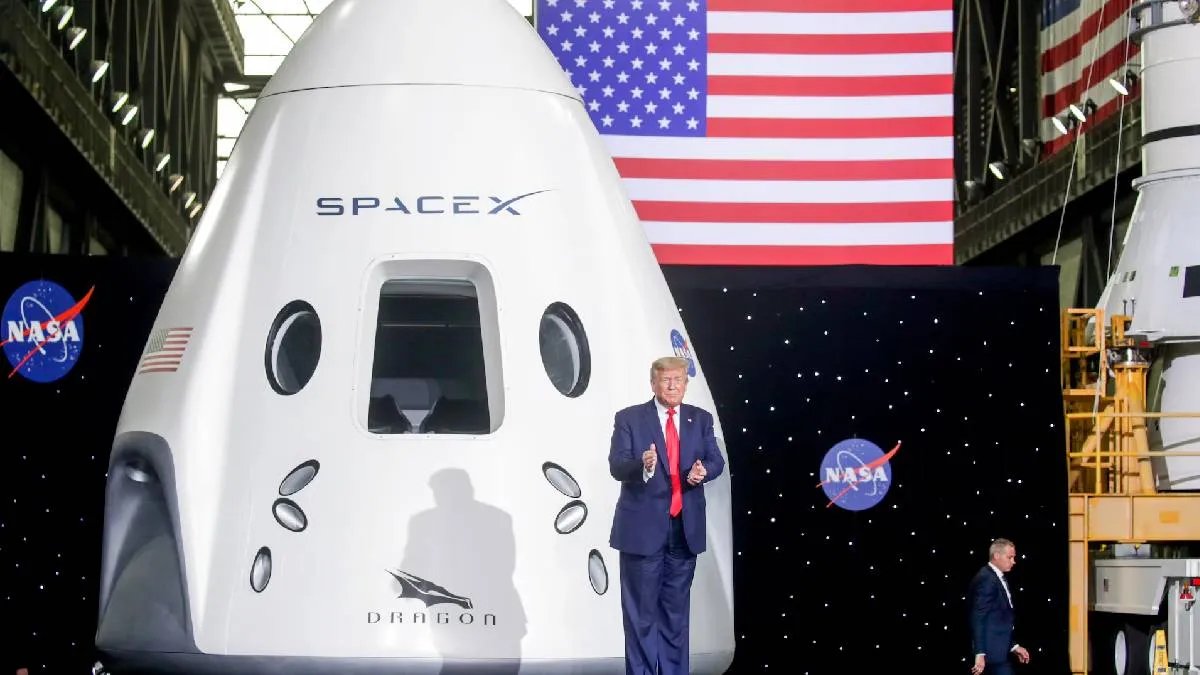
As President Donald Trump and Elon Musk clashed on social media this Thursday, the world’s wealthiest man issued a warning about the potential decommissioning of a space capsule that transports astronauts and supplies to the International Space Station. A few hours later, however, Musk backtracked on his threat. The exchange began when Trump hinted at the possibility of cutting government contracts associated with Musk's SpaceX rocket company and its Starlink internet satellite services. In response, Musk wrote on X that SpaceX would “begin decommissioning its Dragon spacecraft immediately.” The seriousness of Musk's statement was unclear, but several hours later he clarified in a reply to another user that he would not follow through with it.
The Dragon capsule, developed with substantial government funding, plays a crucial role in maintaining the space station's operations. NASA heavily relies on SpaceX for various programs, including launching scientific missions and, later this decade, safely returning astronauts to the moon’s surface.
SpaceX has established itself as the only U.S. company currently equipped to transport crews to and from the space station via its four-person Dragon capsules. In contrast, Boeing's Starliner capsule has only flown astronauts once, with last year's test flight encountering significant issues that forced the two NASA astronauts on board to catch a ride back to Earth with SpaceX in March, more than nine months after their launch.
As NASA deliberates on whether to conduct another test flight with Starliner—this time carrying cargo rather than a crew—the capsule remains grounded. Meanwhile, SpaceX is preparing for its upcoming privately-run mission next week, chartered by Axiom Space, a company based in Houston. Additionally, cargo versions of the Dragon capsule are tasked with delivering food and supplies to the orbiting laboratory.
For now, Russia's Soyuz capsules offer the only alternative for crew transport to the space station. Each Soyuz launch accommodates three individuals, typically two Russian cosmonauts and one NASA astronaut. The arrangement also includes an exchange system whereby each SpaceX launch carries a Russian crewmember, ensuring a mix of U.S. and Russian personnel on board in case of an emergency that necessitates a return.
Since SpaceX made its first crew launch for NASA in 2020—the first private company to achieve an orbital crew flight—NASA has significantly reduced its dependence on Russia for crew transport, which previously cost the U.S. tens of millions of dollars per seat. NASA has also utilized Russian spacecraft for cargo missions alongside contracts with U.S. contractor Northrop Grumman.
In addition to these crew missions, SpaceX has launched numerous science projects for NASA as well as military equipment. Last year, the company secured a contract with NASA to facilitate the safe removal of the space station from orbit when it reaches the end of its usable life. For upcoming lunar missions, NASA has selected SpaceX's Starship mega rocket to carry astronauts from lunar orbit to the moon's surface. Although Starship completed its ninth test flight last week in Texas, it faced control issues and ultimately disintegrated.
Inputs from PTI
