
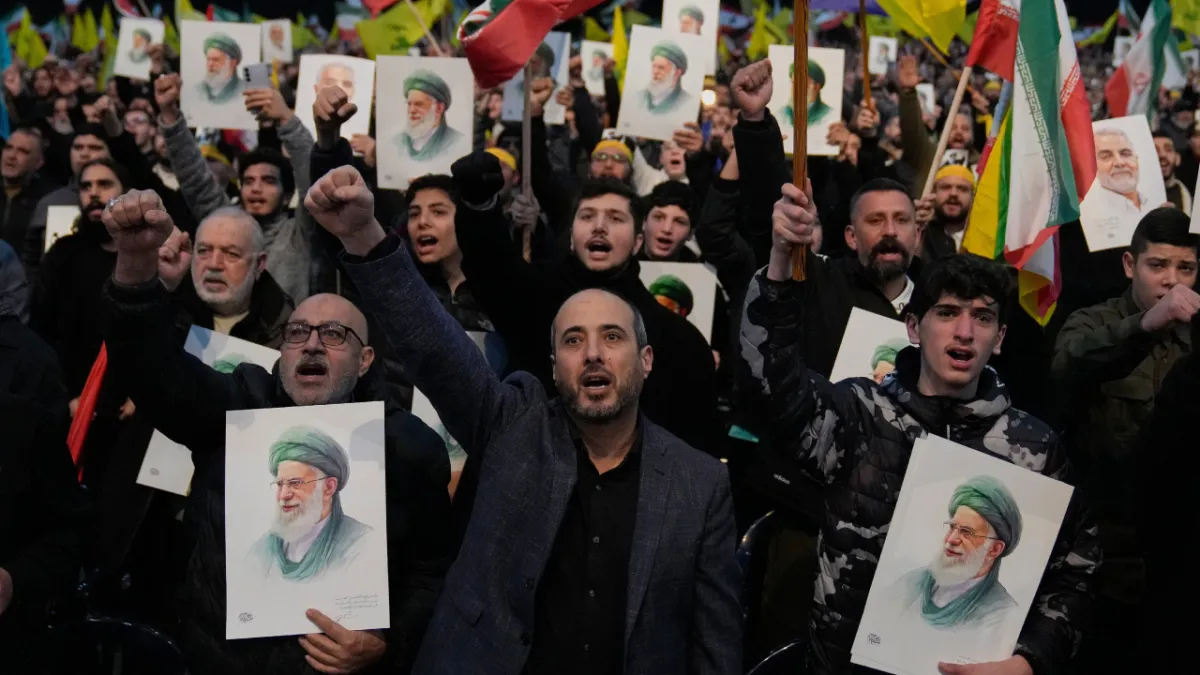
The European Union has designated Iran’s paramilitary Revolutionary Guard as a terrorist organisation following Tehran’s violent crackdown on nationwide protests, the bloc’s top diplomat said on Thursday. EU foreign policy chief Kaja Kallas said the decision was taken unanimously by foreign ministers. She said a regime that kills thousands of its own people is ultimately working towards its own collapse.
Iranian officials sanctioned by EU
The listing comes after the 27-nation bloc imposed sanctions on 15 Iranian officials, including senior commanders of the Revolutionary Guard, over their role in suppressing protests. Six Iranian organisations were also added to the sanctions list, including bodies responsible for monitoring and controlling online content.
Activists say the crackdown has killed more than 6,300 people, making it one of the deadliest episodes of unrest in Iran’s recent history. The EU move marks the latest Western response to the violence.
Kallas said earlier that adding the Revolutionary Guard to the EU’s terrorist list would place it on the same footing as groups such as al Qaeda, Hamas and Daesh. She said that if an organisation acts like a terrorist entity, it should be treated as one.
Rising international pressure on Iran
The EU action adds to mounting international pressure on the Islamic Republic as tensions escalate with the United States. Washington has warned it could consider military action in response to the killing of peaceful demonstrators and reports of possible mass executions.
US forces have moved the USS Abraham Lincoln and several guided missile destroyers into the Middle East, assets that could be used to launch strikes from the sea. It remains unclear whether President Donald Trump will authorise the use of force.
Iran responds with warning
Iran has warned that it could respond with a pre emptive strike or target a wide swathe of the region, including US military bases and Israel. On Thursday, Tehran also issued a warning to ships that it plans to conduct a live fire military drill next week in the Strait of Hormuz, a critical waterway through which about 20 per cent of the world’s oil supply passes.
Iran did not issue an immediate response to the EU’s decision, though it has criticised European governments in recent days as the move was being considered. The designation follows a similar step taken by the United States, which sanctioned the Revolutionary Guard in 2019.
Iran's Revolutionary Guards and their role in crackdown
The Revolutionary Guard was created after Iran’s 1979 Islamic Revolution to protect the clerical leadership and the political system it established. It operates alongside Iran’s regular armed forces and rose in prominence during the Iran Iraq war of the 1980s.
Although its future was uncertain after the war, Supreme Leader Ayatollah Ali Khamenei allowed the Guard to expand into private enterprise, significantly increasing its wealth and influence across Iran’s economy and politics.
The Guard’s Basij force is believed to have played a central role in suppressing the demonstrations, particularly from January 8, when authorities cut off internet access and international phone calls across the country of 85 million people.
Videos that later emerged via satellite links and other channels appeared to show security forces shooting at and beating protesters.
Sanctioning the Revolutionary Guard poses practical challenges, as Iranian men are required to complete up to 2 years of compulsory military service from the age of 18. Many are conscripted into the Guard regardless of their political views, complicating efforts to distinguish between leadership figures and ordinary citizens caught up in the system.
Also read: Russia invites Zelenskyy to Moscow for Ukraine peace talks, assures his safety
