
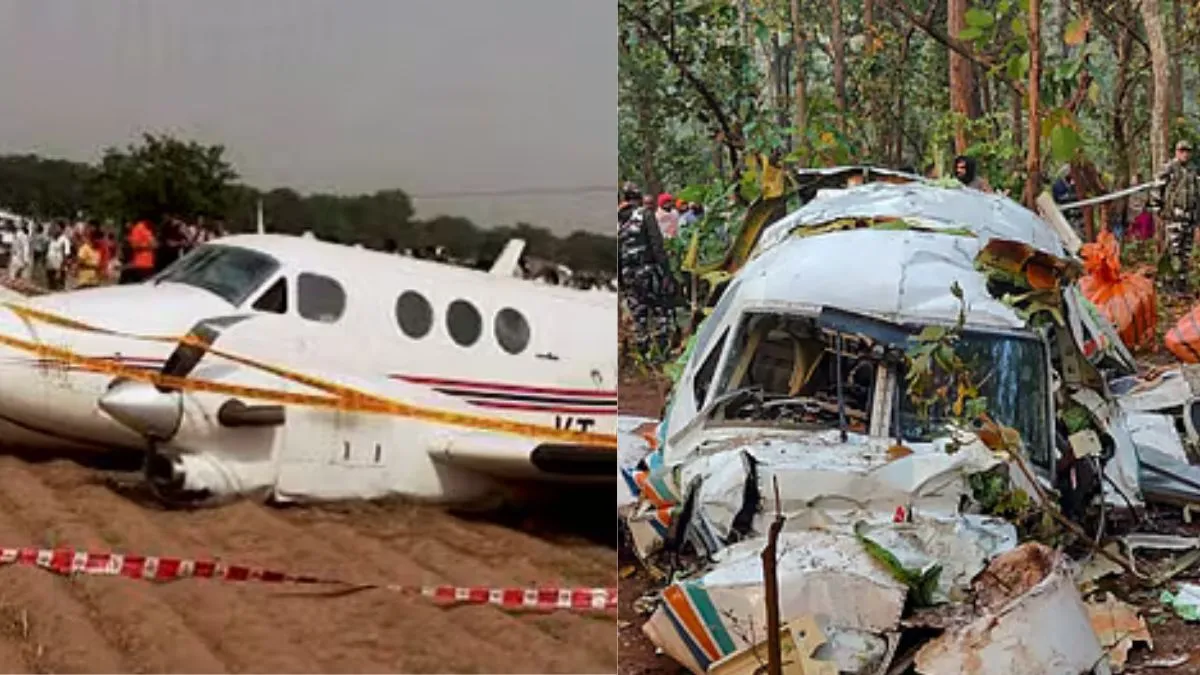
Two air ambulance crashes, ten years apart. The same aircraft family. The same number of people on board. The same mission, to save a life. Yet, the outcomes could not have been more different. The Ranchi-to-Delhi air ambulance that crashed in Jharkhand’s Chatra district shortly after takeoff on February 23 has brought back memories of the 2016 Najafgarh emergency landing in Delhi.
The 2026 Jharkhand tragedy
A RedBird Aviation air ambulance, a Beechcraft King Air BE9L crashed in Jharkhand’s Chatra district shortly after takeoff from Ranchi, killing all seven people on board. According to the Directorate General of Civil Aviation (DGCA), the aircraft took off at 7:11 pm and established contact with Kolkata Air Traffic Control at 7:34 pm.
The pilots requested a route deviation due to bad weather. Minutes later, communication and radar contact were lost nearly 100 nautical miles southeast of Varanasi. Officials said the aircraft likely encountered a thunderstorm before it went down in a dense forest area.
The crash site was located deep inside the jungle in Chatra district. Personnel had to carry bodies for nearly two kilometres. By the time teams reached the site, no one had survived.
Who was on board?
There were seven people on the aircraft, two crew members and five others, including a patient and his family members. The patient, Sanjay, was a resident of Chandwa in Latehar district. He had suffered severe burn injuries in a short circuit accident at his hotel. His family, from a modest background, had borrowed money to hire the air ambulance to take him for treatment at Sir Ganga Ram Hospital in Delhi.
Among the victims were his wife Archana, a relative Dhruv, hospital staff and the flight crew. The Air Accidents Investigation Branch is now probing the crash and examining safety records of the operator.
The 2016 Najafgarh miracle
In contrast, the 2016 crash-landing near Delhi had a far more hopeful ending. An air ambulance, a Beechcraft King Air C90 operated by the Alchemist Group was flying from Patna to Delhi when both its engines failed one after another while approaching the runway.
The aircraft was just six nautical miles from Delhi when the pilot informed Air Traffic Control that both engines had shut down and the plane was losing altitude. The pilot decided to attempt an emergency landing in an open field at Kair village in Najafgarh, in southwest Delhi. His quick thinking possibly averted a major disaster.
Union Minister Mahesh Sharma had then praised the pilots for expertly maneuvering the aircraft despite complete engine failure. Fire tenders and emergency services rushed to the spot. Seven people were on board including a doctor, a technician, a heart patient named Virendra Rai, and the flight crew.
Two people were injured, but everyone survived. The patient was immediately shifted to Medanta Medicity for treatment. The aircraft, manufactured in 1989, was remarkably intact after landing in the field, a rare outcome in cases of dual engine failure.
The striking similarities in the 2016 and 2026 crash
The two incidents share several similarities:
- Both were air ambulances
- Both had seven people on board
- Both were Beechcraft King Air aircraft
- Both were flying patients for urgent medical treatment
- Both faced critical technical or weather-related emergencies mid-air yet, the difference in terrain and circumstances proved decisive. In 2016, the aircraft came down in an open field near Delhi airport. In 2026, the plane crashed in a remote forest during bad weather.
India has seen other air ambulance tragedies as well. In 2011, an air ambulance crashed in Faridabad, killing all 10 people on board. In 2015, a BSF aircraft crashed near Dwarka in Delhi after developing a technical snag, leaving no survivors.
Also Read: Jharkhand air ambulance crash: All seven occupants dead; thunderstorm likely behind fatal accident
