
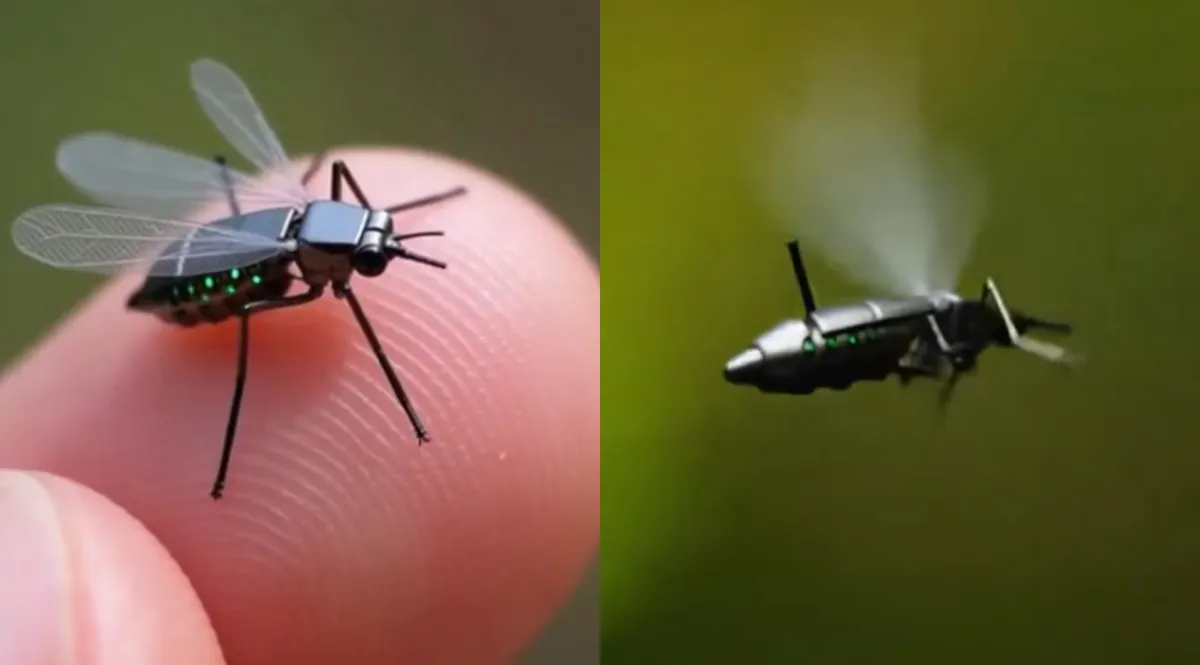
A robotics laboratory at the National University of Defence Technology (NUDT) in China's Hunan province has developed a mosquito-sized drone designed for covert military operations.
The project was unveiled in a report aired on CCTV 7, China's military television channel, which showcased a range of robotic systems, from humanoid machines to miniature drones that are barely visible to the naked eye, South China Morning Post has reported.
About the drone
The micro-drone resembles a mosquito in both size and design. It features a thin, stick-shaped body fitted with two tiny leaf-shaped wings and three hair-thin legs. Researchers also displayed another prototype with four wings, which can be controlled using a smartphone. The drone is so small that it can be held between two fingers.
According to NUDT student Liang Hexiang, the mosquito-like robot is specially designed for information reconnaissance and special missions on the battlefield. Its miniature size allows it to operate discreetly, making it suitable for covert surveillance and intelligence-gathering tasks in sensitive environments where larger drones may be easily detected.
Why is a drone of this size significant
Developing a drone at such a tiny scale poses significant engineering challenges. Essential components such as sensors, batteries, control circuits and communication systems must all fit into an extremely limited space. The project requires expertise from multiple disciplines, including micro-engineering, materials science and bionics, to replicate insect-like movement while maintaining flight stability and control.
China is not alone in pursuing miniature drone technology. One of the most well-known examples is the Black Hornet 4, developed by Teledyne FLIR Defence.
The palm-sized drone is used by armed forces around the world for close-range surveillance and reconnaissance. It transmits live visuals and data through a handheld controller and has been recognised by the US Department of Defence for its advanced capabilities.
Similarly, researchers at Harvard University have been developing the "RoboBee," an insect-inspired micro robot capable of performing advanced manoeuvres. Some versions can transition from swimming underwater to flying and can even perch on surfaces using static electricity.
Military and other purposes
While China's mosquito-sized drone has been developed with military applications in mind, micro-robotics is increasingly being explored for civilian purposes as well.
Scientists are studying miniature robots for medical applications such as targeted drug delivery, minimally invasive surgery, diagnostics and medical imaging. The technology is also being considered for environmental monitoring and agricultural research.
The emergence of mosquito-sized drones marks a major step forward in micro-robotics and surveillance technology.
Their ability to conduct reconnaissance while remaining extremely difficult to detect could transform future military operations. At the same time, the technology raises important questions about privacy, security and the ethical use of miniature autonomous systems in both military and civilian settings.
