NASA's Artemis II crew returns to Earth as 10-day historic Moon mission ends | WATCH
The four astronauts of the Artemis II mission were "stable and green", the NASA has informed, while pointing out that the speed of their spacecraft had reached Mach 33 or 33 times the speed of sound after it entered the atmosphere.
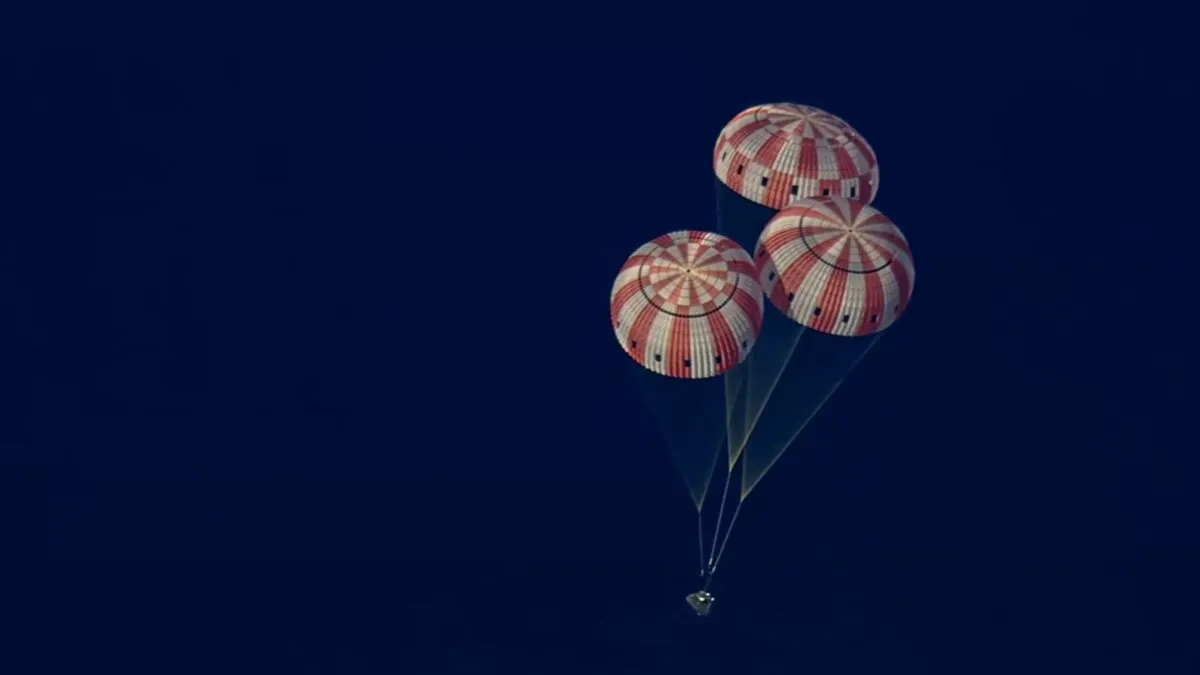
The four astronauts of the Artemis II mission successfully returned from the moon with a splashdown in the Pacific ocean on Friday (local time) off the coast of California, completing their 10-day journey in the space, said the National Aeronautics and Space Administration (NASA). This was humanity's first crewed mission to the moon's neighbourhood since Apollo 17.
"Welcome home Reid, Victor, Christina, and Jeremy!" said NASA in a post on X (previously Twitter), while also sharing a video of the splashdown. "The Artemis II astronauts have splashed down at 8:07pm ET (0007 UTC April 11), bringing their historic 10-day mission around the Moon to an end."
The four crew members were "stable and green", informed the space agency. The astronauts will be helped by the NASA and the US military in leaving the bobbing capsule, following which they will be flown to a recovery ship off the Pacific coast near San Diego.
As per the NASA, the speed of the spacecraft had reached Mach 33 or 33 times the speed of sound after it entered the atmosphere, with the Orion capsule, dubbed Integrity, made the plunge on automatic pilot. "This was a textbook entry and a textbook touchdown," Rob Navias, NASA public affairs official, said.
The historic journey of the Artemis II mission
The 10-day mission started on April 1 with a launch from Florida and it is considered as the key stepping stone towards eventual crewed lunar landings. The Artemis II was NASA's first crewed mission, which aimed at installing a sustained presence on the moon, including the eventual construction of a base.
The second phase of the Artemis program was a test mission to verify the reliability of the Orion capsule, which before now had not carried humans. The voyage also broke a record: the four astronauts become the humans to travel furthest away from the Earth, at 252,756 miles (406,771 kilometers).
While hurtling through deep space and zipping around the Moon the astronauts took thousands of photographs, amassing a stunning portfolio of images that captivated people on Earth. They also witnessed a solar eclipse along with extraordinary meteorite strikes on the lunar surface that had left NASA scientists awe-struck.
Several achievements added to the voyage's historic nature: Glover was the first person of color to fly around the Moon, Koch was the first woman, and Canadian Hansen the first non-American.