Kerala local body poll results: LDF faces setback as UDF surges ahead, lotus blooms in Thiruvananthapuram
Kerala local body election results: BJP’s notable gains in Thiruvananthapuram have fueled speculation about a wider political realignment in Kerala. State President Rajeev Chandrasekhar stated that the party secured over 20 per cent of the votes statewide.
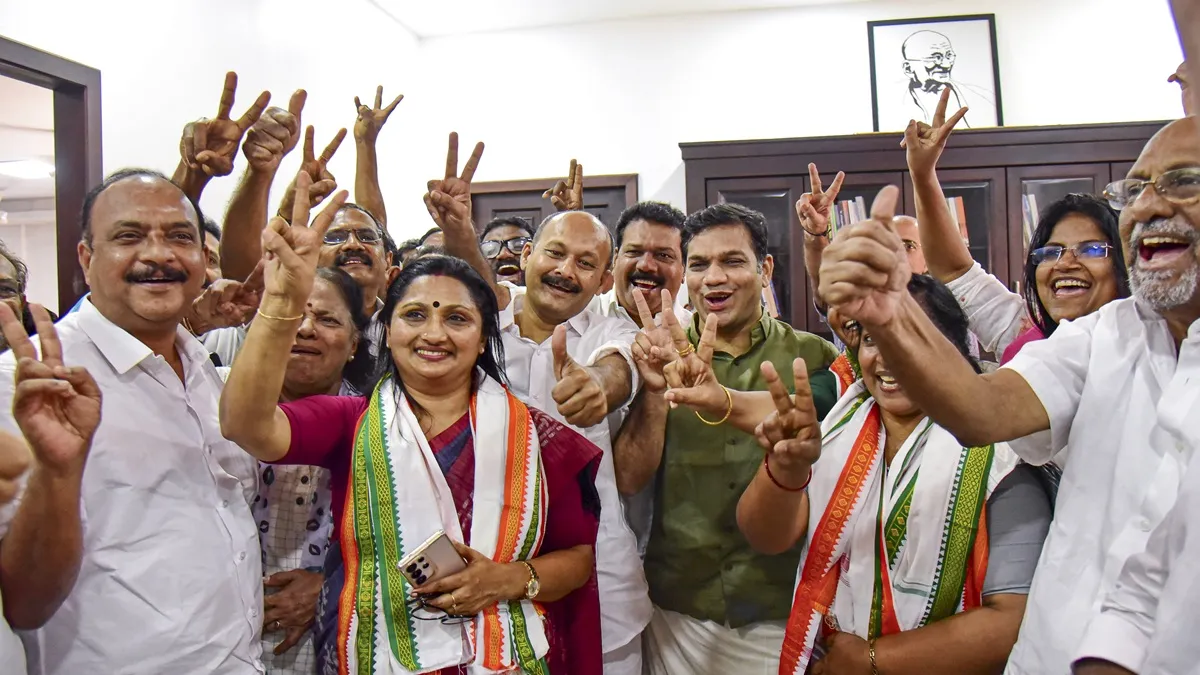
The Congress-led United Democratic Front (UDF) delivered a resounding victory in Kerala’s local body elections, marking a significant shift in the state’s political landscape ahead of the 2026 Assembly polls. The UDF’s sweeping win across municipal corporations, municipalities, block panchayats, and gram panchayats has energised the alliance and sent a clear signal of anti-incumbency against the ruling Left Democratic Front (LDF).
BJP’s historic win in Thiruvananthapuram
In a landmark development, the Bharatiya Janata Party (BJP)-led National Democratic Alliance (NDA) wrested control of the Thiruvananthapuram Corporation from the CPI(M), ending four decades of Left rule in the state capital. This breakthrough is being hailed as a “watershed moment” by Prime Minister Narendra Modi, who credited the party’s grassroots workers for the “spectacular results.” The victory opens the possibility of the BJP’s first-ever Mayor in Kerala, with retired DGP R Sreelekha tipped for the post.
LDF’s setback and introspection
The LDF suffered a major setback, losing control of four out of five municipal corporations, including Thiruvananthapuram and Kollam, where it had ruled for 45 and 25 years, respectively. Chief Minister Pinarayi Vijayan acknowledged the unexpected results and promised a thorough review of the party’s strategies. CPI(M) State Secretary MV Govindan admitted the outcome was an “unexpected setback” but vowed to correct course and move forward.
UDF’s grassroots campaign resonates
The UDF’s campaign, which focused on issues like the Sabarimala gold missing case and governance failures, struck a chord with voters across urban and rural areas. The alliance secured 54 out of 87 municipalities, four out of six corporations, and a commanding lead in the three-tier panchayat system. Senior Congress leaders Rahul Gandhi and Mallikarjun Kharge hailed the results as a “decisive and heartening” endorsement of people-centric politics, while Alappuzha MP KC Venugopal described it as a rejection of the LDF’s “corrupt, authoritarian and anti-people regime”.
BJP’s gains and political realignment
The BJP’s gains, particularly in Thiruvananthapuram, have sparked speculation about a broader realignment in Kerala politics. BJP State President Rajeev Chandrasekhar claimed the party received more than 20% of the votes across Kerala, attributing its success to public resentment against corruption and governance failures. However, the party’s overall performance outside Thiruvananthapuram remained modest, with only five gram panchayats and two municipalities under its control.
Key numbers and urban drama
The State Election Commission’s trends revealed the UDF’s dominance, with 500 gram panchayat wins, while the LDF secured 341. The NDA’s breakthrough in Thiruvananthapuram was a highlight, with 50 seats in the corporation. The UDF also won seven district panchayats, compared to the LDF’s six. In the urban centers, the UDF won 54 municipalities and four corporations, while the LDF managed only one corporation and 28 municipalities.
AAP wins three seats in Kerala local body polls
According to the State Election Commission, the Aam Aadmi Party (AAP) won three seats. The AAP candidates who won in their respective wards are Beena Kurian (Ward 13, Karimkunnam Grama Panchayat), Sini Antony (Ward 16, Mullenkolly Grama Panchayat), and Smitha Luke (Ward 4, Uzhavoor Grama Panchayat).
Aftermath and future implications
The local body results have set the stage for a fierce contest in the upcoming Assembly elections. The UDF’s momentum, the LDF’s introspection, and the BJP’s breakthrough in Thiruvananthapuram indicate a dynamic and evolving political scenario in Kerala. As parties gear up for the next round, the electorate’s demand for change, accountability, and responsive governance remains clear.