Indira Gandhi's birth anniversary: Her equations with Sheikh Mujibur Rahman and Nixon
Indira Gandhi played a crucial role in the birth of Bangladesh in 1971. She shared a warm, trusting relationship with Sheikh Mujibur Rahman. In contrast, her relationship with US President Richard Nixon was tense, as America backed Pakistan for its own geopolitical reasons.
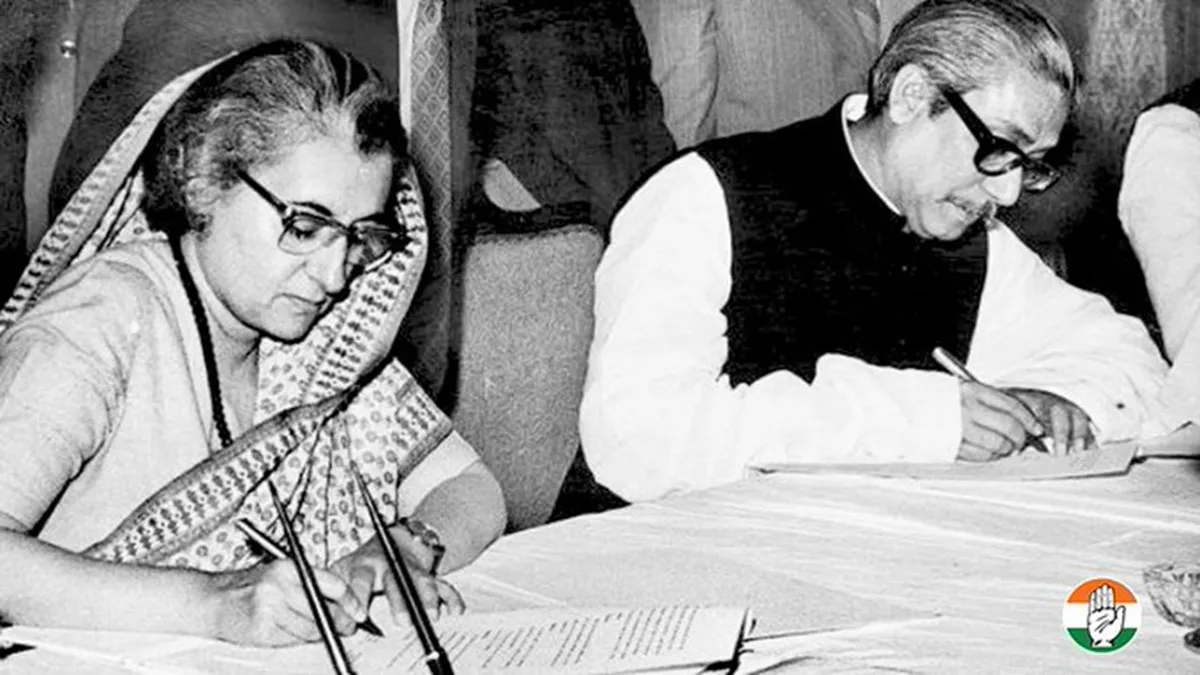
As India marks the birth anniversary of former Prime Minister Indira Gandhi, it is impossible to ignore the two very different leaders whose paths crossed with hers during one of the most turbulent periods in South Asian history, Sheikh Mujibur Rahman, the father of Bangladesh, and Richard Nixon, the President of the United States.
Her ties with one were warm and full of trust, her dealings with the other were tense and full of friction. Together, these relationships shaped the events of the 1971 Bangladesh Liberation War, one of the most defining moments of Indira Gandhi’s leadership.
How the crisis began: Two Pakistans, one broken country
When British India was partitioned in 1947, Pakistan was created in two separate parts, West Pakistan (today’s Pakistan) and East Pakistan (today’s Bangladesh). The two wings were separated by more than 2,000 km, spoke different languages, and had very different cultures.
West Pakistan dominated the government, the military and the economy.
East Pakistan, where most people spoke Bengali, was ignored and mistreated. Over the years, the gap widened so much that people in East Pakistan felt like second-class citizens in their own country.
In the 1970 elections, Sheikh Mujibur Rahman’s party, the Awami League, won a clear majority. He should have become the Prime Minister of Pakistan. But the Pakistani military refused to hand over power. Protests broke out, violence increased, and lakhs of people fled to India to escape the army’s brutal crackdown.
Indira Gandhi and Sheikh Mujibur Rahman: A deep bond of trust
Indira Gandhi saw the suffering in East Pakistan and decided to support the Bengali people. She did not want to rush into a war, but she also did not want to remain silent as thousands were killed and millions crossed into India as refugees.
India secretly helped the Mukti Bahini, the group fighting for Bangladesh’s freedom. Under Operation Jackpot, Indian forces trained them, gave them equipment, and helped them fight back against the Pakistani military. Sheikh Mujibur Rahman trusted Indira Gandhi deeply. After Bangladesh became free, he often called her his “sister”, say some reports. For Indira, Mujib was more than a political partner, he was a symbol of a people fighting for their rights.
Indira Gandhi and Richard Nixon: A cold and difficult relationship
While Indira shared warmth with Mujib, her dealings with the then US President Richard Nixon were exactly the opposite, strained, suspicious and often confrontational.
The US wanted Pakistan’s help to build ties with China during the Cold War. Because of this, Nixon did not want to criticise Pakistan’s violence in East Pakistan. Supporting India, he felt, would hurt America’s larger plans. Declassified tapes later showed Nixon and his adviser Henry Kissinger using insulting language about Indira Gandhi. It revealed how tense the relationship had become.
When war broke out in December 1971 after Pakistan attacked Indian airbases, Nixon sent the US Seventh Fleet to the Bay of Bengal. It was meant to scare India and stop its support to Bangladesh. But Indira Gandhi did not panic. She activated a clause in the Indo-Soviet Treaty, which meant that if India was attacked, the Soviet Union would help. Soon, a Soviet naval fleet moved towards the region. The US and British fleets eventually backed away. Nixon wanted to save Pakistan. Indira Gandhi wanted to save millions of innocent civilians. History remembers who succeeded.
Indira Gandhi’s leadership in the 1971 war
Indira Gandhi followed a clear strategy:- Keep the war short so that America and China could not intervene.
- Let the army prepare properly, trusting Field Marshal Sam Manekshaw’s advice.
- Tell the world the truth by writing to global leaders and travelling across Europe and the US to explain Pakistan’s atrocities.
Her patience paid off. India entered the war only after Pakistan attacked on December 3, 1971. Just 13 days later, on December 16, Pakistan surrendered in Dhaka and Bangladesh was born. It became one of India’s greatest victories, militarily, politically and diplomatically.
Sheikh Hasina: A living link to this shared history
After Bangladesh’s liberation, tragedy struck. On August 15, 1975, Sheikh Mujibur Rahman and most of his family were assassinated. His daughter Sheikh Hasina, who was abroad at the time, sought refuge in India.
Indira Gandhi ensured she received safety, shelter and support. Hasina later carried forward her father's policies, strengthening ties with India, promoting secularism, and honouring the spirit of 1971. Today, Sheikh Hasina is again in India after stepping down amid massive protests in Bangladesh.