- News
- Explainers
- EXCLUSIVE | India's defence export dream: Can it become the world's leading arms seller?
EXCLUSIVE | India's defence export dream: Can it become the world's leading arms seller?
Speaking at an event in Maharashtra's Shirdi last month, Defence Minister Rajnath Singh said India will become the world's largest arms exporter in the next 25 to 30 years. He called for a greater participation of private sector in helping India achieve this goal.
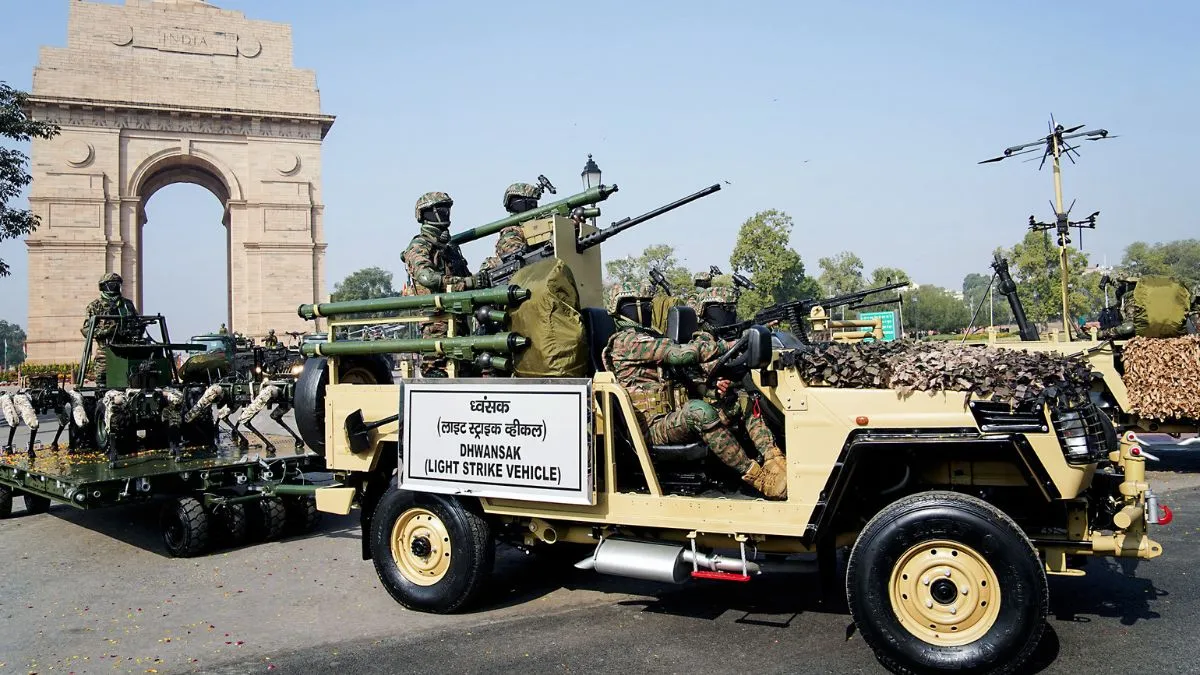
On May 23, Defence Minister Rajnath Singh announced an ambitious goal for India and the country's defence sector -- to make the nation the largest arms exporter within the next 25 to 30 years. He made the remarks during an event in Maharashtra's Shirdi, which was also attended by the then Chief of Defence Staff (CDS) General Anil Chauhan.
"I can say with certainty that no power in the world can stop India from becoming the world's largest exporter in the defence sector in the next 25-30 years. Today, a golden chapter is being written in India's defence and space sectors," Rajnath was quoted by news agency ANI as saying.
For this, Rajnath - who has been India's defence minister since 2019 - said the private sector needs to play a critical role. As of now, the private sector contributes 25 to 30 per cent to India's defence manufacturing, but the Union minister said the government wants to raise this to 50 per cent.
Together with the private sector and the Modi government's vision to make India 'atmanirbhar' or self-reliant, no power can stop the country from becoming the world's top arms exporter in 25 to 30 years, Rajnath asserted following the inauguration of an ammunition manufacturing unit in Shirdi.
"I am glad that today India's private industry also has a good understanding of the wars of the future. Everyone will have to work together to make India a hub for ammunition and automation," the defence minister said.
Rajnath's goal - a reality or a far-fetched dream?
Rajnath Singh's announcement reflects an ambitious vision. However, a glance at a recent report by the Stockholm International Peace Research Institute (SIPRI) suggests that achieving this goal may still require considerable effort and time. The 2025 SIPRI report, titled "Trends in International Arms Transfers”, says that while India has made progress in defence exports, it still has some way to go before emerging as one of the leading global arms exporters. In fact, the report showed that India is not even among the top 25 countries in this race.
According to the report, the United States (US) remains the largest arms exporter and contributed 42 per cent of this from 2021 to 2025. This is an increase of 27 per cent from 2016 to the 2020 phase, when the US contributed 36 per cent of the global arms exports.
"The USA’s arms exports grew by 27 per cent between 2016-20 and 2021-25, and its share of total global arms exports rose from 36 per cent to 42 per cent. In 2021-25, the USA's share of total global arms exports was more than the next seven largest suppliers' shares combined. The USA exported major arms to 99 states in 2021-25 and was among the top three suppliers for 76 states," the SIPRI report stated.
A distant second in this race was France, which contributes 9.8 per cent. Notably, India is the highest importer of French weapons and buys nearly 24 per cent of their equipment. Third, Russia contributes 6.8 per cent, followed by Germany, which has a share of 5.7 per cent in the global arms suppliers race. China stays at fifth place, with a 5.6 per cent contribution.
The SIPRI report also featured Ukraine and Iran, with both countries contributing roughly 0.3 per cent in the global arms exporters race.
India, the second-largest recipient of major arms
The SIPRI report stated that India remains the second largest recipient of major arms. Its share in global arms imports stands at 8.2 per cent from 2021 to 2025, behind only Ukraine, which has a share of 9.7 per cent during the same period. From 2016 to 2020, India's share in this was 9.3 per cent, and there has been a reduction of 4 per cent.
Russia (40 per cent) remains India's largest supplier, followed by France (29 per cent) and Israel (15 per cent).
India's "arms imports are driven by its tensions with both China and Pakistan," the report said. "These tensions have regularly led to armed conflict, as they did briefly between India and Pakistan in May 2025, with both sides using imported major arms. Indian arms imports fell by 4.0 per cent between 2016-20 and 2021-25. The decrease can be partly attributed to India's growing ability to design and produce its own weapons - although there are often substantial delays in domestic production."
The report also said Pakistan's share in global arms imports was 4.2 per cent from 2021 to 2025. This is an increase of 66 per cent from 2016 to 2020, when its share was 2.8 per cent. For Pakistan, China (80 per cent) remains its top supplier, followed by Türkiye (7 per cent) and the Netherlands (4.6 per cent).
Rajnath's announcement: Reality vs ambition
Going by the SIPRI report, the defence minister's announcement looks a bit superficial, but people familiar with the defence industry believe that India could be among the top 10 to 15 arms exporters in the world, which they said would be "pragmatic and a realistic thought".
They pointed out that there are structural challenges, and India needs to focus a lot on research and development. Also, India must strive to make its existing production lines compatible and better than the best available in the world market through innovations, R&D, quality control, and numbers, they said.
This was backed by Admiral (retired) Karambir Singh, who was Chief of Naval Staff from 2019 to 2021. Speaking exclusively to India TV Digital, Admiral Singh said India cannot produce cutting-edge weapons unless we invest adequately in R&D. He gave the example of China, which he said became the manufacturing capital of the world by giving importance to R&D, especially manufacturing R&D.
He, though, credited the government for investing a lot of energy on R&D, but noted that the entire ecosystem -- starting from academia to the user to the involvement of IITs and venture capitalists -- needs more impetus in India.
"You see, our R&D… Not only the defence public sector but also the private sector is not enough. So, if you do not do research and development, you will not produce cutting-edge weapons, and therefore, you are not going to have what you are talking about in terms of exports. Exports are highly dependent on technology, which is a moving target," he told India TV Digital.
"It is not that once you develop something, you can keep marketing the same product. Products have to be constantly improved and modernised. So, what is required is much more investment in R&D. That is extremely important," he added.
The crucial geopolitical factor
Admiral Singh explained that geopolitics plays a role in a country's defence exports. He said India is also focusing on co-production and co-development, alongside R&D.
Giving an example of ship-building capacity, he said China, Japan and South Korea are the leaders in ship-building, but India has the demographic advantage. He said the above-mentioned nations, particularly South Korea, are turning to India for ship-building here due to the demographic decline in their countries.
"So, India stands to gain because of initiatives like China plus one," Admiral Singh told India TV Digital.
"The China plus one is directly related to geopolitics. Also, you see conflicts increasing and therefore requirement for weapons that are mass produced at high scale. Here, if India can up their game, then they can become an important export hub," he added.
Focus on startups, MSMEs
Admiral Singh, who was India's 24th Navy chief, told India TV Digital that the country must also focus on startups and MSMEs to boost its defence exports. An enabling environment needs to be created for them, which he noted the government has already been doing.
"As far as policy for R&D, that is put in place. But we have to get this entire thing cycle right, that we are innovating at the speed of relevance," he said.
Can India be a defence exporter?
India certainly has the capacity to achieve this feat, though there is massive competition from industry leaders such as the US, China, Russia, France, Israel and others. With better policy decisions and good R&D, India can become a major exporter.