JEE Main paper analysis 2026: 'Candidates who practiced previous years' papers, sample papers find it easy'
JEE Main paper analysis 2026: As per the initial reactions from the candidates, the paper was moderately easy. "Lots of questions were a bit identical what we practiced in previous years' papers, sample papers," a candidate told India TV Digital. Check shift-wise paper analysis.
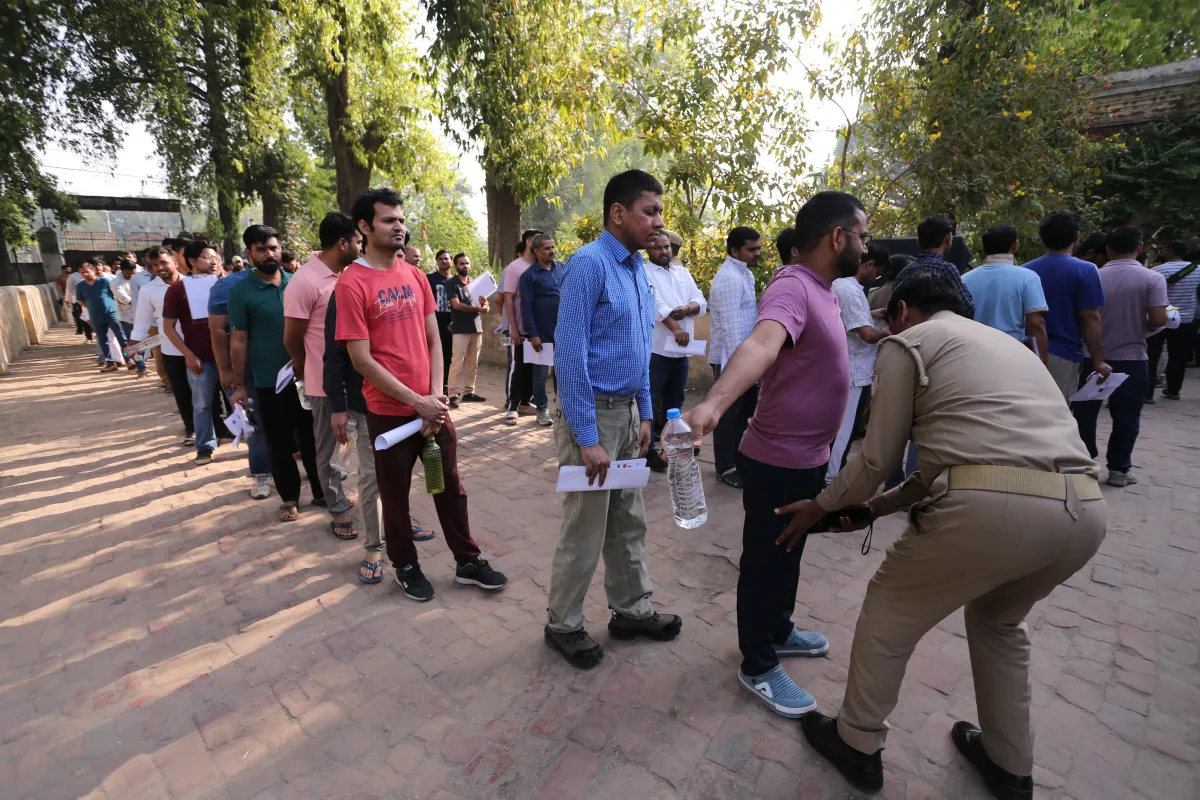
The Joint Entrance Examination (JEE) Main shift one paper was just concluded. JEE Main shift one paper held from 9 am to 12 noon. As per the initial reactions from the candidates, the paper was moderately easy. "Lots of questions were a bit identical what we practiced in previous years' papers, sample papers," a candidate told India TV Digital.
As per Ajay Sharma, National Academic Director, Engineering, Aakash Educational Services Limited, "among the three subjects, Mathematics was the most difficult. Physics was easy to moderate, while Chemistry was moderate to difficult due to its calculation-intensive nature. Both Mathematics and Chemistry were time-consuming, making it challenging to complete the paper within the given time. Overall, the paper was well-balanced in terms of question distribution and chapter coverage." JEE Main 2026 April session exam 2026 Live: Day One shift one exam ends; check paper analysis
Physics
The Physics section was relatively easier. Questions were asked from most major chapters, with a higher weightage from Electromagnetism, while Optics and Waves had comparatively fewer questions. Mechanics had average representation. A few questions were time-consuming, but overall the section was manageable. Topics such as Electromagnetic Waves, Thermodynamics, and Modern Physics were adequately covered.
Chemistry
The Chemistry section was moderate in difficulty. Questions were almost evenly distributed among Organic, Inorganic, and Physical Chemistry, with slightly greater emphasis on Inorganic Chemistry and comparatively fewer questions from Organic Chemistry. While not very difficult, some questions were calculation-intensive and time-consuming, which impacted overall time management.
Mathematics
The Mathematics section was moderate to difficult and the most time-consuming. Questions were well distributed across the syllabus, with higher weightage from Integral Calculus, Conic Sections, and Algebra. Topics such as 3D Geometry, Vectors, and Complex Numbers had average representation. Algebra appeared slightly dominant, while Coordinate Geometry had moderate coverage. Lengthy calculations and tricky problems made this section the toughest.
According to Ramesh Batlish, JEE expert, "the Mathematics paper was analysed as moderate, while Physics and Chemistry papers were reviewed as easy." Here's the section-wise analysis of JEE Main shift one paper -
Mathematics – Moderate. Questions asked from Matrices & Determinants, 3 D Geometry, Vectors, Permutation & Combination, Probability, Complex Numbers, Statistics, Progressions, Quadratic Equations, Set ,Relations & Function, Continuity & Differentiability, Application of Derivative, Definite Integrals, Differential Equations, Area, Straight Line, Circle , Conic Sections . The Numerical Section had lengthy calculations from chapters of Algebra & Coordinate Geometry. A few questions were reported as Lengthy &Tricky.
Physics – Easy . Questions were asked from Kinematics, Gravitation, Semiconductors, Rotational Motion, Laws of Motion, Ray Optics, Electrostatics, Modern Physics, Heat & Thermodynamics. Numerical based questions were Lengthy but Easy. Few fact-based questions from class XII chapters of NCERT were also asked.
Chemistry – Easy. Questions asked from Coordination Compounds, Chemical and Ionic equilibrium , Electrochemistry, Redox reactions, p-block elements, Chemical Bonding, Molecular concept, General Organic Chemistry, Alcohol, Ether & Phenol, Biomolecules. Some fact-based questions from NCERT were asked.
Around 11.23 lakh candidates applied to appear for JEE Main paper one (BE/ BTech) two scheduled to be held in two shifts on April 2, 4, 5, 6 and 8, while paper 2A (BArch), paper 2B (BPlanning) will be held in a single shift from 3 pm to 6 pm.
How to check marks through JEE Main unofficial answer key
JEE Main shift-wise unofficial answer key will be available on various portals following the exam. The candidates can check shift-wise scores through unofficial answer key. To download JEE Main shift-wise unofficial answer key, candidates need to visit the portals where JEE Main answer key is available. Click on the JEE Main shift-wise unofficial answer key link and download it. Now, check your scores through JEE Main shift-wise unofficial answer key.
For details on JEE Main 2026, please visit the official website - jeemain.nta.nic.in.