Delhi: Manjinder Sirsa showcases progress in pollution control, highlights air quality improvement efforts
Delhi weather updates: Delhi’s public works and municipal agencies are working intensively to enhance road infrastructure and streamline waste collection across the city. Sirsa disclosed that over the past 2.5 months, the govt has spent several crores of rupees on constructing and repairing roads.
Delhi’s Environment Minister Manjinder Singh Sirsa on Friday (October 31) addressed a press conference detailing the national capital’s ongoing efforts to reduce air pollution and improve overall environmental conditions. Citing the coordinated efforts of the Delhi government, Delhi Development Authority (DDA), Municipal Corporation of Delhi (MCD), and Irrigation and Flood Control Board, Sirsa said the city’s Air Quality Index (AQI) had improved to 218.
He noted that on the same day last year, the AQI was recorded at 357, while in 2023 it was 328. “This year’s AQI level shows a significant improvement compared to previous years,” Sirsa said.
Massive ground-level monitoring and clean-up operations
Sirsa explained that a workforce of over 1,200 personnel has been deployed across the city to prevent open waste burning, a major contributor to winter pollution. In addition, about 1,000 workers are specifically engaged in dust control operations to limit particulate emissions from roads and construction sites.
The government has introduced large-scale mechanical sweeping, covering nearly 3,000 kilometers of roadways. Efforts are simultaneously underway to monitor 91 newly identified high-rise buildings and ensure strict adherence to pollution norms at 500 construction and demolition (C&D) sites.
Water sprinklers and coordination with agencies
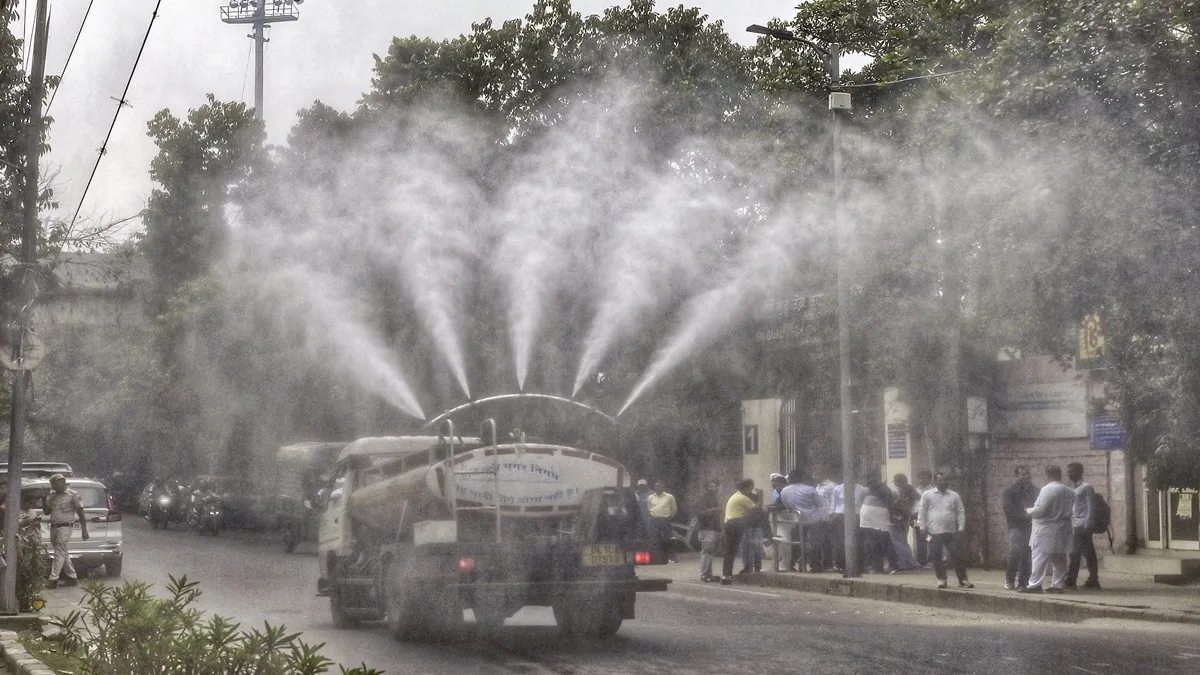
The environment department has currently deployed 280 water sprinklers across Delhi to suppress dust and reduce airborne pollutants. Traffic police have also been instructed to assist at designated “hotspot” locations to manage congestion and minimize dust re-suspension from vehicular movement.
Sirsa added that 91 high-rise structures and industrial areas near dumping and legacy waste grounds are under special focus due to their higher pollution impact.
Automatic monitoring network under central supervision
Responding to claims that air quality data might be manipulated, Sirsa clarified that all air quality monitoring stations in Delhi operate automatically, leaving no scope for manual interference. He further emphasised that the Central Pollution Control Board (CPCB) and the Commission for Air Quality Management (CAQM) jointly oversee monitoring across all stations in real time.
“Our monitoring systems are fully automated. No data can be altered or tampered with,” he said, dismissing recent media reports alleging data distortion as “false and aimed at discrediting the government.”
Focus on infrastructure and waste management
Delhi’s public works and municipal departments are actively engaged in improving road infrastructure and waste collection efficiency. Sirsa revealed that in the last two and a half months, the government has invested crores of rupees to build and repair city roads, particularly around industrial zones identified as pollution hotspots.
According to the minister, MCD teams have increased daily waste collection frequency in comparison to previous years, and deputy commissioners are conducting zone-wise assessments to ensure cleanliness drives are sustained.
Vehicle and emission regulations
Sirsa also clarified recent confusion regarding vehicle restrictions in the city. He stated that no blanket ban has been imposed on BS-IV vehicles, and residents registering their vehicles outside Delhi will have a one-year period to comply with updated regulations.
“Our goal is not to penalise citizens but to implement environmental reforms responsibly and effectively,” he asserted.
Collaborative approach and optimism ahead
Concluding the press conference, the minister credited the combined efforts of Delhi’s administrative agencies and citizens for the tangible improvement in air quality. “The progress we see today is a result of consistent teamwork across departments and rising public awareness,” Sirsa said. “We remain committed to making Delhi cleaner and healthier.”