Modi magic holds Bihar: Prime Minister's campaign pitch successfully overcame local anti-incumbency for NDA
Prime Minister Narendra Modi's campaign strategy, combined with well-planned seat-sharing, grassroots mobilisation, and welfare schemes like the Mukhyamantri Mahila Rozgar Yojana, helped overcome local anti-incumbency.
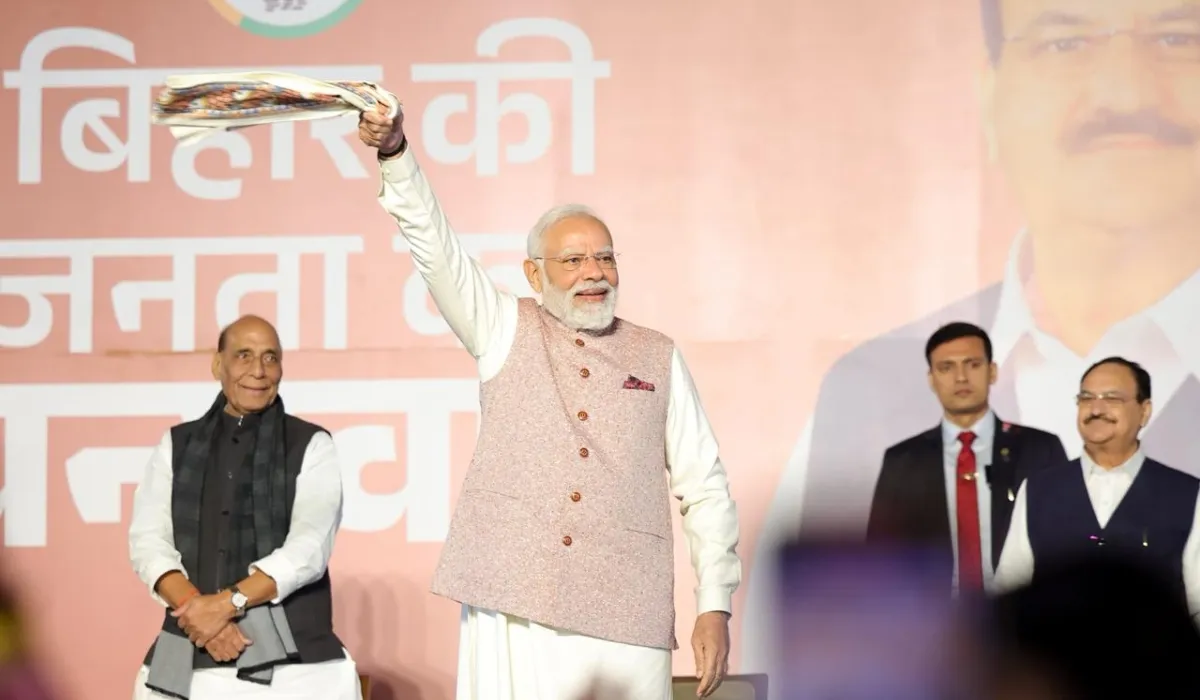
The National Democratic Alliance (NDA) has emerged victorious in the 2025 Bihar Assembly elections, with Prime Minister Narendra Modi's campaign strategy playing a decisive role in overcoming local anti-incumbency. The alliance, led by the Bharatiya Janata Party (BJP) and Janata Dal (United) [JD(U)], secured a commanding lead, signalling widespread voter approval of its governance and development record.
NDA secures a decisive mandate
Trends indicate that the NDA is leading with 203 seats out of 243, mirroring the coalition’s 2010 performance. The BJP emerged as the single-largest party, while JD(U) strengthened its base under Chief Minister Nitish Kumar. Smaller allies, including the Lok Janshakti Party (Ram Vilas), Hindustani Awam Morcha (HAM), and Rashtriya Lok Morcha (RLM), played critical roles in consolidating votes across different communities.
Strategic seat-sharing and coalition cohesion
A key factor behind the NDA’s victory was its meticulously planned seat-sharing arrangement. The BJP and JD(U) contested 101 seats each, the LJP (Ram Vilas) contested 29, and the HAM(S) contested six seats. This strategic distribution ensured each party contested constituencies with strong grassroots support, minimising vote-splitting and maximising electoral efficiency.
Reviving 'Jungle Raj' fears
The NDA’s campaign successfully revived the narrative of ‘Jungle Raj’, recalling the lawlessness of the previous RJD-led regimes. By contrasting Bihar’s improved law-and-order situation under the NDA with past instability, the coalition appealed to voters’ desire for security, stability, and effective governance.
Women and youth vote turnout pivotal
Women and first-time young voters played a decisive role in the NDA’s win. Welfare schemes, such as the Mukhyamantri Mahila Rozgar Yojana, and support for self-help groups energised female voters, while grassroots mobilisation by women volunteers ensured high participation. The combination of women and youth turnout proved critical in tipping the scales in the NDA's favour.
Nitish Kumar factor and JDU resurgence
Chief Minister Nitish Kumar's leadership and popularity were instrumental in consolidating votes for the JD(U) and the broader NDA. His image as a stable and development-focused leader, coupled with the BJP’s national appeal under PM Modi, created a powerful electoral synergy.
Opposition setback
The Mahagathbandhan, led by RJD and Congress, failed to convert anti-incumbency sentiment into votes. Rahul Gandhi’s campaign, focused on electoral roll concerns and ideological critique, and Tejashwi Yadav’s CM projection did not resonate with voters. The opposition’s inability to address local issues and caste dynamics weakened its electoral appeal.
PM Modi hails Bihar victory, eyes bengal
Addressing party workers in Delhi, Prime Minister Modi credited the NDA’s success to grassroots mobilisation and karyakartas. “Your hopes are my pledge and your dreams are my inspiration,” he said, linking Bihar’s win to prospects in states like West Bengal and the South.
The 2025 Bihar Assembly elections underscore the effectiveness of strategic alliances, grassroots outreach, welfare programs, and strong leadership in overcoming local anti-incumbency. The NDA’s victory highlights how combining governance, development narratives, and meticulous political planning can deliver electoral success at the state level.