JWST discovers ancient Black Hole older than its Galaxy, challenges long-held Cosmic Theory
James Webb Space Telescope (JWST) has discovered a remarkable cosmic mystery that could rewrite astronomy textbooks. Scientists have spot an enormous black hole that appears to have formed before its host galaxy, challenging the long-standing belief that galaxies form first.
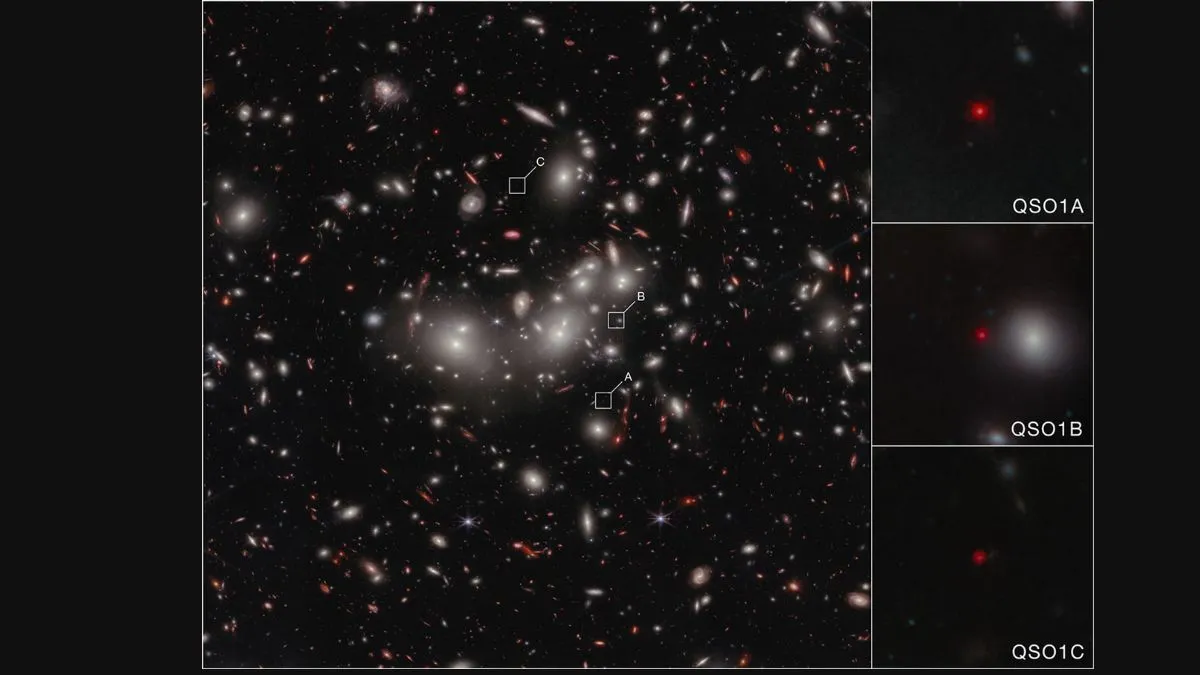
The James Webb Space Telescope keeps shaking up what we thought we knew about the universe. Now, it’s found something that’s really got astronomers scratching their heads: a gigantic black hole that seems to have shown up before its own galaxy even formed. This discovery is giving us fresh hints about how everything began.
These findings, published in Nature on May 27, point to one thing—supermassive black holes started popping up way earlier than people thought. That means we probably need to rethink how galaxies grew and evolved right after the Big Bang.
So, what did JWST actually find?
The centre of all this excitement is Abell2744-QSO1, which belongs to this weird group of ancient objects scientists have nicknamed “Little Red Dots.” JWST first picked them up in 2022. They're tiny, but they’re some of the oldest things floating around out there.
With the telescope’s Near Infrared Spectrograph (NIRSpec), researchers tracked how gas is swirling around Abell2744-QSO1. That let them pin down the black hole’s mass—something nobody’s done with this kind of precision before.
And the numbers floored them. This black hole is about 50 million times heavier than our Sun. Not only that, it’s been sitting there since just 700 million years after the Big Bang.
But things get even stranger when you look at the black hole’s host galaxy. Turns out, the black hole makes up nearly two-thirds of the galaxy’s entire mass. To put it another way, in galaxies today—including the Milky Way—the central black holes add up to just a tiny fraction of their galaxies’ total weight. This one? Thousands of times bigger, in proportion, than anything we’ve seen nearby.
That oversized ratio hints that the black hole came together before most of the galaxy’s stars or structure had a chance to form.
Right now, the leading theories suggest that supermassive black holes build up slowly, feeding on the leftovers of massive stars inside already-formed galaxies. But this black hole doesn’t fit that script at all.
So what’s going on?
Scientists are now tossing around new ideas. Maybe this black hole was “born big”—meaning it formed straight out of a monster cloud of primordial gas right after the Big Bang. Or maybe there’s some process, still totally unknown, that churned out these heavyweight objects super early.
JWST has already found more of these “Little Red Dots,” and researchers are digging in to see just how common these ancient black holes are. If more turn up, we’ll need to rewrite a big chunk of what we thought we knew about how galaxies and black holes kicked off after the cosmos started. Exciting times for astronomy, to say the least.