
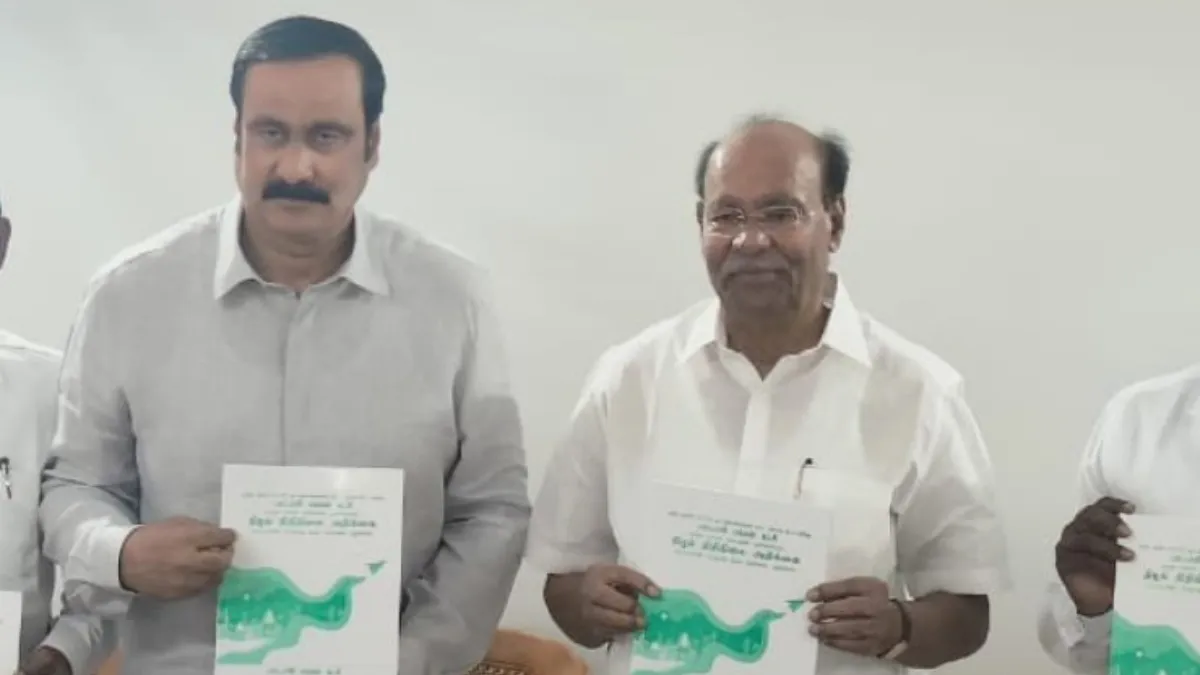
In a tense escalation in the Pattali Makkal Katchi (PMK), founder Dr S Ramadoss has officially expelled his son, former Union Minister Anbumani Ramadoss, from the party. The move, announced on Thursday, comes after Dr Ramadoss accused Anbumani of indulging in anti-party activities and failing to respond to disciplinary notices. Among the allegations were 16 counts of misconduct; Anbumani was given notices twice but did not reply.
Dr Ramadoss lambasted his son's leadership style, calling him politically unfit and likening him to "a weed that needs to be removed." The fallout comes amid Anbumani's statewide campaign opposing the ruling Dravida Munnetra Kazhagam (DMK) in Tamil Nadu and his plans to declare the PMK's electoral alliance lineup soon.
Meanwhile, Anbumani's camp has pushed back, saying his expulsion is invalid, pointing out that his tenure as party president was extended till August 2026 by a general council and vested by the Election Commission.
The split deepens ahead of the 2026 Assembly elections, raising questions about PMK's unity, its Vanniyar vote base in northern Tamil Nadu, and how alliances will be negotiated.
PMK's origins, ideology and role in Tamil Nadu politics
The Pattali Makkal Katchi (PMK), founded in 1989 by Dr S Ramadoss, emerged as a political voice for the Vanniyar community—a dominant caste group in northern and central Tamil Nadu that felt politically under-represented. With the mango as its election symbol, PMK positioned itself as a regional party advocating a blend of caste identity politics and social welfare, particularly for the Vanniyars. Over the years, it has allied with major Dravidian parties and national players like the Bharatiya Janata Party (BJP), often recalibrating based on electoral needs.
Vote share but lingering influence in Vanniyar strongholds
The party opened its account in the Lok Sabha for the first time in 1998 when it aligned itself with the Jayalalithaa-led All India Anna Dravida Munnetra Kazhagam (AIADMK), the BJP, the Vaiko-led Marumalarchi Dravida Munnetra Kazhagam (MDMK), the Tamizhaga Rajiv Congress (TRC) and the Janata Party. The party received around 6 per cent of votes and won four seats, including Vellore, Vandavasi, Chidambaram and Dharmapuri. The PMK was one of the founding members of the BJP-led National Democratic Alliance (NDA), and Dalit Ezhilmalai became the minister in the Atal Bihari Vajpayee government. In the 1999 Lok Sabha polls, the PMK entered into an alliance with the DMK and won five seats. The party retained the Vellore, Vandavasi, Chidambaram and Dharmapuri constituencies and won Chengalpattu, a new seat. Party MPs NT Shanmugam, E Ponnuswamy and AK Moorthy became ministers in the Vajpayee-led Cabinet.
The party saw its peak influence in the early 2000s, winning 6 Lok Sabha seats (Chengalpattu, Arakkonam, Tindivanam, Chidambaram, Dharmapuri and Puducherry) in 2004, when it was part of the Congress-led United Progressive Alliance (UPA). Anbumani Ramadoss was sworn in as the Minister of Health and Family Welfare in the Manmohan Singh Cabinet, while R Velu became Minister of State (Mos).
The party again joined hands with the AIADMK in the 2009 Lok Sabha polls but couldn't win a single seat. The PMK remained with the BJP in the 2014, 2019 (with the AIADMK also in the alliance) and 2024 Lok Sabha elections. The party won just one seat in 2014 when Anbumani won the Dharmapuri parliamentary seat but failed to open its account in the 2019 and 2024 Lok Sabha polls.
In the Assembly elections, the PMK received 5.89% of votes in the 1991 polls and won the Panruti seat, where S Ramachandaran emerged victorious. The party for the first time entered into an alliance with any political party in the 1996 state polls when it forged a pact with the All India Indira Congress (Tiwari). However, the vote share dropped to just 3.84%, but it managed to win four seats, including Andimadam, Edapadi, Taramangalam and Pennagaram.
In the 2001 polls, the party changed sides and contested polls with the AIADMK, winning 20 seats with 5.60% of votes. In the 2006 Tamil Nadu elections, the PMK joined hands with the DMK and almost retained its tally with 18 seats and 5.70% of votes. However, it faced a major setback in the 2011 polls, when it was decimated to just 3 seats in an alliance with the DMK. It received 5.20% of votes. The party fought the 2016 Tamil Nadu polls on its own and failed miserably. It couldn't win a single seat after contesting all 234 but retained its vote bank with 5.36% of the share. In the last 2021 state elections, the PMK entered into a pact with the AIADMK and the BJP and won five seats with a vote share of 3.80%.
So, it is clear that in terms of vote share, the PMK polled around 5-6% in state elections during its stronger years. However, this has declined over time. Despite the dip, it retains influence in Vanniyar-majority districts, though critics argue its caste-centric approach has deepened social divides, particularly with Dalit communities.
What this feud could mean for Tamil Nadu politics going forward
Splintering vote bank: If the father-son conflict results in factional splits, PMK's traditional base — the Vanniyars — might see divided loyalties. That could weaken PMK's influence in northern and central districts during state elections.
Alliance negotiations in flux: PMK has been an ally of the BJP under the NDA, but the power struggle could affect its bargaining power. Major parties may be wary of aligning with a party in visible internal disarray.
Public perception and credibility: Internal fights, public firing of notices, and contradictory claims of legitimacy may erode trust among party cadres and voters who expect stable leadership.
Potential leadership alternatives: The pronouncements by Dr Ramadoss, especially after the general council, where he declared himself "founder-president", and the elevated slant towards party elders or non-Anbumani leadership (including speculation about his daughter) suggest possibilities of reshuffling or realignment in the PMK leadership structure.
Electoral impacts in upcoming polls: With Tamil Nadu Assembly elections slated for 2026, this conflict might play out in seat sharing, campaign strength, and overall vote share. A weakened PMK could benefit rivals (both Dravidian parties and newer caste-based parties).
As of now, the PMK feud remains unresolved publicly; whether Anbumani accepts expulsion or moves legal or electoral countermeasures is yet to be seen. But for Tamil Nadu's political landscape, this is not a mere family fight — it has the potential to reshape alliances, voter calculations, and PMK's standing.