
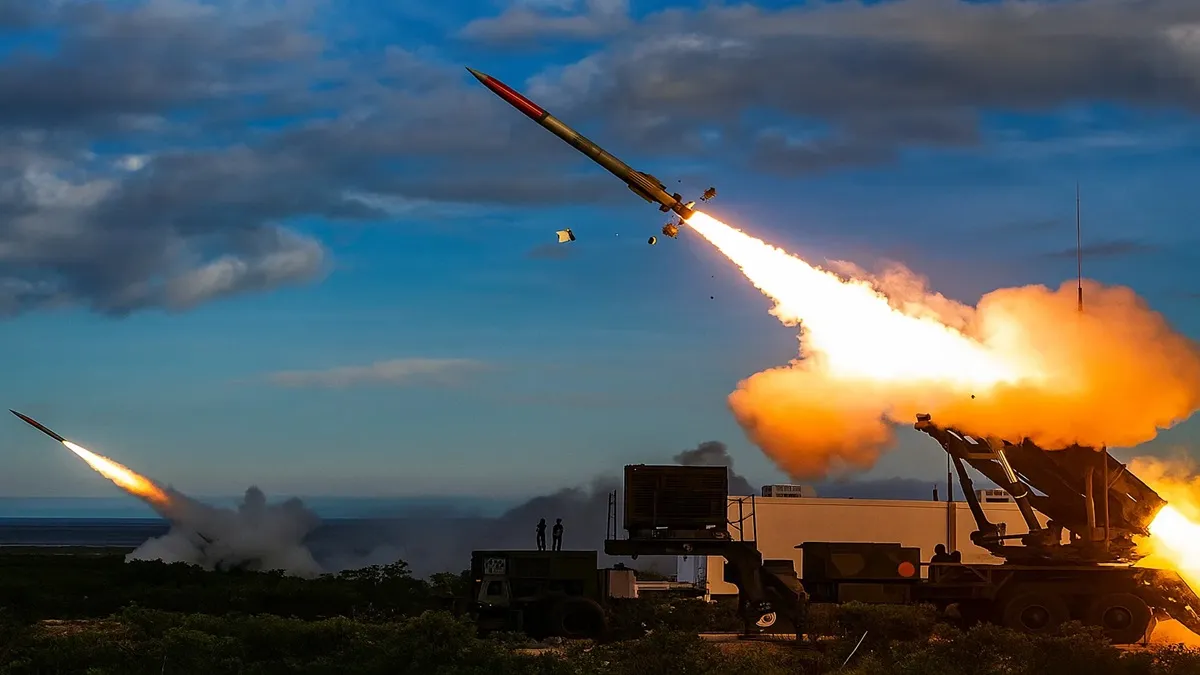
US President Donald Trump has said his administration will supply Patriot air-defence systems to Ukraine as Kyiv struggles to protect itself from intensifying Russian missile and drone attacks. Speaking to reporters at Joint Base Andrews in Maryland, Trump said Ukraine ‘desperately needs’ the advanced air-defence systems but made clear that Washington would not foot the bill. “We’re not paying anything for them. But we will get them Patriots, which they desperately need,” Trump said, without specifying how many units would be sent or the timeline for delivery.
Why Ukraine wants more Patriot missiles now
Ukraine has repeatedly urged the US and its allies to provide additional Patriot batteries to strengthen its air defences. Russian forces have stepped up attacks on energy infrastructure and urban centres ahead of what is expected to be another winter campaign designed to cripple Ukraine’s economy and exhaust civilian resilience.
While Ukraine’s air defences have successfully intercepted many attacks, officials warn the country’s network is overstretched and lacks depth especially beyond Kyiv. Patriots are sought after because of their proven capability to intercept ballistic missiles, cruise missiles and aircraft.
Ukraine received its first Patriot battery in April 2023 under the Biden administration which played a key role in intercepting Russian missiles, including Kinzhal hypersonic weapons. But one battery cannot protect the whole country - its coverage typically extends only to a major city and surrounding area.

What is the Patriot missile system?
The Patriot (MIM-104) is a long-range, mobile surface-to-air missile system developed by Raytheon and Lockheed Martin. First fielded in the 1980s, it has undergone significant upgrades to keep pace with evolving threats. The system is designed to track, target and destroy ballistic missiles, cruise missiles and advanced aircraft.
A Patriot battery typically includes:
- AN/MPQ-65 radar for target detection and tracking.
- AN/MSQ-104 engagement control station, the system’s command hub.
- M901 launcher stations, which carry and fire the missiles.
Missile variants and capabilities
Two types of interceptors are in current use:
- GEM-T (Guidance Enhanced Missile - Tactical): Effective against aircraft and cruise missiles. Range: up to 70 km; altitude: over 24 km.
- PAC-3 MSE (Missile Segment Enhancement): Designed to intercept ballistic missiles with greater agility and accuracy. Range: up to 60 km against ballistic missiles, somewhat less against aircraft and cruise missiles.
The PAC-3 MSE uses hit-to-kill technology rather than explosive warheads. Its enhanced motor and manoeuvrability allow it to tackle more sophisticated threats. A launcher can carry 16 PAC-3 MSE missiles, compared to four GEM-T interceptors.
Each PAC-3 MSE interceptor is estimated to cost between USD 4 million and USD 5 million.
Ukraine’s existing air-defence network under pressure
Ukraine’s current air-defence system is a patchwork of Soviet-era platforms like the S-300 alongside newer Western systems including NASAMS, IRIS-T, and Patriots. While this multi-layered approach has been effective in protecting some critical areas, Ukraine lacks sufficient systems to cover multiple regions simultaneously.
Patriot systems are considered especially valuable for defending high-value targets such as energy facilities, military command centres and cities from ballistic and cruise missile attacks. However their limited coverage means multiple batteries are needed for comprehensive protection.
As Russia intensifies attacks using drones, ballistic and cruise missiles, Ukraine argues that expanding its Patriot coverage is essential to safeguard both infrastructure and morale.
How effective are Patriots for Ukraine?
The Patriot system is among the most capable in the world but not a complete solution. Each battery protects only a limited area typically sufficient to defend a city or military base and is most effective when integrated into a broader, layered air-defence network.
The cost and complexity of the system limit how widely it can be deployed. Patriots are best reserved for defending strategic locations rather than offering blanket protection across frontline regions.
Where Patriots are deployed and their record in combat
Patriot air-defence systems are currently in service with 17 countries across Europe, the Middle East, Asia and the US itself. European operators include Germany, Poland, the Netherlands, Spain, Sweden, Romania and Greece. Some of these deployments contribute to NATO’s broader efforts, including the European Sky Shield Initiative (ESSI) which aims to strengthen collective air-defence in response to threats such as Russia’s missile arsenal.
In January 2024, NATO’s procurement agency signed a USD 5.6 billion contract for up to 1,000 GEM-T interceptors, highlighting Europe’s growing reliance on Patriots as part of its defence architecture.
In Asia, Patriots bolster defences in Japan, South Korea, and Taiwan, while Middle Eastern deployments include Saudi Arabia, the UAE, Kuwait, Qatar, and Israel.
Patriots have been used extensively in past conflicts, from the 1991 Gulf War to more recent deployments in Iraq and Saudi Arabia, where they intercepted missiles and drones targeting civilians and infrastructure.