
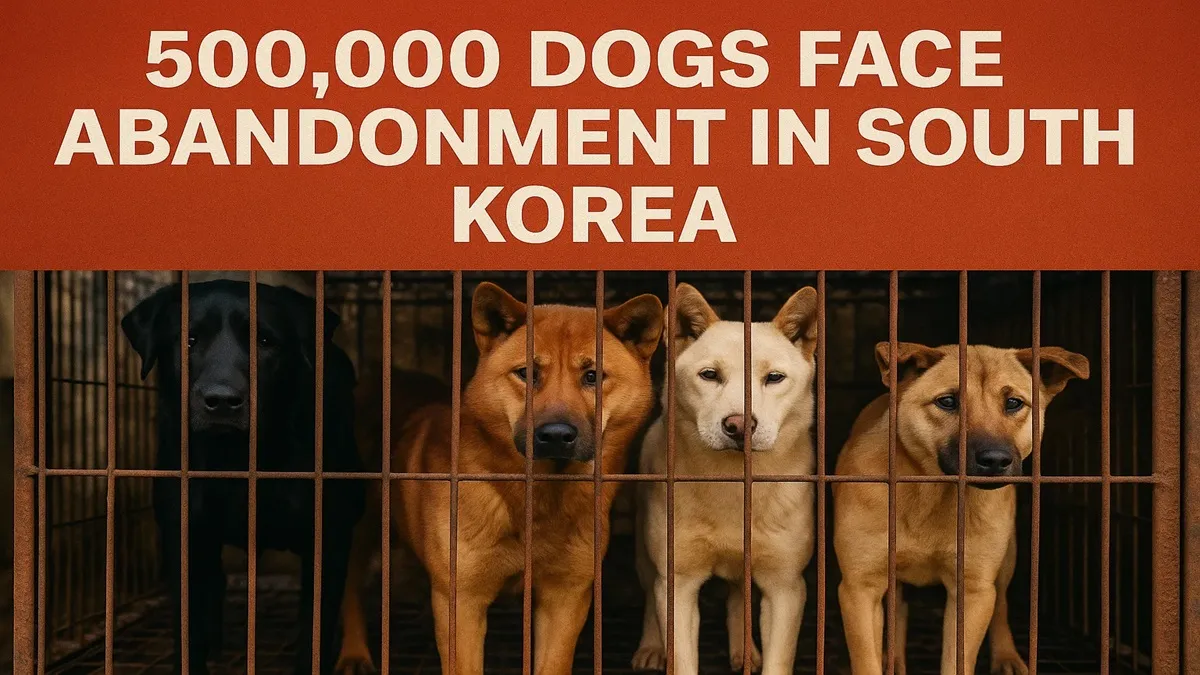
In January 2024, South Korea took a landmark decision that shook centuries of cultural tradition and sent ripples across its farming community: a complete ban on the dog meat industry, set to take full effect by February 2027. The move, passed unanimously by the country's National Assembly, criminalises every step of the trade from breeding and slaughter to distribution and consumption. For animal rights campaigners, it marked a historic shift toward compassion and modern animal welfare norms. For farmers and traders whose livelihoods have depended on the trade, it signalled economic ruin with little clarity on what comes next. Now, midway through the government's three-year grace period, both animals and humans are caught in limbo.
Over half a million dogs: What happens to them?
According to 2022 government data, more than 520,000 dogs - mainly large breeds such as Tosa-Inus - were being raised across over 1,100 farms for human consumption.
With public shelters already stretched and private ones lacking capacity, rehoming efforts are buckling under pressure. Local municipalities were tasked with accepting surrendered dogs, but large-breed animals often face a stigma. Many are legally classified as "dangerous", complicating adoption in urban homes where smaller pets are preferred.
Animal welfare activists, including Lee Sangkyung of Humane World for Animals Korea, say the government has not outlined a clear rescue strategy. "Although the dog meat ban has passed, both the government and civic groups are still grappling with how to rescue the remaining dogs," Lee told BBC.
Some dogs are being sent abroad for adoption but these numbers are negligible against the scale of the problem. Critics warn of dire outcomes if no alternatives emerge. "If remaining dogs become 'lost and abandoned animals', then it's heartbreaking but they will be euthanised," said Cho Hee-kyung of the Korean Animal Welfare Association.
The government denies euthanasia is part of the official plan. Instead, it has introduced financial incentives, offering up to 6,00,000 Korean won (about USD 450) per dog for farmers who voluntarily exit the trade early.
Livelihoods at stake
For people like Reverend Joo Yeong-bong, 60, the legislation has transformed his farm from a viable business into a burden. "Since last summer, we've been trying to sell our dogs, but the traders just keep hesitating. Not a single one has shown up," he told the BBC.
With mounting debts and no buyers, many farmers feel trapped. "We're drowning in debt, can't pay it off, and some can't even find new work. It's a hopeless situation," said Joo.
Chan-woo, a 33-year-old farmer with 600 dogs, echoed the concern. He faces a legal deadline of February 2027. Failing to shut down could mean two years in prison. "Realistically, even just on my farm, I can't process the number of dogs I have in that time," he said. Despite investing all his savings into the farm, he claims both the authorities and activists have offered little practical help.
"There was no real plan. They passed the law and now say they can't even take the dogs," he added.
Public support grows, but so does unease
While younger South Koreans increasingly see dogs as companions, not cuisine, the transition has also sparked questions about ethical consistency and cultural autonomy.
According to Gallup Korea, dog meat consumption has plummeted, from 27 per cent in 2015 to just 8 per cent in 2023. A government survey in 2024 found only 3.3 per cent of respondents intended to continue eating dog meat post-ban.
Yet opposition remains. Some vendors accuse the government of giving in to Western moral pressure, while others argue the ban is hypocritical. "If dog meat is banned because dogs are animals, then why is it okay to eat other animals like cows, pigs or chicken?" asked former dog meat farmer Yang Jong-tae, who shut down his farm in 2023.
Even so, Yang acknowledged that rescue teams had opened his eyes. "When I saw how they handled the animals, like they were handling people - it really moved me. For us, raising dogs was just a way to make a living."
Government response: Not enough, say critics
In response to the unfolding crisis, the Ministry of Agriculture, Food and Rural Affairs (MAFRA) has pledged 6 billion Korean won annually to expand public shelters and support private ones. However, civil society groups say the measures are too vague and insufficient.
"Public shelters are overcrowded, and private ones don't have the funds or space," said JungAh Chae of Humane Society International Korea, who described the legislation as "history in the making" - but warned that implementation is dangerously behind schedule.
What next?
As the February 2027 deadline approaches, calls are growing for a grace period extension. Farmers say they need time, financial support, and clearer guidance. "Right now, people are still holding on, hoping something might change," said Joo. "But by 2027, I truly believe something terrible will happen." As Seoul plans to outlaw a centuries-old practice by 2027, dogs bred for slaughter and farmers who depended on the trade now face an uncertain future.
