
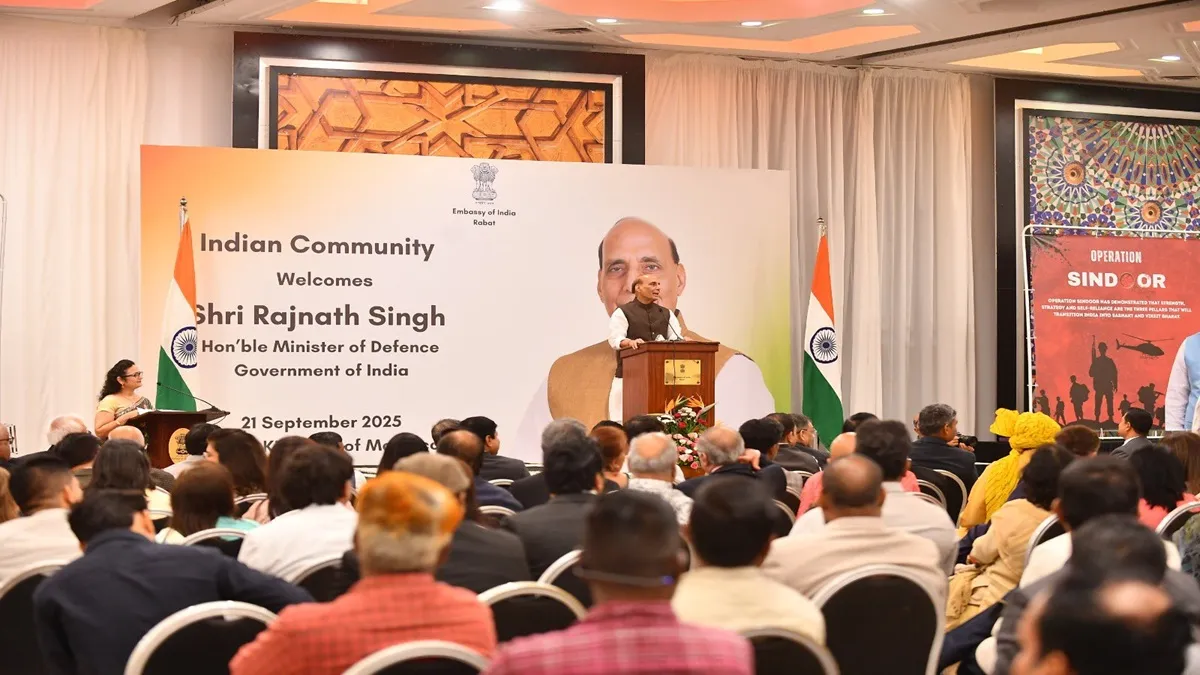
Defence Minister Rajnath Singh on Monday said that Operation Sindoor could see a second or even third phase if Pakistan continues to support terrorism. Speaking to the Indian community in Morocco's Rabat, Singh reiterated Prime Minister Narendra Modi's earlier statement that the counter-terrorism operation was "just a pause" and could be resumed. "Whether part 2 remains to be done or part 3, we can't say... It depends on their (Pakistan's) conduct... If they indulge in terrorist activities, they would get a reply," Singh said. "PM too has said that this is just a pause. Operation Sindoor has only been halted...It can be started again," he added.
Decision after Pahalgam attack
Recalling the Pahalgam terror attack of May 7 that claimed 26 lives, the Defence Minister said the government acted precisely. "The first question I asked in the meeting with CDS, the three service chiefs and the defence secretary the next day, on 23rd April, was if they are ready for an Operation if the government decided upon one. You would be delighted to know they didn't take even a second and responded that they are absolutely ready," he said. Singh added that the plan was then presented to Prime Minister Modi, who gave a free hand to proceed.
'India's response guided by actions, not religion'
The minister highlighted that India's actions during Operation Sindoor were not guided by religion but by the deeds of those responsible. "Ab bharat ki visheshta dekho, atankwadio ne deshvashiyo ka dharam puch kar mara, magar hum logo ne kisi ka dharm dekh kar nahi, unka karm dekh kar maara hai," he said. He underlined that India's response deliberately avoided civilian or military establishments. "We killed only those who killed our people. We didn't attack any civilian or any military establishment. Only India can have this character. Had we wanted, we could have attacked any military establishment or civilian establishment, but we didn't do it. We should uphold this character of India," Singh told the gathering.
Emphasis on India's secular fabric
Stressing India's secular values, Singh said, "We have no problems in people believing in whatever religion. This is the freedom, whoever wants to believe in whatever religion they believe. Whoever, whether from a particular religion, community, we don't discriminate. This is India's character."
Why Rajnath Singh's visit to Morocco matters?
Rajnath Singh's visit to Morocco will also be the first-ever trip to that country by an Indian Defence Minister. His visit is being seen as a key step in India’s growing defence diplomacy and its emergence as a credible global defence exporter. During his two-day visit, Singh will dedicate a plant set up by Tata Advanced Systems (TAS) for the production of wheeled armoured personnel carriers in Morocco. The facility at Berrechid is the first-ever Indian defence manufacturing plant in Africa, which will produce state-of-the-art military equipment to cater to regional requirements. The two countries are also set to strengthen their strategic convergence with the signing of a Memorandum of Understanding (MoU) on defence cooperation, providing a formal framework for deeper engagement through joint training programmes, exchange of delegations, and collaboration in defence industrial projects.
In addition, Indian Navy ships have been making regular port calls at Casablanca in recent years, and this agreement will further consolidate such ties, the ministry said in a statement. It said Tata Advanced Systems Maroc's facility is the first-ever Indian defence manufacturing plant in Africa, which marks an important milestone reflecting the growing global footprint of India's defence industry. During the visit, Singh will hold a bilateral meeting with his Moroccan counterpart Abdeltif Loudiyi.
Operation Sindoor
It is to be noted here that Operation Sindoor was launched on May 7 in response to the Pahalgam terror attack that killed 26 people. Following this, India carried out targeted strikes on terror infrastructure and Pakistani airbases, while Pakistan retaliated with drone and missile attacks, which were neutralised by Indian armed forces. The period also witnessed intense cross-border shelling.
ALSO READ: 'Met our objectives': IAF chief explains the idea behind ceasefire during Operation Sindoor