
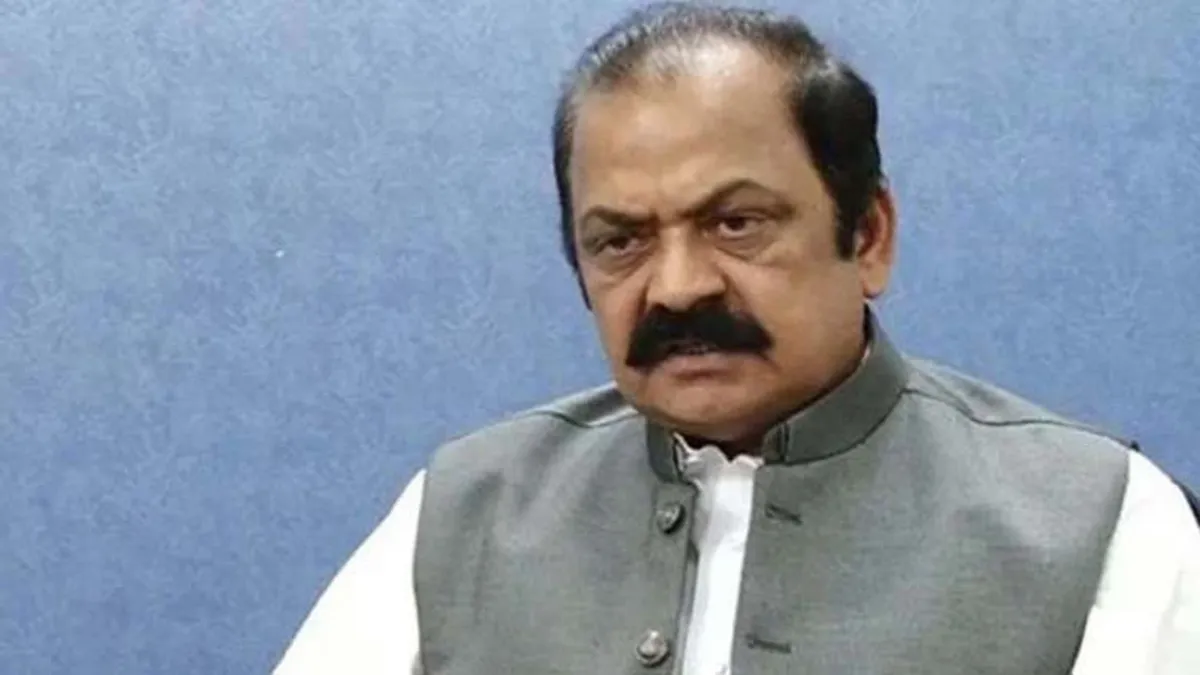
In a significant and unsettling revelation, Rana Sanaullah, senior adviser to Pakistani Prime Minister Shehbaz Sharif, acknowledged that the Pakistan military had only 30 to 45 seconds to evaluate whether a BrahMos missile fired by India during 'Operation Sindoor' carried a nuclear warhead. His statement underlines the heightened risk of nuclear miscalculation during the recent military escalation between the two nations.
"Just 30-45 seconds to decide": BrahMos missile raises nuclear alarm
Speaking to a Pakistani news channel, Rana Sanaullah stated that when India launched a BrahMos cruise missile targeting the Nur Khan airbase in Rawalpindi's Chaklala region, the Pakistan Air Force (PAF) had mere seconds to assess the nature of the threat.
"To decide anything on this in just 30 seconds was a dangerous situation," Sanaullah noted, referring to the potential for nuclear retaliation based on misjudgment.
He added that while India may not have used a nuclear payload, Pakistan could have misinterpreted the launch, potentially triggering a nuclear conflict with catastrophic global consequences.
Operation Sindoor: A devastating Indian strike
Launched in response to a terror attack in Jammu and Kashmir’s Pahalgam, where 26 Indian tourists were killed by Pakistan-based militants, India executed a coordinated military campaign dubbed Operation Sindoor.
Key highlights of the operation-
- Airstrikes on multiple Pakistani air bases, including Nur Khan (Chaklala), Sargodha, Bholari, Jacobabad, Sukkur, and Rahim Yar Khan.
- Extensive infrastructure damage was observed via satellite imagery, including runways, hangars, and control buildings.
- Precision targeting of terror camps linked to Lashkar-e-Taiba (LeT), Jaish-e-Mohammad (JeM), and Hizbul Mujahideen.
- Over 100 terrorists reportedly neutralised during the operation.
This marked India’s second strike on Nur Khan airbase, the first being during the 1971 war when IAF’s 20 Squadron targeted the site using Hawker Hunter jets.

Pakistani retaliation and mutual ceasefire
In response to India’s overnight strikes, the Pakistani military launched drones and missiles toward western India, which were successfully intercepted by Indian air defence systems. India, in turn, responded with additional targeted strikes deep within Pakistani territory. After four days of high-intensity cross-border conflict, both nations agreed to a mutual ceasefire to halt further military escalation.
Global concerns over escalation
The revelations by Rana Sanaullah shed light on just how close the region came to a potential nuclear crisis, drawing international attention to the fragile security balance in South Asia. The incident has reignited calls for stronger crisis communication protocols and confidence-building measures between India and Pakistan to prevent such escalations in the future.