
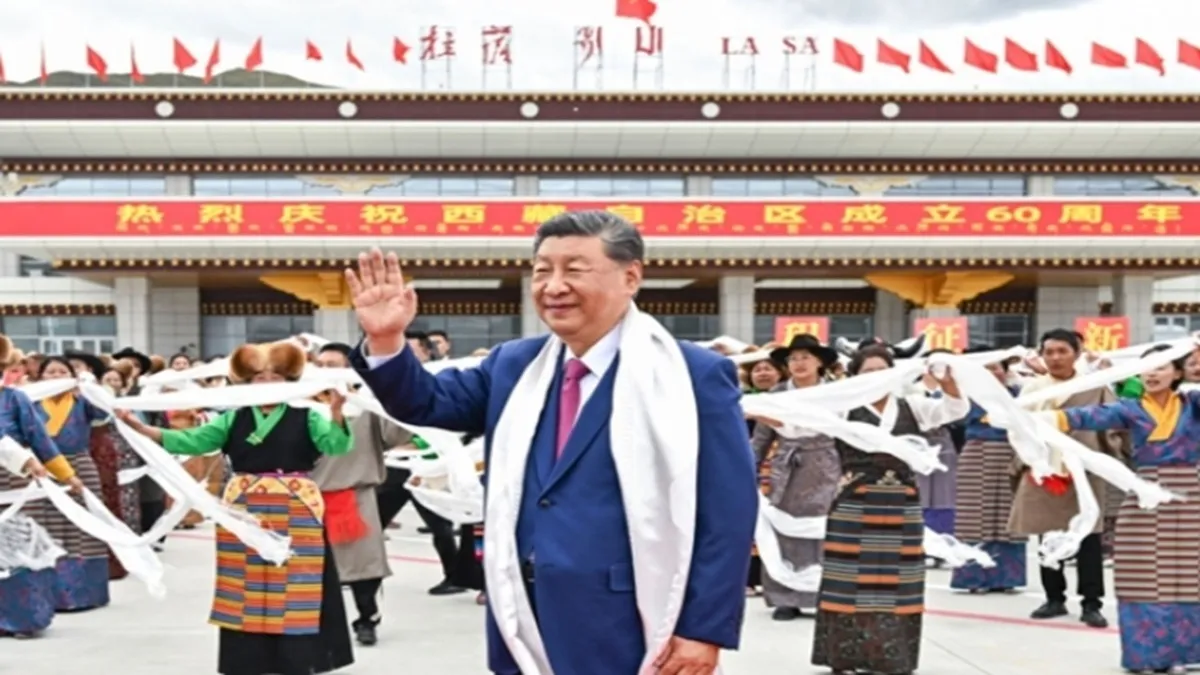
Chinese President Xi Jinping on Thursday made a rare visit to Tibet, stressing Beijing's determination to assert control over the region on its 60th anniversary as a Chinese autonomous region.
Xi Jinping highlights political importance of his visit
While addressing to a crowd of 20,000 in Lhasa, Xi Jinping highlighted the political importance of the visit amid ongoing tensions over the Chinese occupation of Tibet. Even as he did not mention the Dalai Lama, the exiled spiritual leader revered by Tibetans, but said that Tibetan Buddhism needed to change.
In his address to local officials after his arrival, Jinping stressed the importance of upholding the leadership of the ruling Communist Party of China (CPC) over work related to Tibet.
Without referring to the Dalai Lama, Jinping emphasised the need to promote two-way exchanges between Tibet and other parts of China to guide Tibetan Buddhism in adapting itself to socialist society.
Jinping advocates sinicisation of all religions
Since he came to power, Jinping has advocated the sinicisation of all religions including Buddhism and Islam.
Notably, Jinping joined around 20,000 local officials and people from several ethnic groups and walks of life in the celebration, state-run Xinhua news agency reported.
Potala Palace was the traditional winter residence of the Dalai Lamas - Tibetan spiritual leaders - and served as the centre of political and spiritual authority in Tibet for centuries.
The Tibet Autonomous Region (TAR) was officially established by China in 1965 after it annexed the region in 1950. China calls Tibet Xizang.
Dalai Lama with other Tibetans fled to India in 1959
The Dalai Lama, along with a large group of Tibetans fled to India in 1959 and has lived in Himachal Pradesh's Dharamshala ever since.
The monk celebrated his 90th birthday last month during which he said his successor will be chosen by Gaden Phodrang Trust founded by him in 2015.
China has rejected the Dalai Lama's succession, insisting that any future heir must receive its seal of approval.
Jinping arrived in Lhasa on Wednesday, his second visit to Tibet since he came to power in 2012. The visit makes him the only Chinese President to have visited Tibet twice.
Last month, a Chinese Foreign Ministry spokesperson Mao Ning spoke to the media about the sinicisation of religions being advocated by the CPC.
“Sinicisation of religion is not about restricting religious practice; rather, all religions must adapt to the social, cultural and historical context of the country. Tibetan Buddhism in China is a prime example of a religion that has integrated Chinese characteristics, exemplifying the process of sinicisation,” she said.
China’s governance of Tibet has historically raised concerns in the Himalayan region and the world, with human rights groups highlighting restrictions on Tibetan Buddhism and cultural practices, Tibetan language, limitations on religious activities, and stricter security measures which intensified after unrest in 2008.
