
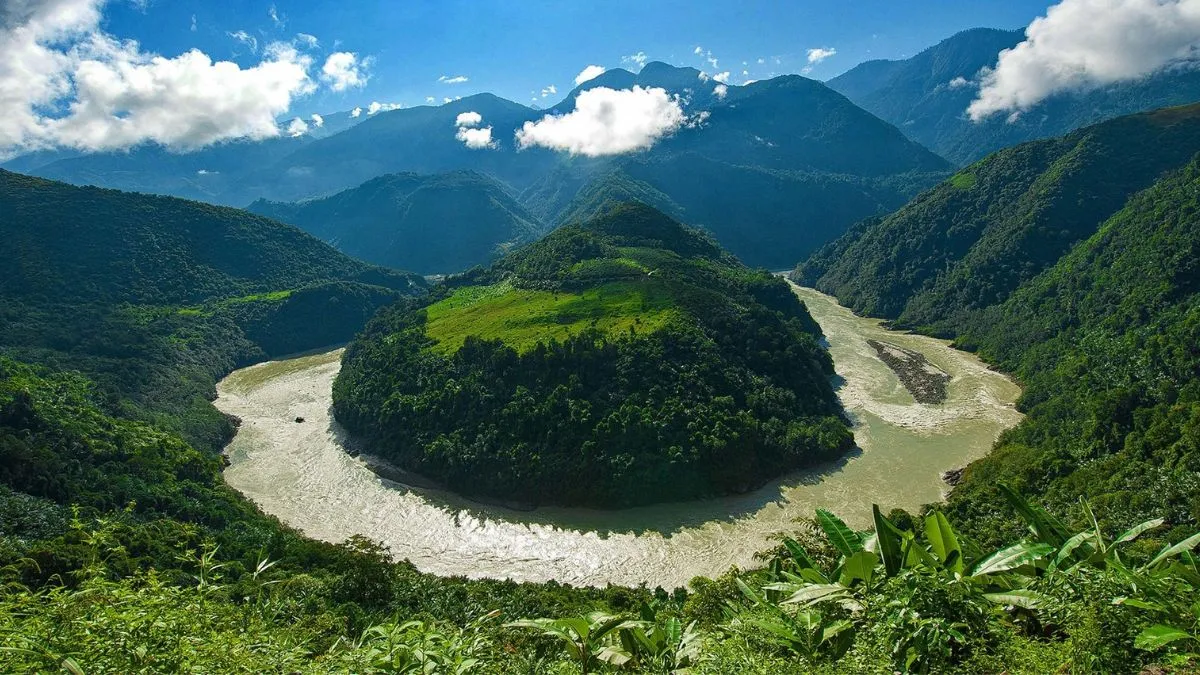
In a major global development, China on Saturday formally began the construction of a USD 167.8 billion dam over the Brahmaputra River in Tibet, close to the Indian border in Arunachal Pradesh.
Chinese Premier Li Qiang announced the start of the construction of the dam at a groundbreaking ceremony in the lower reaches of the Brahmaputra River, locally known as Yarlung Zangbo, at Nyingchi City, official media reported.
The foundation-laying ceremony was held at the site of the Mainling hydropower station in Nyingchi, located in the Tibet Autonomous Region, according to state-run Xinhua news agency.
Project raises concerns in India and Bangladesh
The hydropower project, considered the largest infrastructure initiative globally, has raised concerns in downstream countries India and Bangladesh. According to reports, the project will include five cascade hydropower stations, with a total estimated investment of approximately 1.2 trillion Yuan (around USD 167.8 billion).
A 2023 report stated that the hydropower station is projected to produce over 300 billion kilowatt-hours of electricity annually, sufficient to meet the yearly power needs of more than 300 million people.
Strategic concerns for India
India has raised concerns over China's massive dam project on the Brahmaputra, as it could potentially give Beijing control over the river's water flow. Due to its size and capacity, the dam could also be used to release large volumes of water during times of conflict, posing a flood risk to border regions.
In response, India is constructing its own dam on the Brahmaputra river in Arunachal Pradesh, aiming to manage water resources and ensure a strategic balance.
Trans-border water cooperation
To address issues related to shared rivers, India and China set up the Expert Level Mechanism (ELM) in 2006. Under this framework, China shares hydrological data with India on the Brahmaputra and Sutlej rivers during the flood season.
Data sharing on trans-border rivers was also a topic of discussion during the meeting between Indian National Security Adviser Ajit Doval and Chinese Foreign Minister Wang Yi, held on December 18 last year as part of the Special Representatives (SRs) dialogue on the boundary question.
Geological and engineering challenges
The construction of the Brahmaputra dam poses significant engineering difficulties, as the project site lies on a tectonic plate boundary, an area prone to frequent seismic activity.
The Tibetan Plateau, often called the "roof of the world," is highly vulnerable to earthquakes due to its position over active tectonic plates, further complicating large-scale infrastructure development in the region.
(With PTI inputs)
