
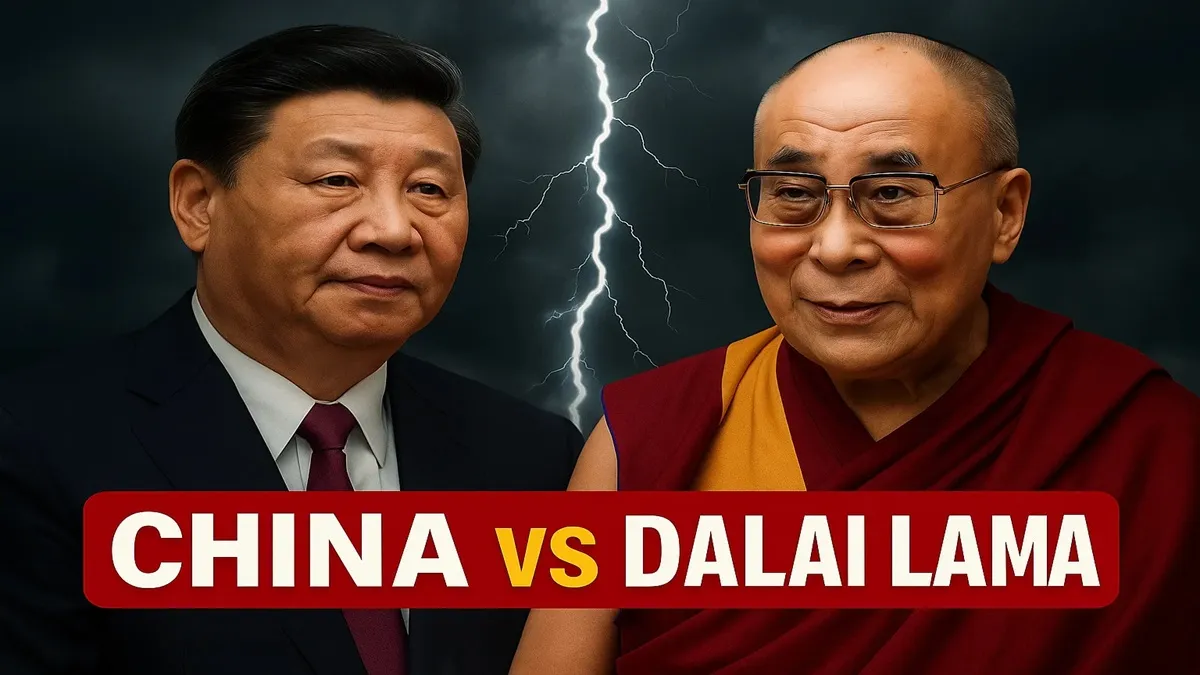
China reiterated on Wednesday that the Dalai Lama's successor must have “Chinese government approval.” The Chinese government has reasserted its claim over the succession of the Dalai Lama, stating that the 15th Dalai Lama must be selected through the Qing dynasty-era “golden urn” method and approved by Beijing. The statement came just hours after the Tibetan spiritual leader reaffirmed that the process of identifying his reincarnation will be guided solely by Tibetan Buddhist traditions, free of political interference.
“The reincarnation of the Dalai Lama, the Panchen Lama and other great Buddhist figures must be chosen by drawing lots from a golden urn, and approved by the central government,” Chinese foreign ministry spokesperson Mao Ning said.
The remarks set the stage for a potential face-off, as the 14th Dalai Lama, who turns 90 on July 6, has declared that the Gaden Phodrang Trust - the official office established by him, will have sole authority in recognising the next Dalai Lama.
What is the ‘golden urn’ method?
The golden urn system dates back to the 18th century, instituted by the Qing dynasty to assert control over Tibetan religious institutions. Names of potential reincarnated lamas are placed inside the urn, and a name is drawn at random.
Tibetan Buddhists have criticised this method as politically motivated and lacking spiritual legitimacy. The current Dalai Lama has repeatedly rejected it, saying the decision must lie with senior Tibetan Buddhist lamas and traditional practices.
Dalai Lama’s instructions: Tradition over politics
In a statement posted on X (formerly Twitter), the Dalai Lama reiterated: “They should consult the various heads of the Tibetan Buddhist traditions and the reliable oath-bound Dharma Protectors who are linked inseparably to the lineage of the Dalai Lamas.”
The Dalai Lama has insisted that his successor must be born outside Chinese territory, suggesting the child could be born in India or another free country. The Gaden Phodrang Trust, which he established in 2015, has been tasked with coordinating the recognition process.
Could there be two Dalai Lamas?
Yes. Many observers believe a scenario of two rival Dalai Lamas - one chosen by Beijing, another by the Tibetan exile community.
A similar precedent was set in 1995 when China abducted Gedhun Choekyi Nyima, the boy recognised by the Dalai Lama as the 11th Panchen Lama. China then appointed its own candidate, who remains widely rejected by Tibetans.
"In future, in case you see two Dalai Lamas come, one from here, in a free country, one chosen by Chinese, then nobody will trust, nobody will respect (the one chosen by China)," the Dalai Lama said in 2019.
Can the next Dalai Lama be a woman?
The Dalai Lama has stated that there is no reason why a woman cannot be recognised as the next reincarnation. The Gaden Phodrang Trust has also acknowledged that gender is not a barrier.
“From a Buddhist point of view, women are fully capable of being reincarnated as spiritual leaders,” he has said on multiple occasions. However, there has never been a female Dalai Lama in the tradition's 600-year history.
Why China wants control over succession
Beijing regards the Dalai Lama as a separatist and sees control over his succession as critical to managing Tibetan nationalism. Chinese law mandates that reincarnated lamas must be approved by the state.
Control over the institution would allow Beijing to dilute the spiritual and political influence of the Tibetan diaspora, especially in India, where the Central Tibetan Administration (CTA) is based.
Global stakes
India hosts the Dalai Lama and the Tibetan government-in-exile in Dharamshala. A China-appointed Dalai Lama could shift the delicate status quo along the India-China border, particularly in Arunachal Pradesh, which Beijing claims as South Tibet.
The United States has backed the Tibetan position. In 2020, the Tibetan Policy and Support Act (TPSA) was passed, affirming that only Tibetan Buddhists have the right to determine their spiritual leader. The Act allows sanctions against Chinese officials who interfere in the succession.
