
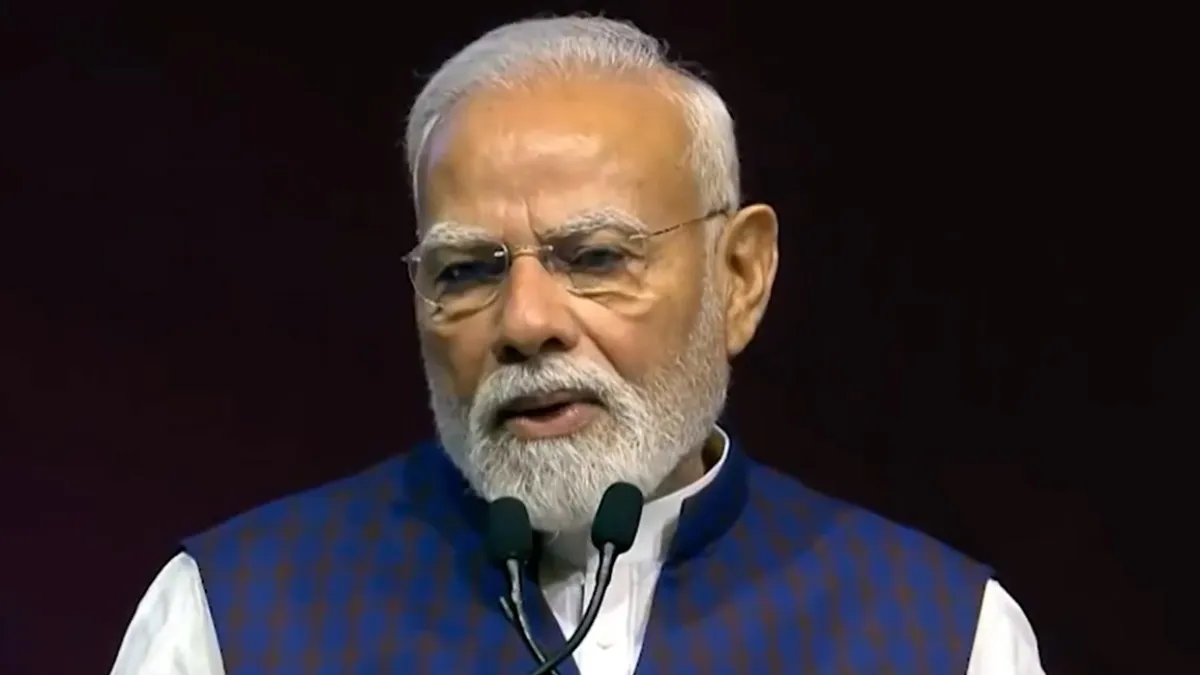
Prime Minister Narendra Modi on Tuesday said India's economy registered a growth of 7.8 per cent in the first quarter of the current financial year, despite "challenges arising from economic selfishness," in an apparent reference to US President Donald Trump's tariffs on Indian goods.
Addressing the Semicon India 2025 conference in Delhi, a day after winding up his trip to China and Japan, PM Modi said the Indian economy performed better than all expectations and estimate, and that nothing can stop the country now.
"Just a few days ago, the GDP numbers for the first quarter of this year have come. Once again, India has performed better than every expectation, every assessment. At a time when there are concerns in the economy of the world, there are challenges created by economic selfishness; in that environment, India has achieved a growth of 7.8 per cent," he said.
Nothing can stop us now: PM Modi
The Prime Minister further said, "India is now moving beyond the backend to become a full-stack semiconductor nation. The day is not far when India's smallest chip will drive the biggest change in the world. Our journey started late, but nothing can stop us now...."
PM Modi began his address with a light-hearted comment, "I returned last night after visiting Japan and China... are you clapping because I went, or because I came back?"
The Prime Minister further said India is emerging as a trusted partner in the global semiconductor ecosystem, and the world is ready to build the future of the industry with India. PM Modi said that day is not far when the world will say: Designed in India, Made in India, and Trusted by World.
Drawing a parallel between past and present, PM Modi remarked, "It is said in the semiconductor world that oil was black gold, but chips are digital diamonds. Our last century was shaped by oil, but the power of the 21st century is limited to a small chip. This chip has the power to accelerate the development of the world," he said.
"In the year 2021, we started the Semicon India program. By the year 2023, India’s first semiconductor plant was approved. In 2024, we approved additional plants. In 2025, we cleared five additional projects. Overall, an investment of more than Rs 1.5 lakh crore is being made in 10 semiconductor projects. This shows the world’s growing trust in India," he said.
"We have implemented the National Single Window System. Through this, all the approvals from the Centre and the states are being received on a single platform. As a result, our investors are now freed from a significant amount of paperwork," the Prime Minister added.
Govt working on next phase of India Semicon Mission: PM Modi
He further said that the government is working on the next phase of India Semiconductor Mission and Design-Linked Incentive Scheme. "We are working on the next phase of the India Semiconductor Mission," Modi said.
PM Modi further said the base of digital infrastructure is critical minerals and the country has started working on the Critical Minerals Mission and is committed to meeting the growing demand for rare earth minerals.
He said that the days are not far when the smallest chip made in India will drive the biggest change in the world. "The government is going to give shape to the new DLI (design-linked incentive) scheme," Modi said.
First made in India chip presented to PM Modi
PM Modi inaugurated the Semicon India 2025, a conference aimed at catalysing India's semiconductor ecosystem, in New Delhi on Tuesday. The three-day conference starting from Tuesday will focus on advancing a robust, resilient and sustainable semiconductor ecosystem in India, it said.
Union IT minister Ashwini Vaishnaw on Tuesday presented the first made-in-India chip to Prime Minister Narendra Modi.
Vaishnaw presented the Vikram 32-bit processor and test chips of four approved projects to PM Modi. Developed by ISRO's Semiconductor Lab, Vikram is India's first fully indigenous 32-bit microprocessor, qualified for use in harsh launch vehicle conditions.
Semiconductors are at the heart of modern technology. They power essential systems in healthcare, transport, communication, defence, and space. As the world moves toward greater digitalisation and automation, semiconductors have become integral to economic security and strategic independence. In just four years, since the launch of the India Semiconductor Mission (ISM) in 2021, India has transformed its semiconductor journey from vision to reality.
