
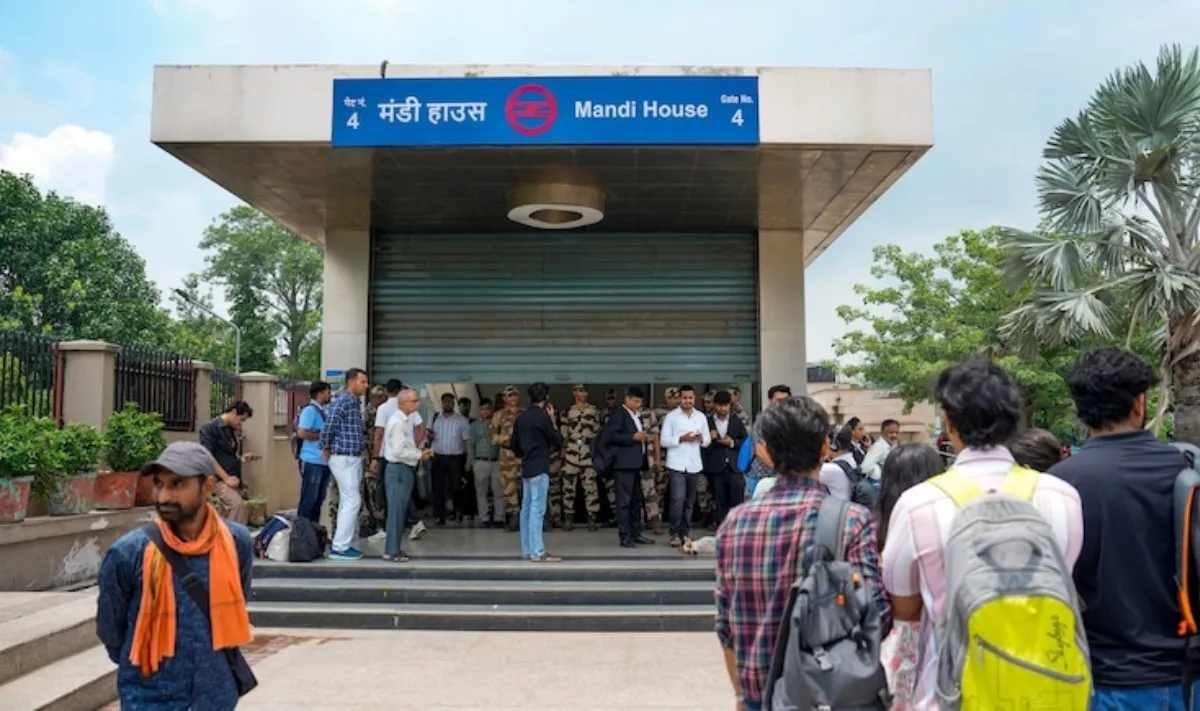
The Supreme Court on Friday asked the Centre to reconsider blanket restrictions on Delhi Metro and railway services ahead of the Cockroach Janata Party's (CJP) October 10 protest, observing that "everything cannot be halted" at the cost of public convenience.
The Cockroach Janta Party (CJP) has announced a protest at Jantar Mantar in Delhi, demanding the resignation of Chief Election Commissioner Gyanesh Kumar for alleged "vote theft.
Public transport services should not be shut down
A bench headed by Chief Justice of India Surya Kant expressed serious concern over the closure of 57 Metro stations and restrictions on train services, saying such measures could cause hardship to millions of commuters travelling from Gurugram, east Delhi, south Delhi and other areas for work.
The court said public transport services should not be shut down entirely and directed the authorities to consider regulated arrangements that would allow services to continue without compromising security.
The Solicitor General assured the bench that he would discuss the matter with the government and concerned authorities to ensure that commuters were not inconvenienced. The court said restrictions should be proportionate to the prevailing situation and that traffic movement must also be ensured.
'Millions depend on Metro for livelihood'
During the hearing, the court was told that 57 Metro stations had been closed. The bench said it was seriously concerned about the impact on ordinary commuters, noting that while some lawyers might travel in private vehicles, many court staff members relied on the Metro.
"Closing facilities such as Metro stations will cause inconvenience to millions of people. We have to look into this," the court observed.
The CJI said commuters should be informed about the locations of barricades and the alternative routes available to them. The bench stressed that people needed clarity about which transport services would be operational and when.
Justice Joymalya Bagchi said the court had taken note of the restrictions on Metro and railway services, adding that road transport must also remain available.
"These things cannot be completely shut down," Justice Bagchi observed, while noting that restrictions could be imposed depending on the situation.
Justice Bagchi: We have noted the points regarding the metro and trains. Road transport arrangements must also be in place; these services cannot be completely shut down.
Solicitor: Sometimes, a complete ban is necessary.
Justice Bagchi: Measures should be taken according to the situation, but a total ban would not be appropriate.
Centre cites security concerns
Solicitor General Tushar Mehta told the court that permission had been granted for a protest on June 20 for one day, but the demonstrators continued their sit-in for 17 days. He also alleged that protesters had attempted to march towards Parliament.
"I wish to state something with full responsibility. Permission for the protest was granted by the police for June 20th. They obtained permission for one day but continued to sit there for 17 days. An attempt was also made to march towards Parliament," he said.
The Solicitor General said more than 200 police personnel were injured while preventing protesters from entering Parliament.
He further alleged that women police personnel had been molested and maintained that the restrictions were necessary to ensure public safety.
He also disputed the suggestion that the entire national capital had been brought to a standstill, saying internet restrictions were limited to specific areas.
Mehta assured the court that he would take up the concerns over public transport restrictions with the authorities and discuss steps to minimise inconvenience.
SC suggests alternative protest venue
The CJI observed that Jantar Mantar's geographical location and limited space posed challenges for organising large protests, suggesting that an alternative venue should be considered. "In our view, there is an issue regarding the geographical location of the protest site (Jantar Mantar). The space is also small; an alternative location should be considered," the court said.
He said inadequate space could affect protesters' fundamental rights by creating difficulties related to food, sanitation and access for ambulances.
The court also emphasised that authorities should issue public advisories explaining traffic restrictions, barricading and alternative routes to help commuters plan their journeys.
Court says hearing focuses on public inconvenience
The bench clarified that it was not considering the merits of the protest itself because no organiser had appeared before it. The court had earlier indicated that organisers could present their submissions, but senior advocates present said they were not representing them.
Advocate Vrinda Grover said she was appearing in her capacity as a citizen and raised concerns about people being warned against attending the protest.
The court said its immediate concern was the inconvenience caused to the public by restrictions on public transport.
It noted that orders concerning Metro and railway services, including an order issued in August under Section 163 of the Bharatiya Nagarik Suraksha Sanhita (BNSS), had been placed before it. The bench was also informed that train services from New Delhi and Hazrat Nizamuddin railway stations had been affected.
The Supreme Court said authorities should reconsider a complete shutdown of Metro stations and railway services ahead of the October 10 demonstrations and instead put in place controlled arrangements that balance security requirements with the public's need for transport.
The Supreme Court has asked the Centre to continue services in a regulated manner so that the general public faces no hardship.
The Court is now discussing the report of the high-powered committee constituted to address issues related to the July protests. According to the report, the committee has commenced its work but requires certain facilities.
The Court has asked the government to cooperate with the committee.
Also Read
INDIA bloc protest LIVE Updates: Opposition MPs to meet at 5 pm at Parliament's central hall
INDIA bloc to meet President Murmu at 8 pm over ECI row as Oppn intensifies 'vote theft' protest