
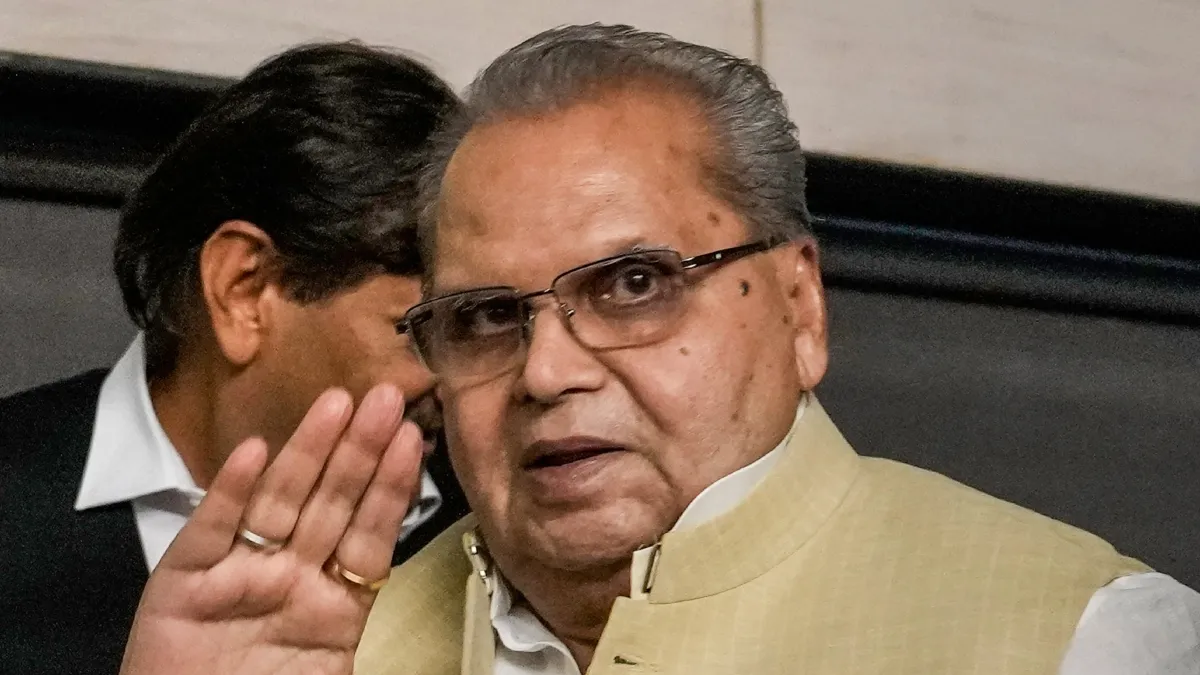
Former Jammu and Kashmir Governor Satya Pal Malik passed away on Tuesday at the age of 79 after a prolonged illness. He died approximately 1:12 pm at the Ram Manohar Lohia Hospital in Delhi, where he was receiving medical treatment for a prolonged illness. A post shared on the official X account informed of Malik's demise.
The former Governor had been admitted to Ram Manohar Lohia Hospital since May 11. He was reportedly suffering from multiple health issues, including leg infection, urinary tract infection, as well as lung and kidney infections.
Satya Pal Malik served as the last Governor of the erstwhile state of Jammu and Kashmir from August 2018 to October 2019, a period marked by a significant moment in India's constitutional history. It was during his tenure that Article 370 was abrogated on 5 August 2019, effectively revoking the special status of Jammu and Kashmir. Today marks the sixth anniversary of that historic decision.
Following his term in Jammu and Kashmir, Malik was appointed Governor of Goa, and later served as the Governor of Meghalaya until October 2022.
A look at the political journey of Satyapal Malik
Satyapal Malik, a prominent Jat leader from Baghpat, known for his outspoken views and fearless voice, passed away, leaving behind a rich legacy spanning decades of public service. His political journey, marked by bold choices and strong convictions, began in 1968–69 when he was elected president of the student union and culminated in the stately corridors of Raj Bhavans across India.
Born in Hisawada village in Uttar Pradesh’s Baghpat district, Malik's political consciousness was shaped by the socialist ideals of Dr Ram Manohar Lohia. In 1965-66, inspired by Lohia's ideology, he stepped into politics. Just a year later, in 1966-67, he was elected president of the Meerut College Students Union, and by 1968-69, he became the president of the Students Union of Meerut University, now known as Chaudhary Charan Singh University.
In 1974, Malik entered mainstream politics, winning the Baghpat Assembly seat on a Bhartiya Kranti Dal ticket and serving as the party’s Chief Whip in the Uttar Pradesh Legislative Assembly. His rise continued as he became the All-India General Secretary of the newly formed Lok Dal in 1975. His parliamentary innings began in 1980 when he was nominated to the Rajya Sabha from the Lok Dal.
Malik's political flexibility was evident as he joined the Indian National Congress in 1984, and was re-elected to the Rajya Sabha in 1986. However, he resigned in protest during the Bofors scam in 1987. He quit both the Rajya Sabha and the Congress Party and founded a new political outfit, Jan Morcha, which later merged with Janata Dal in 1988. Alongside VP Singh, Malik toured the country, addressing public meetings, becoming the voice of the public conscience.
Between 1987 and 1991, he served as Secretary and Spokesperson of Janata Dal. In 1989, he was elected to the Lok Sabha from Aligarh. During this period, he also held significant roles such as being part of the Panel of Chairmen in the Rajya Sabha and the Panel of Speakers in the Lok Sabha. He served as Union Minister of State for Parliamentary Affairs and Tourism from April to November 1990.
In 2004, Malik joined the Bharatiya Janata Party (BJP) and contested from Baghpat. His influence grew steadily in the party, with key roles including Vice President of BJP in Uttar Pradesh (2005-06), All-India In-charge of BJP's Kisan Morcha (2009), and National Vice President of BJP in 2012 and again in 2014. He played a crucial role in shaping the BJP’s 2014 election manifesto on agricultural issues and addressed numerous farmer rallies.
In 2017, he was appointed Governor of Bihar. A year later, in August 2018, he was sworn in as the Governor of Jammu and Kashmir, a tenure that witnessed the historic abrogation of Article 370 and the bifurcation of the state. He held the post during two major events, the revocation of Article 370 in 2019 and the Pulwama terror attack that killed 40 CRPF personnel. After his tenure in Jammu and Kashmir, he also served as Governor of Goa and then Meghalaya.
He also briefly held the charge of Odisha, and later served as the Governor of Goa and Meghalaya.
Also Read: Satyapal Malik, former Jammu and Kashmir governor, dies at 79
Also Read: Amit Shah becomes India's longest-serving Home Minister: Key milestones of his tenure
