
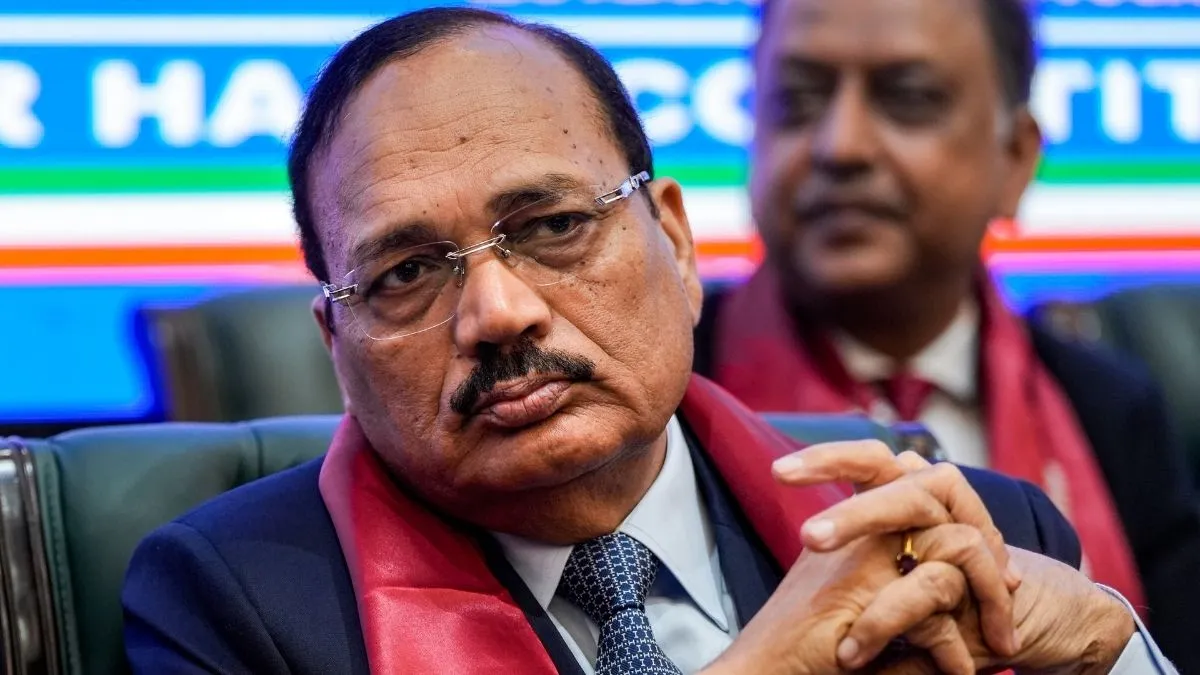
Chief Justice of India Surya Kant has said the Indian judiciary has proactively responded to emerging fraudulent schemes such as digital arrest scams instead of waiting for Parliament to address them.
Speaking at the closing session of the 43rd International Symposium on Economic Crime in London on Saturday, the CJI said the Supreme Court had recently taken suo motu cognisance of the “digital arrest” scam. In such cases, fraudsters allegedly impersonate police officers, judicial officials or bureaucrats over video calls to dupe citizens.
Supreme Court takes suo motu cognisance of digital arrest scams
Justice Kant said that in response to the growing problem, the Supreme Court had directed the Union and state governments to assess its extent. He said the court had also called for the establishment of a distinct offence for digital arrest scams, with penalties proportionate to the harm caused.
According to the CJI, the development reflects a broader pattern of an Indian judiciary that responds to emerging fraudulent schemes rather than waiting for Parliament to address them.
Judiciary's role in economic crime
Justice Kant said India's modern response to economic crime should not be viewed as a single statute but as a layered legal architecture developed over successive decades. He referred to legislation including the Prevention of Money Laundering Act (PMLA), 2002, and the Fugitive Economic Offenders Act, 2018.
However, he noted that these mechanisms were not infallible. He said several individuals had alleged misuse of the PMLA process by investigating authorities, including claims of arrests without articulated reasons and custody being extended beyond what the facts appeared to justify. The CJI said the judiciary had intervened in such cases to rectify the situation.
CJI highlights due process and presumption of innocence
Justice Kant referred to the Supreme Court's verdict holding that grounds for arrest must be provided to an accused in writing rather than merely being read aloud. He also referred to the Arvind Kejriwal versus Central Bureau of Investigation case, a decision he had authored. He said the court upheld the legality of the arrest but granted bail on the principle that prolonged pre-trial detention should not become punishment under another guise.
According to Justice Kant, despite changes in law and technology, the Supreme Court's position has remained consistent on the importance of due process, proportionality and the presumption of innocence.
Parallel recovery proceedings can continue
The CJI also referred to the Insolvency and Bankruptcy Code, 2016, saying it operates alongside criminal proceedings. He said India's justice delivery system had become increasingly comfortable with authorising parallel civil recovery even when a criminal trial remains protracted. Justice Kant also highlighted the role of Mutual Legal Assistance Treaties in recovering assets from other countries. He said such treaties, despite imperfections in their machinery and procedures, bring recovered assets home more reliably than extradition.
CJI cites Kautilya on economic crime
During his address, Justice Kant referred to Indian statesman and teacher Kautilya and his treatise on statecraft, the Arthashastra. He said Kautilya had written in the second century BC about ways in which officials could siphon money from the state treasury.
Justice Kant cited Kautilya's observation comparing an official handling state revenue to someone holding honey or poison on the tip of the tongue, saying it illustrated the difficulty of handling wealth without taking some of it.
Global cooperation needed to tackle illicit wealth
Justice Kant said the nature of illicit wealth and economic crime meant that such activities did not respect national sovereignty. He called for vigilance, cooperation and the rule of law to work together to combat fraud and economic crime. The CJI also highlighted the scale of money laundering globally. He said that if global estimates were even roughly accurate, the amount of money laundered worldwide in a single year would be enough to buy every one of the eight billion people on the planet a modest laptop, with money still left over.
He noted that less than one unit in a hundred of the illicit wealth was recovered, by the most generous estimate. In his concluding remarks, Justice Kant said the success of the symposium should not be measured by how eloquently the problem was described, but by the diligence with which participants worked in their respective jurisdictions to tackle it.
(With inputs from PTI)
Also read:
Supreme Court reconstitutes bench to hear pending petitions challenging landmark 2022 PMLA verdict