
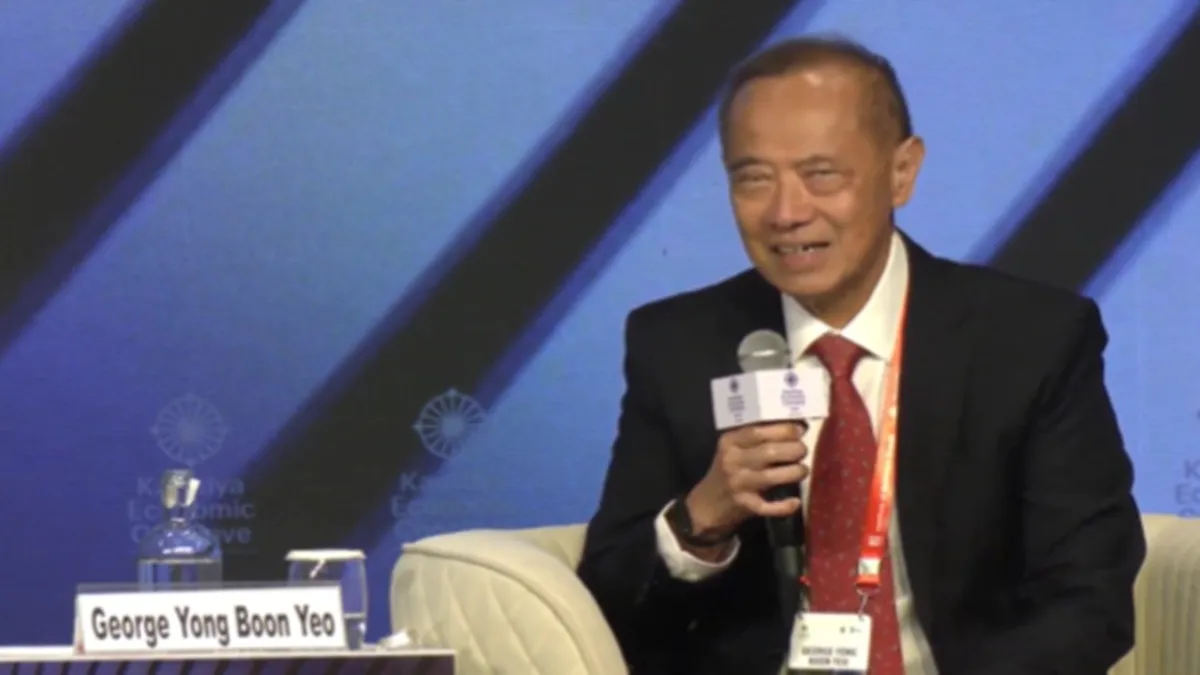
Singapore's former foreign minister George Yeo has highlighted India's diversity, geographical position and centuries of cultural exchanges as factors that make the country particularly familiar and comfortable for foreigners. Speaking with External Affairs Minister S Jaishankar at the 5th Kautilya Economic Conclave in New Delhi on Monday, Yeo said India's long history of interaction with different cultures had created a unique openness towards the outside world. He contrasted this experience with China, where he said foreigners may find it harder to fully understand or settle into the country's social environment.
"India is not threatening to any major powers the way China is. India has positioned itself very well. So other countries wish India well. Southeast Asia wants India to do well. Japan, Europe and the US want India to do well," Yeo stated.
George Yeo explains India's unique global appeal
Yeo said India's location along major maritime routes had exposed the country to different peoples, cultures, ideas and influences over centuries. According to him, this continuous interaction has helped shape India's distinctive social and cultural character. "It's not easy, I think, for foreigners to fully understand China, whereas India... has always been where the winds blew six months in one direction, six months in the other," Yeo said.
He said the movement of people, spices, cultures and ideas across the Indian Ocean had played an important role in shaping India's diversity. "India, in a sense, reflects the diversity of the world all around the Indian Ocean rim, and it gives people a sense of comfort, of familiarity when they come to India, in the way which they may not feel when they go to China," Yeo said. Yeo further described the contrast by saying foreigners in China could feel like "a foreigner in the homogeneous sea. In India, you can always find niches, comfort zones for yourself," he added.
India positioned to benefit from changing global order
Yeo's comments were not limited to India's cultural diversity or its appeal to foreign visitors. He also linked the country's openness and diversity to its broader position in the evolving global order. He said India had positioned itself well at a time when countries were dealing with increasing geopolitical competition and uncertainty. Its ability to maintain relationships with different major powers while expanding its economic presence, he suggested, could work to its advantage.
Yeo also pointed to India's large domestic market and strategic importance. Countries around the world, he said, have reasons to want India to succeed because of the country's growing economic and geopolitical significance. India's size, diversity and engagement with the outside world could therefore become important advantages as global power equations continue to change.
Jaishankar calls current period an 'age of flux'
Jaishankar, who participated in the same discussion, described the present international environment as an "age of flux", marked by geopolitical tensions, conflicts and economic uncertainty. "We know that this is going to be an age of flux, as you call it. And it is going to be turbulent and volatile, with uncertainties," Jaishankar said.
The External Affairs Minister pointed to ongoing conflicts and economic pressures, along with challenges related to energy, food and fertilisers. He said these uncertainties needed to be taken into account while India planned its response to a rapidly changing global environment. "These are choppy waters," Jaishankar said, while expressing confidence that India would be able to navigate the challenges ahead.
Also Read:
