
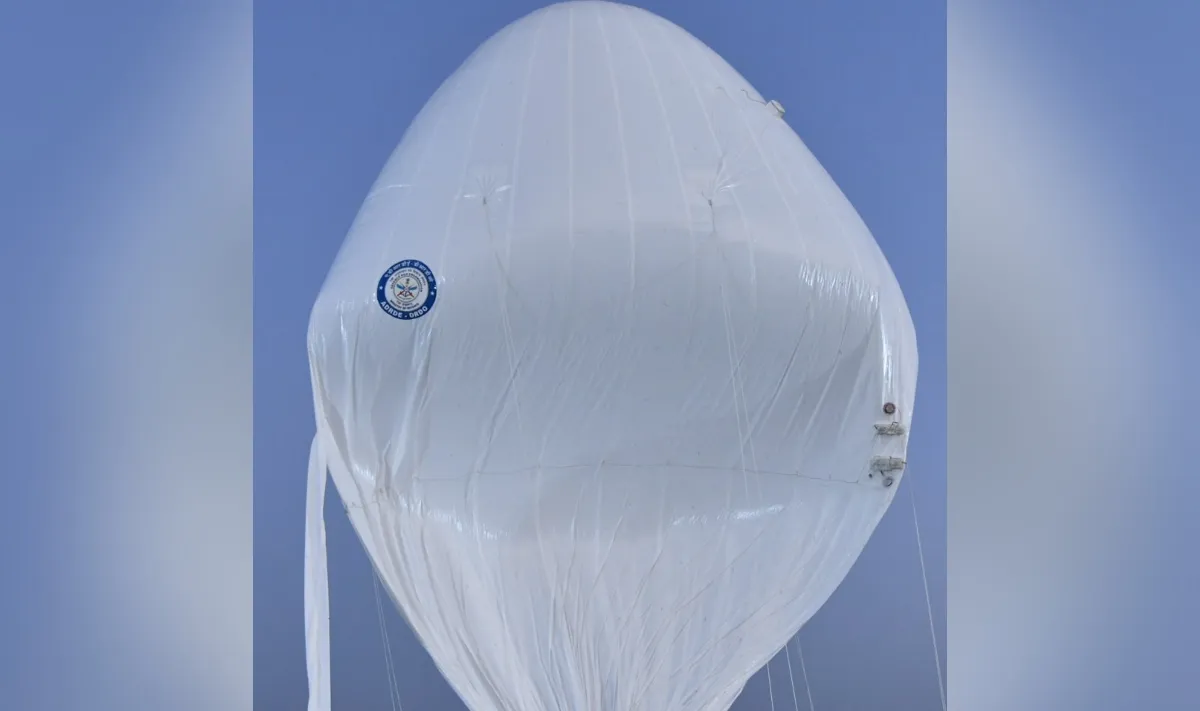
Defence Research and Development Organisation (DRDO) has carried out the successful flight trial of an indigenously developed High-Altitude Platform (HAPS). The experimental flight attained an altitude of 21 km above mean sea level (AMSL) and remained at an altitude of 20 km AMSL for more than 30 minutes before it was commanded to descend back to the ground. The system was successfully recovered, and flight performance data was analyzed.
The real-time video data and all other vehicle parameters were acquired from the airborne platform at the ground control station during the entire flight, which showed the intended flight performance. The system carried various instrumentation and control electronic packages like an inertial measurement unit, global positioning system receiver, onboard cameras, altitude control mechanism, besides various other sub-systems. The trial was conducted in coordination with various agencies, namely Indian Air Force (IAF), Centre for Military Airworthiness and Certification (CEMILAC), Directorate General of Civil Aviation (DGCA), Airports Authority of India (AAI) and other civil authorities.
The High-Altitude Platform, a lighter-than-air system as a long-endurance stratospheric aerial surveillance platform, is being designed and developed by Aerial Delivery Research and Development Establishment (ADRDE) in Agra.
Defence Minister Rajnath Singh has complimented DRDO, IAF, PSUs and Industry on the successful flight trial of the High-Altitude Platform and stated that the successful trial is an important milestone in India's Aatmanirbhar Bharat journey towards realizing a long-endurance stratospheric Airship.
Defence Secretary and Secretary, Department of Defence R&D and Chairman, DRDO Rajesh Kumar Singh also congratulated the teams associated with the flight trial of the high-altitude airship platform.
DRDO conducts maiden AHAP live jump at 16,000 feet
DRDO also conducted the maiden live jump of the Advanced High-Altitude Parachute (AHAP) at one of the highest-altitude drop zones, Nyoma (Mudh DZ).
The jump was executed at 16,000 feet above mean sea level (AMSL). The parachute was deployed at 15500 feet AMSL, and landing was undertaken at Nyoma (Mudh DZ), which is at 13,700 feet. The jump proved the efficacy and tactical employability of the AHAP parachute at extremely high-altitude terrain.
Designed and developed by Aerial Delivery Research and Development Establishment (ADRDE), Agra, AHAP is a static line parachute system for mass drop of paratroopers. The system has been manufactured by Ordnance Parachute Factory (OPF), Kanpur, inspected by DGAQA, and certified by CEMILAC, RCMA, Kanpur.
AHAP offers various deployment modes, has a very wide operational altitude range (up to 18000 ft), and has the safest rate of descent, especially suited for the tactical requirements of the Indian Defence Forces for high-altitude terrains. Static line parachute jumps at these high altitudes are complex and inherently risky owing to very high opening shock and rate of descent.
Also Read
Defence Ministry signs Rs 661 crore deal for BrahMos Fire System, Launchers for Navy ships
Navy sailor arrested for leaking classified defence data to Pakistani operative, was 'honey trapped'
