
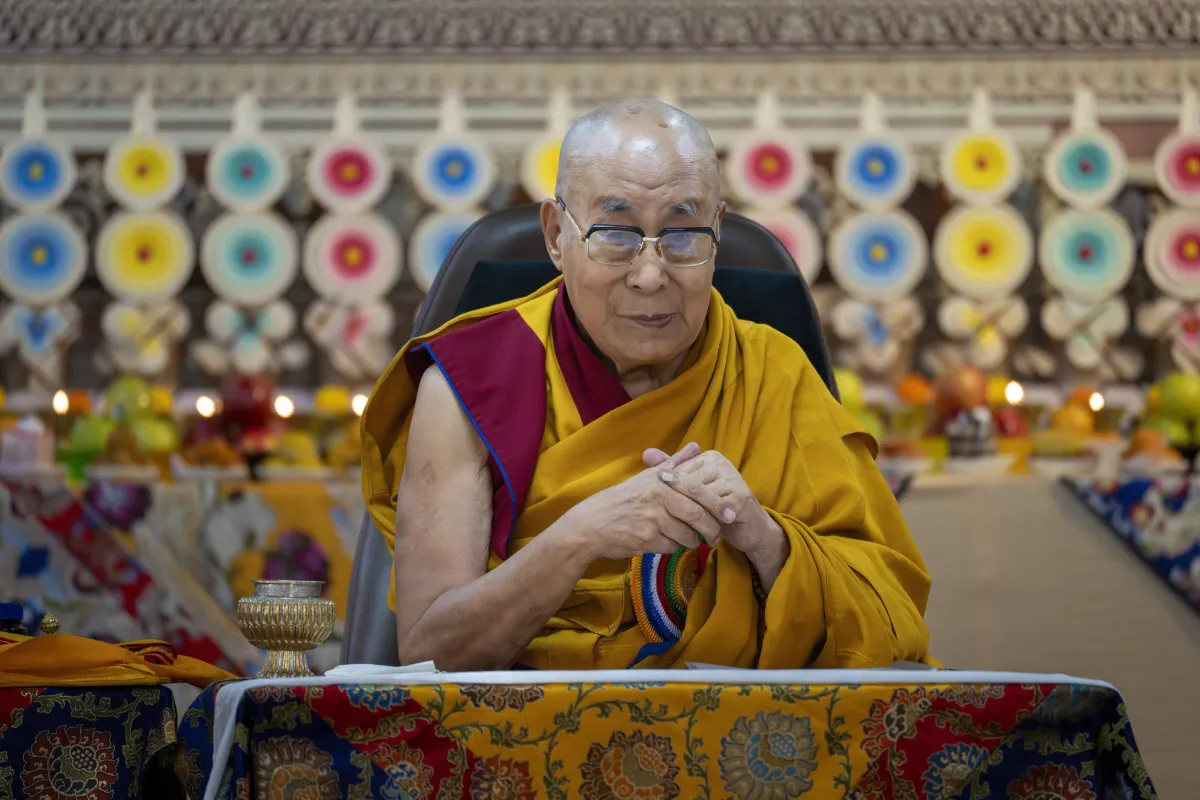
As the Dalai Lama turns 90 on July 6, celebrations are underway in McLeodganj, Dharamshala. But this milestone also carries global significance, not just for Tibetan Buddhists, but for China, India, the US and beyond. Not just because of the occasion, but because of what the Dalai Lama may say about his succession. For over a decade, he has suggested that his 90th birthday would be the moment to address the future of his spiritual office. With his latest statement hinting that the institution will continue "under some kind of a framework," the question now is whether he will reveal how the next Dalai Lama will be chosen and from where.
Who is the Dalai Lama?
The Dalai Lama is the highest spiritual figure in Tibetan Buddhism and is considered the human embodiment of Avalokiteshvara, the Bodhisattva of Compassion. The current and 14th Dalai Lama, Tenzin Gyatso, was born in 1935 in Amdo (now in China's Qinghai province). He was identified as a reincarnation at age two and officially installed in Lhasa in 1940. Dalai Lamas have historically held both spiritual and political authority in Tibet. That changed after China took control of the region in 1950. He has lived in exile in Dharamshala ever since, serving as both the spiritual leader of Tibetan Buddhists and the global face of their resistance to Chinese control.
Where is the Dalai Lama currently?
The Dalai Lama currently resides in McLeod Ganj, a suburb of Dharamshala in Himachal Pradesh, India. He has lived there in exile since 1959, after fleeing Tibet following a failed uprising against Chinese rule. His residence in Dharamshala has become the centre of the Tibetan government-in-exile and a global hub for Tibetan Buddhism.

Why is his 90th birthday so important?
In 2011, the Dalai Lama said he would consult senior monks and the Tibetan people about whether the institution of the Dalai Lama should continue and if so, how the next reincarnation should be recognised. In a recent statement ahead of his 90th birthday, he said the institution will continue under "some kind of a framework." This week, a major Buddhist conference is being held in Dharamshala from 2 to 4 July, and a video message from the Dalai Lama is expected. It may lay out new guidelines or a succession plan. Given rising concerns that China may attempt to impose its own choice, the timing and content of this announcement are critical.
What is the traditional process of choosing a Dalai Lama?
Traditionally, the selection of a new Dalai Lama is a sacred and complex process rooted in Tibetan Buddhist belief in reincarnation. After a Dalai Lama dies, senior monks look for signs, visions and omens. They study the direction of smoke from cremation, consult oracles, and interpret dreams. Often, the search centres on Lhamo La-Tso, a sacred lake believed to provide visions about the next reincarnation's location. Once a potential child is found, he is tested by being asked to identify objects, some of which belonged to the late Dalai Lama. Correct identification is taken as spiritual confirmation. This process is spiritual, symbolic, and deeply tied to Tibetan tradition.
How was the current Dalai Lama chosen?
The current Dalai Lama was discovered in this way. After the 13th Dalai Lama's body was laid in state, monks noted the direction his head had turned. A vision at Lhamo La-Tso led them to Taktser village, where a two-year-old boy named Lhamo Thondup correctly identified items belonging to the previous Dalai Lama. He was recognised and installed as the 14th Dalai Lama, later named Tenzin Gyatso. But replicating this process today faces a major challenge: Chinese interference.
Could China choose its own Dalai Lama?
Beijing has declared that the selection of the next Dalai Lama must comply with Chinese law. In 2007, the State Religious Affairs Bureau issued Order No. 5, asserting the Communist Party's authority over all Tibetan Buddhist reincarnations. The Chinese government insists on using the Golden Urn method, a Qing dynasty lottery-like ritual to approve the next reincarnation. Officials claim this is based on historical precedent, though in reality the method was used only sporadically and not for the current Dalai Lama. China's goal is clear: control the next spiritual leader to weaken the Tibetan movement.
Why are Tibetans worried?
In 1995, the Dalai Lama recognised a six-year-old boy named Gedhun Choekyi Nyima as the 11th Panchen Lama, a key spiritual figure second only to the Dalai Lama. Days later, the boy vanished. He has not been seen since. China later installed its own Panchen Lama, Gyaltsen Norbu, who is now being positioned to play a larger role in Tibetan Buddhism. In June 2025, President Xi Jinping met Norbu in Beijing and spoke of shaping religions to fit "Chinese characteristics". The Panchen Lama precedent shows how China could attempt to repeat the same with the Dalai Lama's succession.
What has the Dalai Lama said about his successor?
The Dalai Lama has made several strong public statements. In a 2004 interview with TIME, he said, "My life is outside Tibet, therefore my reincarnation will logically be found outside." In 2011, he warned that the reincarnation system could be misused for political gain. In his 2025 book Voice for the Voiceless, he declared that the next Dalai Lama "would be born in the free world," and urged Tibetans not to accept any candidate imposed for political ends, including one chosen by the Chinese government.
Has a Dalai Lama ever been born outside Tibet?
There are two historical precedents for Dalai Lamas being born outside Tibet. The 4th Dalai Lama, Yonten Gyatso, was born in Mongolia in 1589. The 6th Dalai Lama, Tsangyang Gyatso, was born in what is now Arunachal Pradesh, India. Both were recognised and accepted within the traditional system. This undermines China's claim that the next Dalai Lama must be born within its borders.
Why does this matter globally?
For India, the Dalai Lama's presence has geopolitical value. India hosts over 1,00,000 Tibetan refugees and is home to the Tibetan government-in-exile. His spiritual stature lends India moral weight in its dealings with China, especially amid ongoing tensions along the Line of Actual Control. A succession struggle that spills across borders would inevitably impact India's internal politics, especially in Himalayan states with large Tibetan Buddhist populations.
The United States, too, has taken an active interest. Last year, US lawmakers passed the Tibet Dispute Act, calling for direct dialogue between China and the Dalai Lama's representatives. President Biden reaffirmed that the US would not recognise any Beijing-appointed Dalai Lama. Washington sees Tibet as a human rights and religious freedom issue, and China's attempts to politicise religious succession could become a flashpoint in broader US-China relations.