
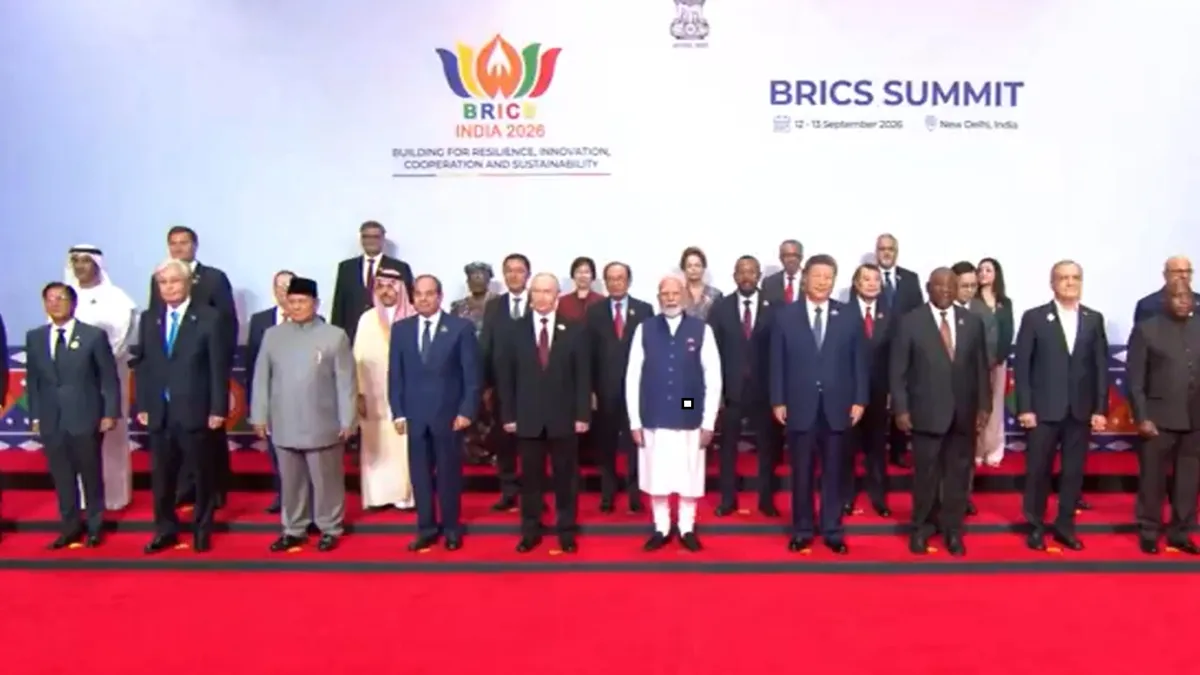
The two-day BRICS Summit on Sunday concluded successfully, with the bloc unanimously adopting the New Delhi Declaration and Prime Minister Narendra Modi thanking all the leaders for ensuring that the summit was "very productive and outcome oriented".
During his address at the summit, PM Modi flagged concerns over rising global conflicts and urged the bloc to work together to mitigate their far-reaching impact on ordinary lives. He also called for dialogue and diplomacy to resolve all global and regional conflicts.
"We may be rooted in different realities, but together, we rise through cooperation and blossom for humanity. May our diversity be our identity, our cooperation our inspiration, and our progress serve all of humanity," he said in presence of top leaders of the grouping including Chinese President Xi Jinping, Russian President Vladimir Putin and Iranian President Masoud Pezeshkian.
He said that with the support of BRICS member countries, India had translated the grouping's shared vision into 'win-win collaboration'.
On Saturday, the BRICS Summit adopted a joint declaration by consensus after overcoming sharp differences between the United Arab Emirates and Iran over the West Asia conflict. The declaration notably avoided any direct reference to the US over its attacks on Iran.
In the New Delhi Declaration, the BRICS leaders appeared to endorse India's call for ending the conflict through "dialogue and diplomacy" while stressing the need for collective efforts to ensure the smooth flow of global trade, supply chains, and energy in accordance with "applicable" international law.
BRICS, comprising Brazil, Russia, India, China and South Africa, expanded in 2024 to include Egypt, Ethiopia, Iran, the UAE and Saudi Arabia, with Indonesia joining in 2025. Belarus, Bolivia, Kazakhstan, Cuba, Malaysia, Nigeria, Thailand, Uganda, Uzbekistan and Vietnam became BRICS partner countries last year.