
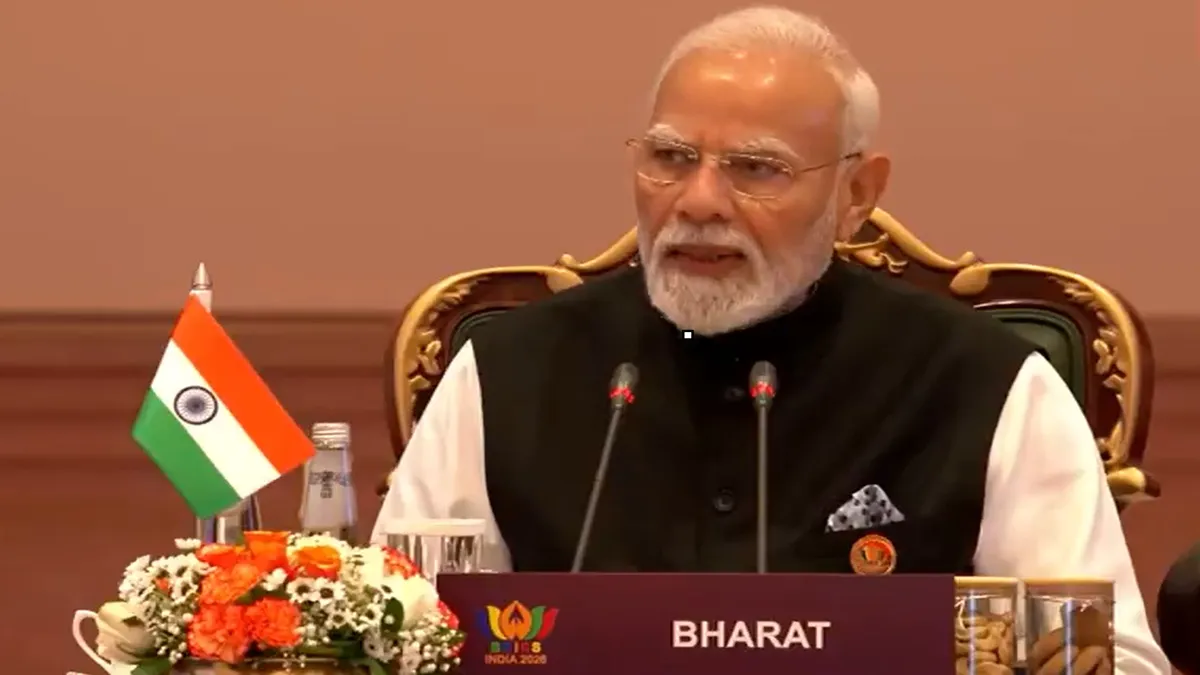
In a significant diplomatic breakthrough, BRICS countries have reached consensus on a Joint Statement after intensive negotiations that continued until 4 AM. The negotiations saw differences on several contentious issues. India led sustained consultations to bridge competing positions and build consensus among members. The breakthrough assumes particular significance given that Iran, Saudi Arabia, and the UAE are all part of the same forum, despite deep differences and competing positions on several regional and geopolitical issues.
Against the backdrop of ongoing conflicts and heightened tensions in West Asia, securing consensus among countries such as Iran, Saudi Arabia, and the UAE presented a particularly complex diplomatic challenge. India’s diplomatic prowess ensured that these differences did not derail the BRICS process, paving the way for a consensus Joint Statement despite sharply divergent geopolitical positions among member countries.
PM Modi welcomes guests at inaugural session of BRICS Summit 2026
Ahead of the inaugural session of BRICS Summit 2026, PM Modi earlier in the day welcomed Brazilian Foreign Affairs Minister Mauro Vieira at Bharat Mandapam, the venue for the BRICS Summit 2026 under the chairship of India.
Apart from him, PM Modi also welcomed Prime Minister of Ethiopia, Abiy Ahmed Ali, Iranian President Masoud Pezeshkian, Crown Prince of Abu Dhabi Sheikh Khaled bin Mohamed bin Zayed Al Nahyan and Indonesia President Prabowo Subianto at the venue.
Participating leaders to hold a joint session later in the day
Later in the day, all these participating world leaders representing the BRICS nations at the summit will hold a closed session on "Inclusive Global Governance and Strengthening Multilateralism" at the Summit Hall.
It should be noted that India is hosting the 18th BRICS Summit in New Delhi on September 12-13 and India's Chairship has been guided by the theme “Building for Resilience, Innovation, Cooperation and Sustainability”, with development, sustainability and innovation forming key areas of focus.
It is significant to note that the BRICS grouping has emerged as an important platform for coordination among major emerging economies and for advancing the interests of the Global South in multilateral institutions. The main agenda of BRICS covers development, finance, technology, trade and people-to-people exchanges. This grouping right now comprises 11 countries -- Brazil, China, Egypt, Ethiopia, India, Indonesia, Iran, Russia, Saudi Arabia, South Africa and the UAE.
Also Read:
Ahead of PM Modi-Xi meet, China calls for managing differences, boosting BRICS cooperation