
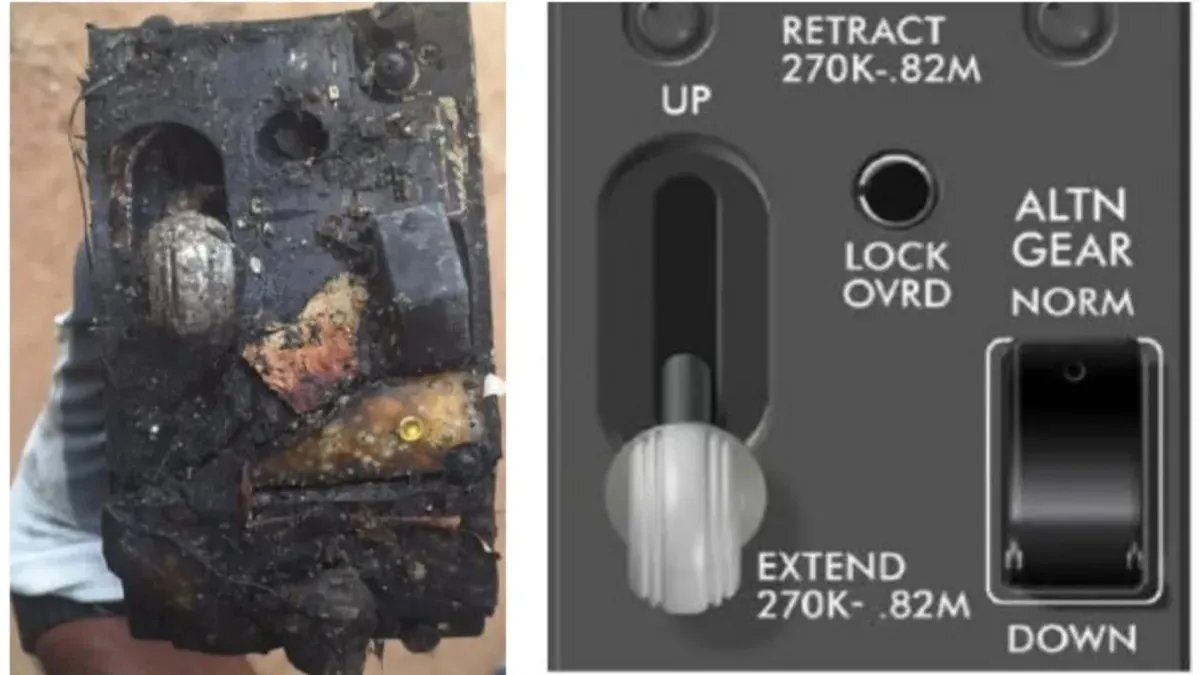
Almost a month after the tragic Air India plane crash in Ahmedabad, the Aircraft Accident Investigation Bureau (AAIB) released its preliminary report, revealing critical cockpit voice recordings and technical findings. One notable detail from the report is a photograph taken after the crash showing the aircraft’s landing gear lever in the "DOWN" position. This has sparked curiosity and concern about the implications of this setting at the time of the crash.
What is a landing gear lever?
The landing gear lever is a crucial control mechanism in an aircraft’s cockpit that operates the aircraft’s landing gear system. This system includes the wheels, struts, and other components that support the aircraft during takeoff, landing, and ground movements (taxiing). The lever can be set to two main positions: "DOWN" (gear extended) and "UP" (gear retracted).
What does the "DOWN" position indicate?
When the landing gear lever is in the "DOWN" position, it signals that the landing gear is fully extended and locked. This is typically the configuration during takeoff and landing when the aircraft needs support from its wheels while on the runway. It also allows the plane to taxi safely on the ground.
Why the lever's position matters after takeoff
Normally, pilots retract the landing gear shortly after the aircraft lifts off to reduce aerodynamic drag and improve fuel efficiency. If the landing gear remains extended after takeoff, it could point to an operational oversight or a technical issue. Leaving the gear down unnecessarily could hinder the aircraft’s climb performance and speed, and may affect fuel consumption.
In rare cases, if the pilot forgets to retract the gear or a mechanical malfunction prevents it, it can contribute to complications during flight, especially if compounded by other technical failures, as was the case with the AI171 crash, which involved engine shutdowns shortly after liftoff.
Conclusion: A critical technical detail in focus
The fact that the landing gear lever was still in the "DOWN" position at the time of the crash is now under scrutiny. Whether it was a result of pilot action, a technical delay, or a procedural oversight remains unclear. Investigators are likely to assess whether this setting played a role in the aircraft's failure to regain altitude after its engines lost power seconds after takeoff.
Here are some related stories of Air India plane crash: