
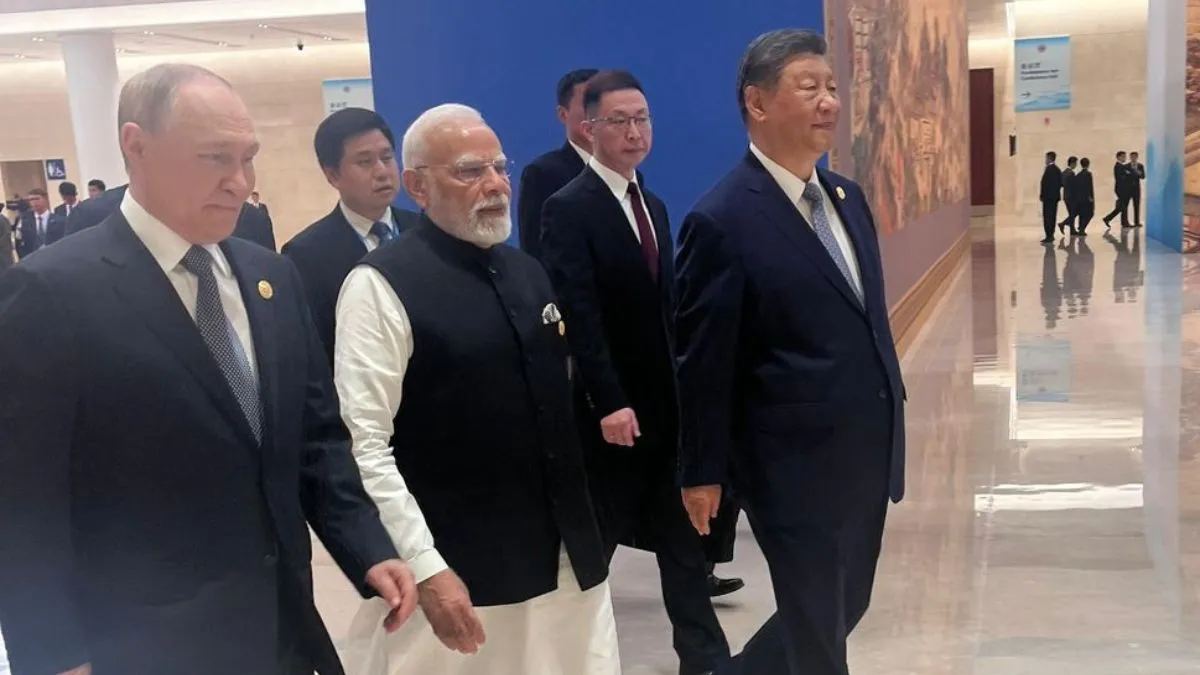
"A picture is worth a thousand words." True to this adage, when Prime Minister Narendra Modi's photograph with Chinese President Xi Jinping and Russian leader Vladimir Putin was clicked during the Shanghai Cooperation Organisation (SCO) Summit in Tianjin, it was indeed a message to the United States (US) – that New Delhi will not get bogged down by the Trump tariffs.
When President Trump announced his decision to impose 50 per cent tariffs on New Delhi for procuring Russian crude and the trade imbalance between India and the US, he must have thought that India would succumb to the pressure and start reducing its dependency on Moscow. However, the exact opposite happened, and his move helped India find an unexpected ally in China, which openly came out in support of New Delhi.
And with PM Modi attending the SCO Summit in Tianjin and holding a bilateral meeting with Xi and Putin, it further intensified one of the West's worst fears – the revival of the RIC troika, a concept that was conceptualised in the 90s by former Russian Prime Minister Yevgeny Primakov.
What is the RIC troika?
Designed as a strategic alignment against the Western hegemony, the RIC troika has a simple concept – promote a multipolar world. It has also held around 20 ministerial-level consultations since the early 2000s.
Although India and China have been sceptical about it, the camaraderie that was seen between Modi, Xi, and Putin during the recent SCO Summit could lead to the revival of the RIC troika, as the US continues to show its assertiveness.
Speaking to India TV Digital, Anil Wadhwa, former Secretary at the Ministry of External Affairs (MEA), said the camaraderie between Modi, Xi, and Putin at the SCO Summit shows that India, China, and Russia have an "alternate world view as opposed to the Trump and Western world view".
He stressed that India, China, and Russia can come together for self-interest if required. "As far as India is concerned, it shows India's clear preference for strategic autonomy and exploring all options and groupings to shore up its economy and development," he said.
"The meeting was held in the context of the SCO grouping, and nothing more should be read into it."
Meanwhile, Brigadier Arun Sahgal (Retd) – Founder Director of the Office of Net Assessment, Indian Integrated Defence Staff (IDS) – told India TV Digital that Modi, Xi, and Putin's camaraderie indicates New Delhi's multiple strategic choices. "There are a couple of messages. First, the emergence of new global realignments in the form of the Eurasian Bloc, which dominates the continental landmass of Asia and Eurasia, comprising three major economies, military and nuclear powers," he noted.
China: A friend or foe to India?
For someone who has an interest in geopolitics in India, China needs no introduction. It has been a rival of India since the 1960s. The two countries also fought a full-fledged war in 1962, apart from skirmishes in 1967 and the infamous 2020 Galwan Valley clash.
However, in geopolitics, there's a common saying – "There are no permanent friends or permanent enemies, only permanent interests." The Indian leadership, including Defence Minister Rajnath Singh and External Affairs Minister (EAM) Dr S Jaishankar, has been advocating for this since Trump imposed tariffs, hinting it is ready to improve ties with China.
Speaking to India TV Digital about India-China relations, Wadhwa said the two nations have differences because of an unsettled border. China also considers India as its rival in South Asia, and thus, wants to maintain its supremacy "by whatever means it can", he feels.
"The India-China adjustment can be considered tactical. Any long-term rapprochement between them will depend on the sound management of the. Order and movement towards de-escalation after disengagement and eventually a resolution to the border issue," Wadhwa told India TV Digital.
"It will also depend on the willingness of China to accommodate its requirements like magnets for the auto industry, APIs, speciality fertilisers, and tunnel boring machines, and changing its stance on actively and militarily supporting Pakistan in military conflict with India," he noted.
Brigadier Sahgal, meanwhile, pointed out that two big powers will always have contested relations, adding that India needs to recognise the asymmetry of economic and military power. "Require a twin-track strategy – work on boundary resolution, and along with that, increase trade, investment, etc. USD 400-500 billion in trade will create mutual dependencies," he said.
"It will also help in dealing with the US and Europe, as this will become strong leverage. The US will not be able to coerce us. Equally in the region, it will help undermine Pakistan's Chinese influence."
Can India diversify its trade to Russia and China after Trump tariffs?
Trump has regularly targeted India over trade between the two countries. He has claimed that India does a lot of trade with the US, but the latter does hardly any trade with the former. However, the US President's claim seems to be incorrect, as Washington enjoys a USD 35-40 billion surplus "once all earnings are counted", according to data by the Global Trade Research Initiative (GTRI).
The report claimed that the US generates more earnings from India than India does from the US. Even though the US has a USD 45 billion trade deficit with India, it maintains a positive surplus of USD 35-40 billion, the GTRI report claimed.
However, with Trump imposing tariffs on India, questions are being raised about whether New Delhi can diversify its trade to Moscow and Beijing. According to Wadhwa, the labour-intensive exports to the US cannot be easily diverted to China since the latter itself is a competitor in these goods. He said trade with China is based on primary commodities, just a few items that Beijing does.
"These items, however, could find a market in Russia, but given its current preoccupation with the war on Ukraine and the disposition of its population as well as its buying power, these opportunities are limited and will take time to fructify," he told India TV Digital, adding that India will have to look at diverse markets to compensate for the huge US market for its labour-intensive exports.
About India's trade with China and Russia
According to the data available on the Indian Embassy in China's website, India's export to China stood at USD 14.25 billion in 2024-25. Meanwhile, India's imports were USD 113.46 billion, and New Delhi's trade deficit stands at USD 99.21 billion.
Meanwhile, the bilateral trade between India and Russia during FY25 amounted to USD 68.72 billion. Indian exports amounted to USD 4.88 billion, while imports from Russia amounted to USD 63.84 billion, according to the India Brand Equity Foundation (IBEF).
Also Read - SCO Summit: Xi, Putin and Modi to meet – how does the Russia-India-China troika redraw the global order?
