
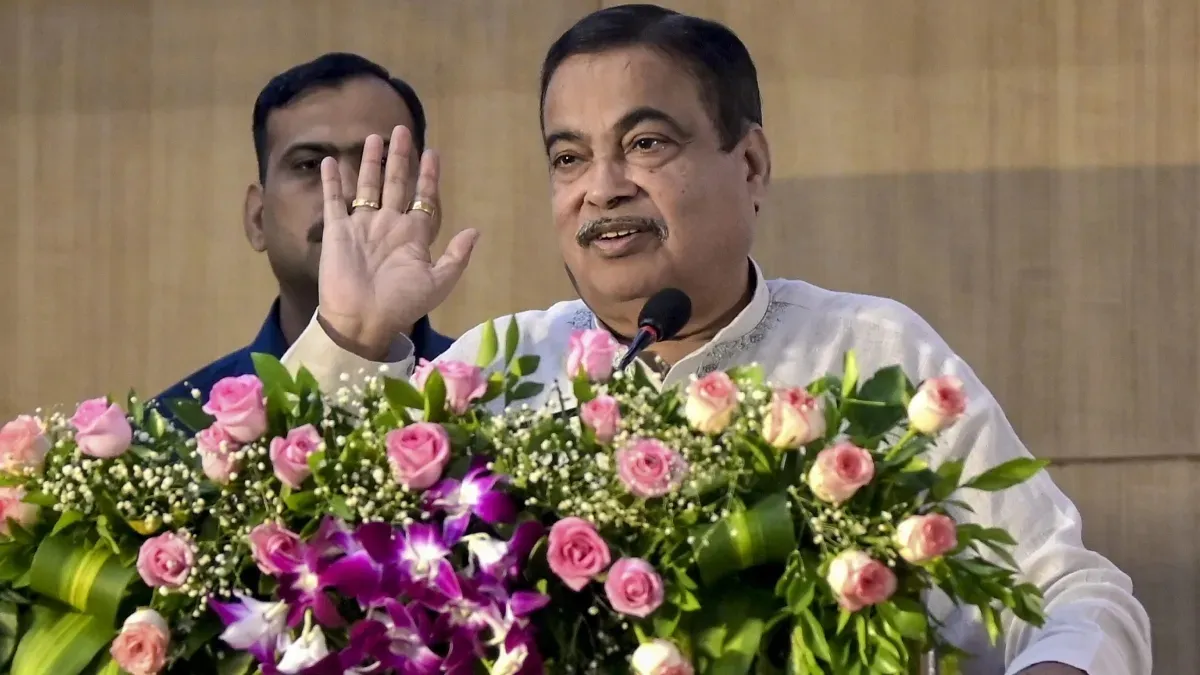
Union Minister for Road Transport and Highways Nitin Gadkari arrived nearly an hour late for the 22nd Indo-American Corporate Excellence Awards ceremony in Mumbai, attributing the delay to heavy traffic and joking that he was 'paying for his mistake'. He highlighted the need to replace ageing flyovers and adopt advanced construction technology to tackle Mumbai's growing traffic congestion.
Need tech for better infrastructure
Addressing the gathering, Gadkari said he had been stuck in traffic for nearly an hour while travelling from Worli to the hotel where the event was being held. "Today I got late by an hour to reach here for this programme because I got stuck in the traffic from Worli to this hotel. It took me one extra hour," Gadkari said.
Reflecting on Mumbai's traffic problems, Gadkari recalled that between 1992 and 2000, he had facilitated projects including 55 flyovers, the Bandra-Worli Sea Link and the Mumbai-Pune Expressway. He said these projects were necessary at the time, but newer technologies and approaches were now needed to address the city's evolving traffic challenges.
"But that is actually me paying for my mistake," he said, drawing laughter from the audience. "From 1992-2000, I got a chance to construct 55 flyovers, the Bandra-Worli Sea Link and the Mumbai-Pune Expressway, but at that time this technology was not available," he added.
Gadkari remarked that construction technology had advanced significantly and suggested building multi-level flyovers to ease bottlenecks caused by existing infrastructure. He said roads at different levels, along with a metro line at the top, could potentially be constructed on a single pier.
Emphasis on India-US cooperation
The Union Minister further highlighted technology and infrastructure as key drivers of the nation's development. He said that there is immense potential to enhance cooperation between India and the US in the fields of technology, industry, and investment. "India possesses a vast pool of talented engineers and entrepreneurs; the US boasts strong technological capabilities and resources. Combining the strengths of both nations could create a "win-win" situation," he said.
Linking entrepreneurship with job creation, he emphasised the need to encourage entrepreneurship to boost capital investment, industry, and business within the country. According to him, it is not possible to solve the problem of poverty without creating adequate employment opportunities.
Gadkari also highlighted India's growing capabilities in electric vehicles and battery technology. He noted that battery costs have come down and that, alongside lithium-ion, work is also underway on alternative technologies such as sodium-ion, zinc-ion, and aluminum-ion.