
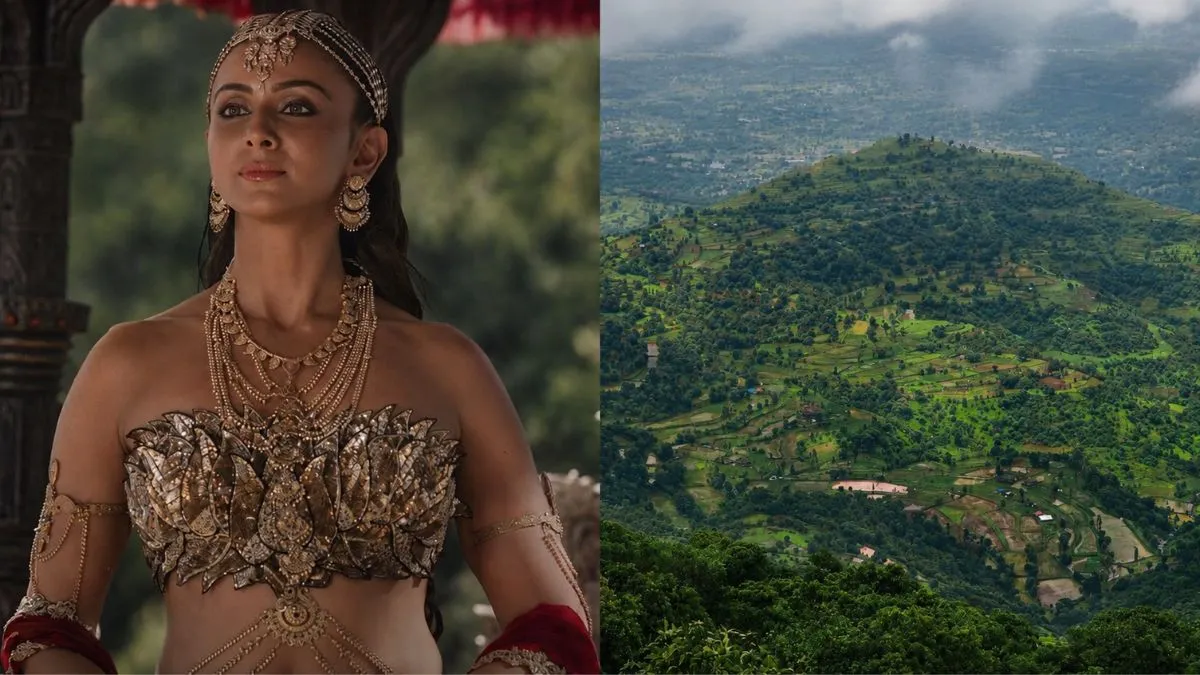
The first trailer of Nitesh Tiwari's Ramayana, released in July, introduced Rakul Preet Singh as Surpanakha, Ravana's sister, with the title "Princess of Janasthan". The character appears in the part of the story that sets off a chain of events leading to the conflict between Rama and Ravana. But the title also points to a place with an interesting connection to present-day India.
Janasthan is traditionally associated with the Nashik region of Maharashtra. The connection is particularly interesting because Nashik itself is linked, through local tradition, to the episode involving Surpanakha and Lakshmana. So, who was the princess of Janasthan, where was her kingdom, and how did the place become associated with Nashik?
Janasthan and its connection to modern-day Nashik
Janasthan is traditionally associated with the Nashik region of Maharashtra. The Nashik district administration's historical account lists Janasthan among the ancient names connected with the area. It also identifies Panchavati, on the banks of the Godavari in present-day Nashik, as the place where Rama, Sita and Lakshmana are believed to have stayed during their exile.
In the Ramayana, Surpanakha encounters Rama and Lakshmana while they are living in the forest. She approaches Rama, who rejects her advances. The encounter eventually leads to Lakshmana cutting off her nose. Surpanakha then turns to her brother Ravana, and the episode becomes an important part of the chain of events that leads to Sita's abduction and the battle in Lanka.
There is an important distinction here. Janasthan is an ancient name associated with the wider Nashik region in the Ramayana tradition. It is not simply another name for the modern city, and the exact boundaries of the place described in the epic cannot be established through these traditional associations alone.
How Nashik got its name
The most popular explanation for the name Nashik comes from Surpanakha's story. The Sanskrit word Nasika means nose. According to local legend, the place came to be known as Nasik after Lakshmana cut off Surpanakha's nose. The name eventually evolved into Nashik.
This is not the only explanation, though. The Nashik district's tourism account also mentions a Marathi tradition linking the name to Navashikha, meaning a settlement spread across nine hills. Some scholars consider this a more plausible explanation for the name's origin. The association with Surpanakha remains the popular local account, but it is not the only theory.
Nashik's connection with the Ramayana extends beyond this story. Panchavati, situated along the Godavari, is traditionally identified as the place where Rama, Sita and Lakshmana spent part of their exile. It remains an important religious destination, keeping the city's association with the epic alive.
What we know about Nitesh Tiwari's Ramayana
The film bringing this story to the big screen is a two-part adaptation directed by Nitesh Tiwari, known for Dangal. It is produced by Namit Malhotra through Prime Focus Studios, in association with DNEG and Yash's Monster Mind Creations.
The main cast includes Ranbir Kapoor as Rama, Sai Pallavi as Sita, Yash as Ravana, Ravie Dubey as Lakshmana, Sunny Deol as Hanuman and Rakul Preet Singh as Surpanakha. The ensemble also features Arun Govil as Dasharath, Lara Dutta as Kaikeyi, Sheeba Chaddha as Manthara, Shobana as Kaikasi, Vivek Oberoi as Vidyutjihva and Kunal Kapoor as Indra.
The music is another major talking point. Oscar-winning composer Hans Zimmer has joined AR Rahman for the film's score, marking their first collaboration on an Indian film. The combination of Rahman's music and Zimmer's orchestral background has added to the anticipation around the project. Kumar Vishwas has also been associated with the film as its lyricist.
The scale of the production has attracted plenty of attention. The reported budget for the two-part project is around Rs 4,000 crore, making it one of the most expensive Indian film productions. The figure covers the larger two-part project and should not be mistaken for the budget of the first film alone.
The first part, titled Ramayana: Rise of a Legend, is scheduled to release worldwide on November 5, 2026, around Diwali. The second part is planned for Diwali 2027. The film is also being prepared for an international release, with Sony Pictures handling worldwide distribution.
The hype around the film has been building through its trailers, the scale of its cast and the coming together of major names from Indian and international cinema. The first official trailer was released on July 30, 2026, after the film's first glimpse had already introduced Ranbir Kapoor as Rama. It offered a look at the central characters and the conflict between Rama and Ravana, while also introducing Rakul Preet Singh's Surpanakha.
And that brings us back to the title "Princess of Janasthan". Surpanakha is often remembered mainly for the episode involving Lakshmana and her nose. But her introduction also offers a way to explore the geography of the Ramayana, and the long-standing traditions that connect the ancient story to places such as Nashik.
ALSO READ:
Ramayana trailer: 3 boons Lord Brahma granted Ravana and the loophole that led to his defeat
