
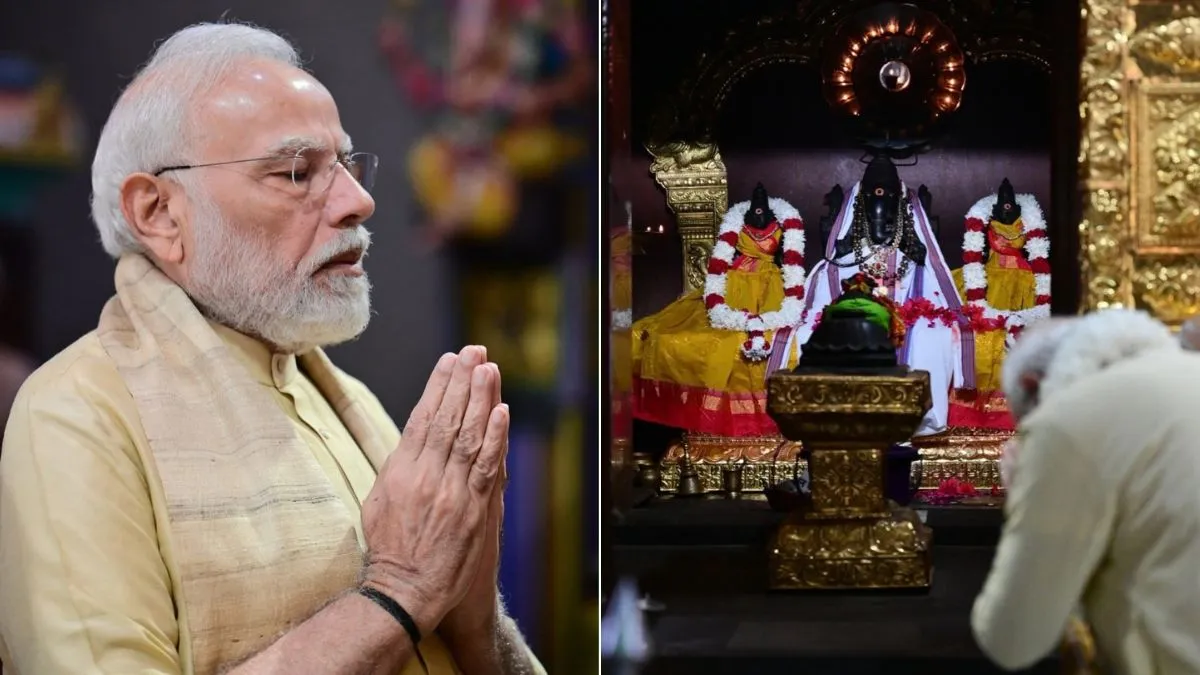
Prime Minister Narendra Modi visited the Shri Vinayak Mandir in Sarojini Nagar, New Delhi, on Wednesday and offered prayers to Lord Ganesha. The visit came as PM Modi completed 25 years as the head of a government, a journey that began when he became Gujarat Chief Minister on October 7, 2001. The Prime Minister performed worship and rituals at the temple and prayed for the happiness, prosperity, and good health of people across the country.
Sharing pictures from the visit, PM Modi invoked Lord Ganesha as Vighnaharta and prayed that his blessings bring welfare to all and help the country continue on its path of progress. While the temple came into focus because of the Prime Minister's visit, the Shri Vinayak Mandir has its own history stretching back more than seven decades to the efforts of Delhi's South Indian community.
Why was Shri Vinayak Mandir built?
The story of the temple begins around 1950, when members of Delhi's South Indian community felt the need for a dedicated place of worship where they could follow traditional pujas, rituals, and religious ceremonies.
A group of philanthropists and citizens subsequently came together to form the Sree Vinayaka Mandir Committee. The committee was formally registered with the Registrar of Societies in Delhi on April 16, 1953, with the primary objective of establishing a temple dedicated to Lord Vinayaka in the national capital.
A small temple was then constructed with a sanctum sanctorum, or garbha griha, and a surrounding prakaram. The temple committee says the construction was funded through voluntary contributions from the public, giving the institution a community-driven beginning.
The main Vinayaka idol was consecrated in 1961
The temple's main idol has a particularly important place in its history.
The idol of Sree Siddhi Buddhi Sametha Karpaga Vinayakar was sculpted by traditional sthapathis from South India. It was consecrated on August 24, 1961, in what was then known as Vinay Nagar, the area now called Sarojini Nagar. The consecration was carried out in the traditional South Indian style and was attended by devotees from different parts of the country.
The temple has since grown considerably from that original structure. Shrines for Lord Hanuman and the Navagrahas were subsequently added to the complex. A separate temple dedicated to Lord Shiva was consecrated in June 1983 to meet the wishes of local devotees.
The Shiva shrine houses a Swayambhu Linga of Omkareshwarar brought from the Narmada river, along with idols of Parvati, Ganesha and Kartikeya and Nandikeshwar, according to the temple's own history.
A temple known for Vedic rituals
The Shri Vinayak Mandir has developed into more than a place for daily worship. Its official history records a long list of Vedic programmes and religious activities conducted at the temple over the decades.
These include Maharudra Yagyam, Athirudram, Maha Mrityunjaya Homam, Medha Dakshinamoorthy Homam, and Sahasra Chandi, besides Rig, Yajur, Sama, and Atharva Veda-related programmes. The temple has also conducted Jata Parayanam, Gana Parayanam, and other traditional rituals.
The temple also says it has been conducting evening Veda classes for beginners since 1979. This gives the mandir an educational role alongside its religious activities, particularly in preserving and passing on Vedic traditions.
What makes the temple's traditions distinctive?
One of the practices highlighted by the temple committee is the recitation of Swapageetham at the end of the day.
According to the temple's official history, devotees receive darshan of Lord Vinayaka with his consorts Siddhi and Buddhi before the sanctum is closed. A set of eight special shlokas known as Swapageetham is then recited by devotees before the curtain of the sanctum sanctorum is drawn.
The temple also has a distinctive Siddhi-Buddhi Vivaha tradition. The temple committee says it developed a specific Siddhi-Buddhi Vinayaka Vivaha paddhathi, along with a book explaining the ritual for devotees and other temples. The ceremony is performed every year on the day after the main Vinayaka Chaturthi celebration and has been conducted for more than 30 years, according to the committee.
Shri Vinayak Mandir's golden jubilee
The temple marked 50 years since the consecration of its main Vinayaka idol in 2011. The year was observed as its Golden Jubilee, with a series of Vedic rituals and cultural programmes.
The celebrations concluded with a Swarna Bhandhana Kumbabhishekam on June 19, 2011. The temple committee describes Kumbabhishekam as an elaborate ritual involving special abhishekam with holy water on the kalash installed atop the temple's gopuram.
The temple has also continued to organise major religious programmes over the years, including later editions of Athirudram and Sahasra Chandi, as well as other Vedic and devotional events.
Where is Shri Vinayak Mandir located?
The temple is located at Sree Vinayaka Mandir Marg, AB Block, Sarojini Nagar, New Delhi. The road itself carries the temple's name. An NDMC document records that the lane was renamed Shri Vinayak Mandir Marg in 2002.
Today, the mandir stands as a long-established place of worship in one of Delhi's best-known neighbourhoods. Its history is closely tied to the South Indian community that helped establish it, while its daily pujas, Vedic programmes and festivals have allowed it to grow into a wider religious and cultural institution.
PM Modi's visit on Wednesday has once again put the Sarojini Nagar temple in the national spotlight, but the mandir's story began decades before the visit, with a community's effort in the 1950s to create a traditional place of worship in India's capital.
ALSO READ:
