
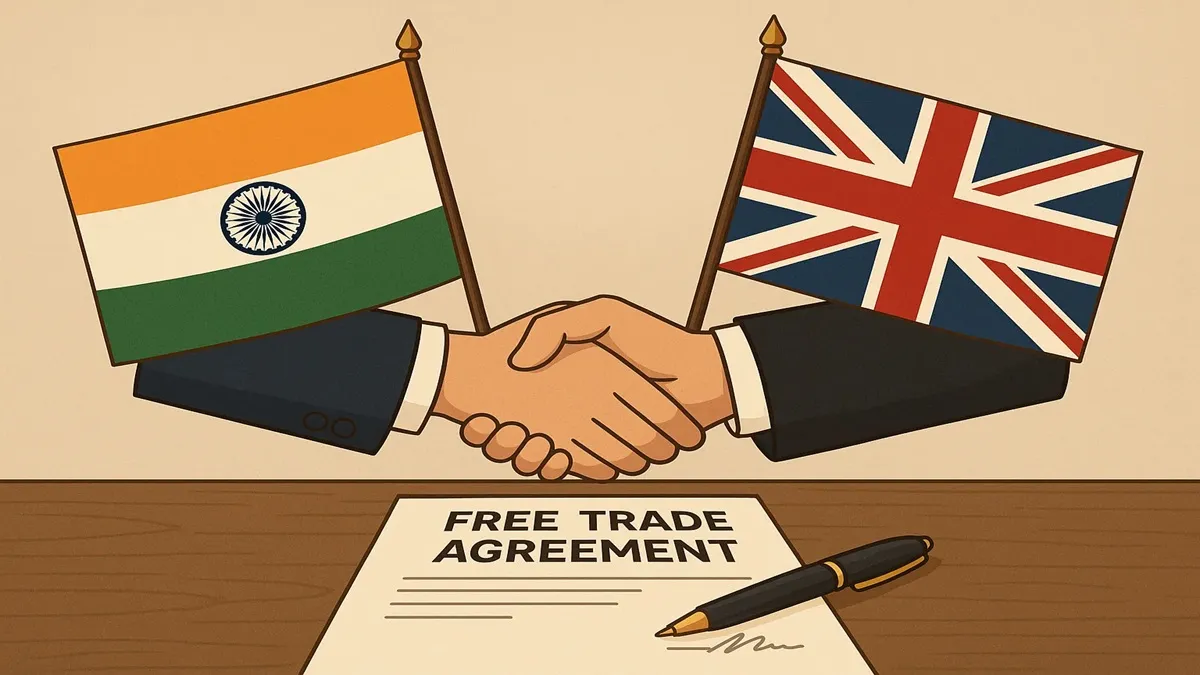
India and the United Kingdom on Thursday signed the landmark Free Trade Agreement (FTA) on Thursday (July 24) during Prime Minister Narendra Modi's ongoing visit to the UK. The agreement marks India's first major bilateral trade pact with a developed country in over a decade and follows nearly three years of negotiations. The FTA will come into effect after necessary legal clearances from the British Parliament and the Union Cabinet in India, likely within the next year.
What are India and the UK offering?
India's concessions:
- Scotch and gin: Import duties on Scotch whisky and gin will be reduced from 150 per cent to 75 per cent immediately and brought down to 40 per cent over the next ten years.
- Cars: Duties on UK-made vehicles, currently exceeding 100 per cent, will be slashed to 10 per cent under a quota-based system.
- Other goods: Tariff reductions on UK exports such as cosmetics, medical devices, chocolates, biscuits, and salmon (variety of fish).
UK's concessions:
Indian exports: 99 per cent of Indian products will get duty-free access to the UK market, covering nearly the entire value of current bilateral trade.
Big wins for Indian sectors
Industries set to benefit include:
- Textiles and Apparel (e.g., Welspun India, Arvind Ltd.).
- Footwear (e.g., Bata India, Relaxo).
- Auto components and EVs (e.g., Tata Motors, Mahindra Electric).
- Engineering and Manufacturing (e.g., Bharat Forge).
- Gems, Jewellery, Sports Goods, Furniture, Chemicals, and Machinery.
Indian electric and hybrid vehicle manufacturers will also receive preferential treatment under a new quota-based system.
UK gains: From scotch to supercars
UK-based companies are also set to gain significantly:
- Diageo, a key player in Scotch whisky, will enjoy broader access to India's market.
- Luxury car brands like Aston Martin and Jaguar Land Rover (owned by Tata Motors) will benefit from lower Indian tariffs.
UK estimates suggest the FTA could boost its GDP by £4.8 billion (Rs 56,150 crore) annually. British consumers may also see cheaper prices on Indian-made garments, footwear, and food products.
Mobility, services, and procurement
The FTA includes major breakthroughs in service sector and mobility access-
- Short-term visas: Indian yoga instructors, chefs, musicians, and service providers will be allowed short-term entry into the UK.
- Social security relief: Indian professionals posted in the UK will be exempt from social security contributions for up to three years- potentially saving Rs 4,000 crore annually.
- Government procurement: UK firms can now bid on India's non-sensitive federal procurement tenders above Rs 2 billion, opening up access to contracts worth over Rs 4 lakh crore annually.
Boosting bilateral investment
The FTA is expected to significantly enhance investment flows:
- Indian Presence in the UK: Over 1,000 Indian companies currently operate in the UK, employing 1 lakh+ people and investing $20 billion (Rs 1.73 lakh crore).
- UK Investment in India: The UK has invested around $36 billion (Rs 3.11 lakh crore) in India, making it India's sixth-largest foreign investor.
PM Modi's next stop will be the Maldives
PM Modi, who is making his fourth UK visit since assuming office in 2014, will also meet British Prime Minister Keir Starmer to discuss strategic areas including trade, energy, education, healthcare, and defence cooperation. Modi will depart for the Maldives on July 25 (Friday) to continue his diplomatic outreach.
Here are some related stories of FTA-