
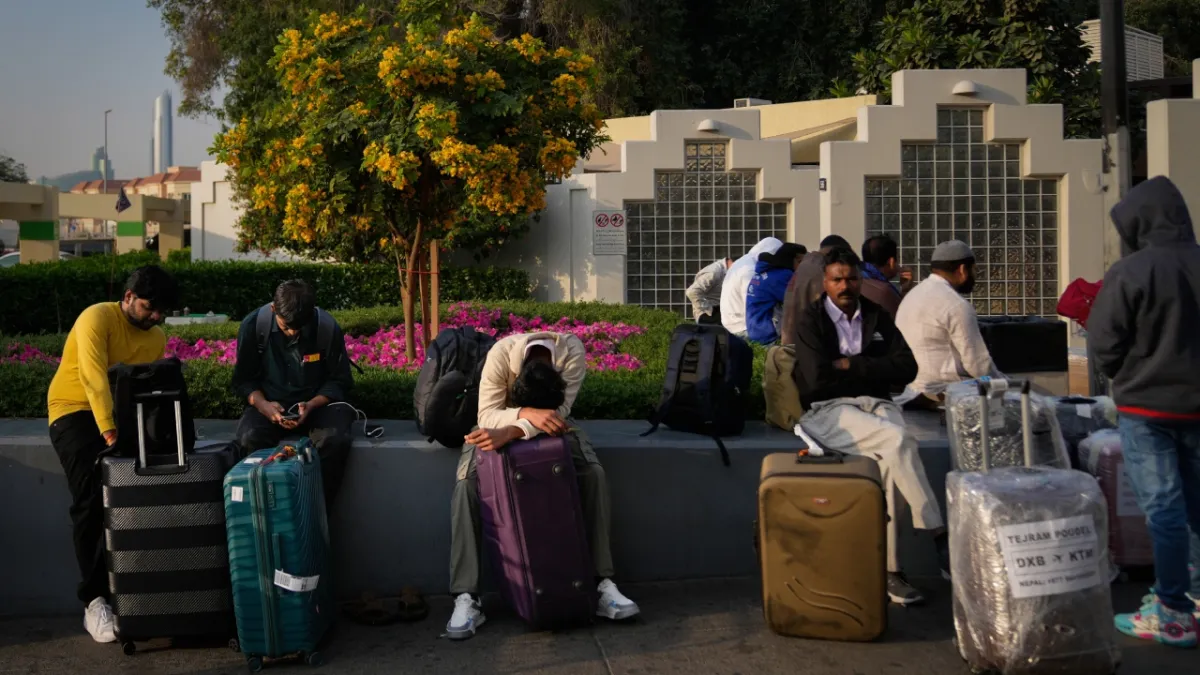
The conflict with Iran continues to disrupt air travel across the Middle East and beyond, as several of the world’s busiest airports grapple with widespread airspace closures. Only a limited number of flights are currently departing the region. The United States has advised its citizens to leave the region using available commercial options. However, a broad swathe of Middle Eastern airspace remained shut on Tuesday, with countries neighbouring Iran restricting inbound and outbound flights.
A small number of services have resumed from US aligned Gulf states, including Dubai and Abu Dhabi in the United Arab Emirates. Even so, the situation remains volatile, and passengers are being urged to monitor official advisories and stay in close contact with their airlines.
Fresh Iranian strikes on Saudi Arabia late Monday have further complicated travel arrangements for those stranded.
Is Middle East airspace still closed?
Airspace over the UAE, Qatar, Kuwait, Israel, Bahrain, Iraq and Jordan remained largely empty on Tuesday morning, according to flight tracking data from Flightradar24.
The Middle East hosts several major global carriers, including Emirates and Etihad Airways in Dubai and Abu Dhabi, and Qatar Airways based in Doha. These cities function as key international transit hubs, handling millions of passengers each year, meaning disruptions have had worldwide repercussions.
Emirates, which had suspended all flights to and from its hub, restarted a limited schedule on Monday night. flydubai also resumed some services. Dubai Airports’ website showed several departures scheduled for Tuesday morning, though passengers were advised not to travel to the airport unless directly contacted by their airline.
Etihad has suspended all scheduled commercial flights to and from Abu Dhabi until 2 pm UAE time on March 4. The airline said certain repositioning, cargo and repatriation flights may operate in coordination with UAE authorities and subject to strict safety approvals.
Flights operated by Qatar Airways to and from Doha’s Hamad International Airport remain suspended due to the closure of Qatari airspace. The carrier said it would issue a further update before 9 am local time on Tuesday.
India brings back passengers
Air India operated a special repatriation flight, AI916D, to bring back stranded passengers from Dubai. The aircraft landed in Delhi at 10:58 am Indian time, returning 149 passengers on aircraft VT EDC. It marked the first evacuation flight operated by an Indian carrier amid the current Middle East crisis.
Earlier in the day, 143 pilots and cabin crew members from Air India and Air India Express, who had been stranded in Dubai, arrived safely in Delhi on special flight AI918D.
SpiceJet announced on Tuesday that it would operate 4 special flights from Fujairah in the UAE to evacuate stranded passengers. The airline said the services would connect Fujairah with Delhi, Mumbai and Kochi over the coming days, including 2 flights to Mumbai.
More than 1,000 flights cancelled
More than 1,000 flights had been cancelled by Tuesday morning, adding to thousands scrapped over Sunday and Monday, according to data from FlightAware.
Airlines outside the region have also rerouted or cancelled services scheduled to pass near the conflict zone. Lufthansa, for example, has suspended flights to and from Dubai until March 4, and halted services to Tel Aviv, Beirut, Amman, Erbil, Dammam and Tehran until March 8.
What should you do if your flight is cancelled?
Passengers are advised to contact their airline or travel agent promptly for rebooking or refund options, although many travellers report difficulty reaching customer service because of heavy call volumes. Rebooking and compensation policies vary between carriers.
Flight operations across the Middle East remain severely disrupted due to ongoing airspace closures linked to the escalating conflict involving the United States, Israel and Iran.
