
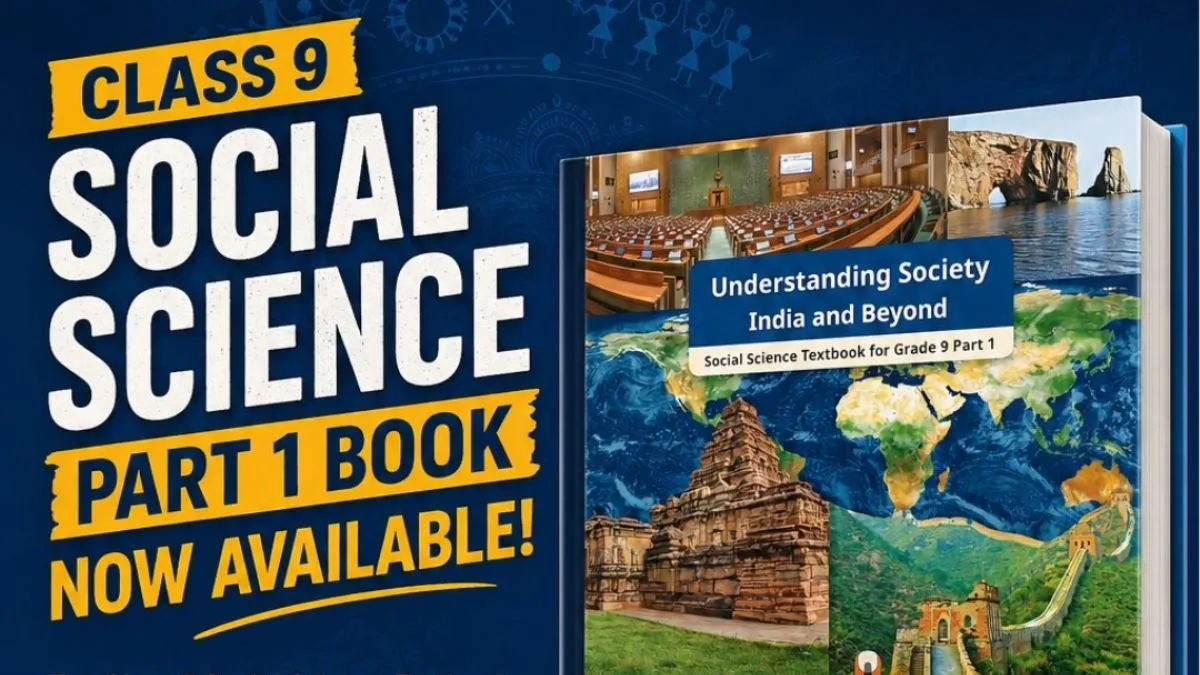
In a first, the National Council of Educational Research and Training, NCERT has added a chapter on "income tax" in Class 9 curriculum which will make students understand "how to manage personal finances" and how to pay taxes, an important responsibility of citizens. The book titled "Understanding Society India and Beyond-Part 2" was released on Tuesday, the first part of the book was released in June.
According to NCERT Chief Dinesh Prasad Saklani, students can now work through the actual slab-wise tax calculation under the new regime -- a first for this age group (Class 9) -- wrapped in a civic message: paying taxes "honestly and on time" is called an "important responsibility of every citizen" that funds the nation's development, as reported by news agency PTI.
The chapter "Managing Your Personal Finances" says journey towards managing money begins in childhood. "Managing money wisely is not just about earning more, it is about making careful financial decisions at every stage, whether it involves spending, saving, investing, protecting against risks, borrowing responsibly or paying taxes. The choices individuals make today shape their financial future and determine their ability to achieve financial stability while managing financial opportunities and challenges," the textbook read.
The new chapter contains a table of tax slabs and goes on to detail steps to calculate the tax liability as per the listed slabs. There is no mention of the old tax regime in the chapter.
Temples in 1000-1700 CE provided legitimacy to political authority: NCERT
Temples served as sources of legitimacy for political authority during 1000-1700 CE besides functioning as significant economic institutions, as per NCERT's new Class 9 social science textbook. The book titled "Understanding Society India and Beyond-Part 2" was released Tuesday, six months after the new academic session began.
The first part of the textbook was released in June.
The chapter titled "Resistance and Resilience (1000-1700 CE) has a section named "Temples: The Resilience of sacred sites", which details how temples functioned as pillars of the region's socio-economic and political life during the period. "Temples functioned as central pillars of the region's socio-economic and political life.
These religious institutions evolved into major economic hubs that managed extensive land grants, provided employment to hundreds of specialised workers and served as financial institutions for local traders," the textbook reads.
NCERT book refers NEP, Ayushman Bharat as excellent examples of policymaking
NCERT's Class 9 Social Science textbook referred new National Education Policy, Ayushman Bharat Scheme and Khelo Bharat Niti -- all introduced under the Prime Minister Narendra Modi-led government as "excellent examples of policy making". The Class 9 Social Science textbook describes the NEP 2020 as an "excellent example of how public policy is developed through consultation, expert advice, and public participation.
"
It traces the process to 2015, when the Centre began work on a new education policy, and notes that an expert committee headed by scientist K Kasturirangan was constituted in 2017.
The textbook says the committee included experts from education, science, technology, social sciences and public administration, while the draft policy was opened for feedback from citizens and stakeholders.
According to the textbook, 2.5 lakh gram panchayats, 6,600 blocks, 6,000 urban local bodies and 676 districts were consulted during the process, with about two lakh suggestions received.
Mahatma Gandhi visualised 'Ram Rajya' as ideal model of governance
The NCERT's Class 9 social science textbook referred Mahatma Gandhi's "Ram Rajya" as an ideal model of governance. The chapter called "Governance and Public Policy" cites the Sanskrit saying "Prajasukhe sukham rajnah, prajanam cha hite hitam", which translates to "in the happiness of the people lies the happiness of the ruler, and in the interest of the people lies the interest of the ruler".
"Mahatma Gandhi visualised 'Ram Rajya' as an ideal model of governance, rooted in probity, transparency, compassion, welfare and people-centric orientation in governance and public policy. Gandhi's views on Ram Rajya reflect the collective imagination of Indians from their distant past to the present day," the textbook read.
-With PTI Inputs
Also Read:
NCERT rewrites controversial chapter on judiciary in Class 8 Social Science textbook